



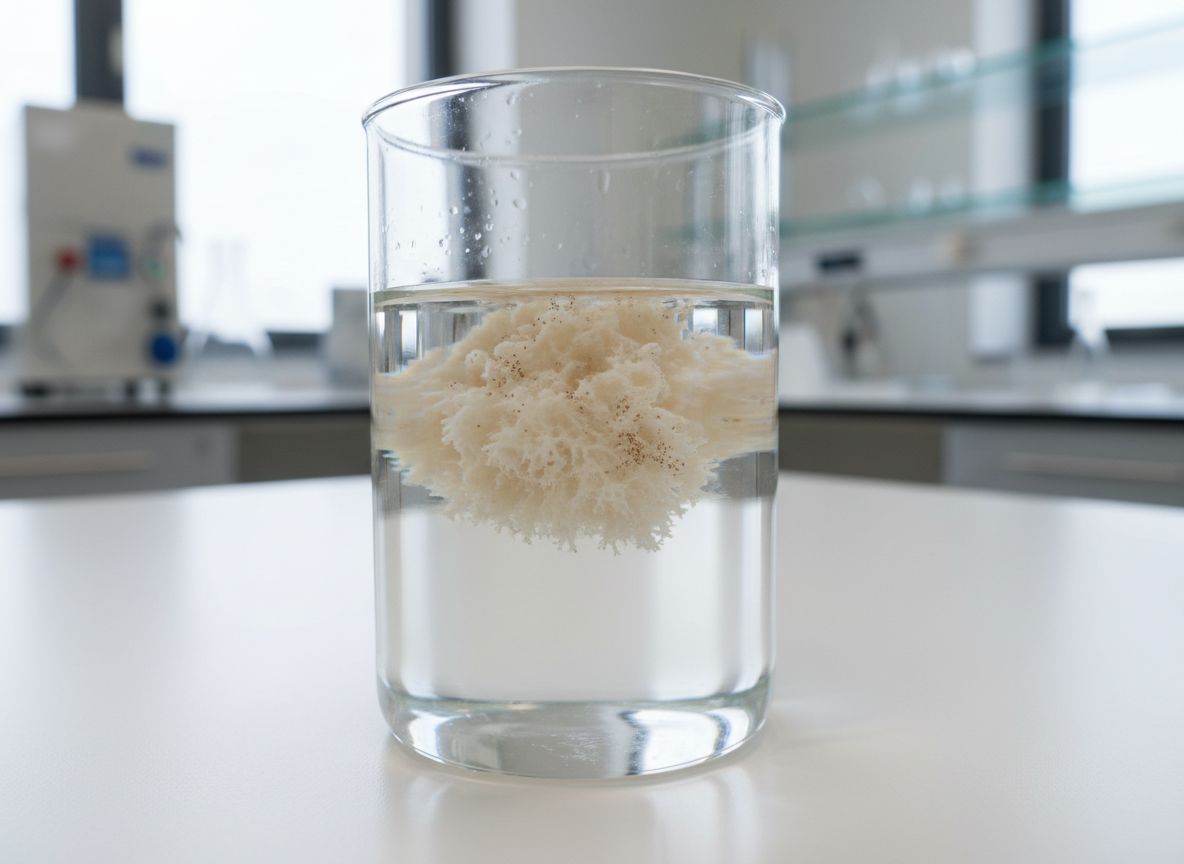



A common environmental fungus removed nearly 93% of selenium nanoparticles from an aqueous solution when researchers tested its dried biomass, pointing to a possible biological route for treating emerging nanoparticle contamination.
The laboratory study found that Aspergillus brasiliensis could adsorb or accumulate selenium nanoparticles under several experimental conditions. The strongest result came from dried, non-living fungal biomass, which achieved a removal efficiency of 92.93%.
The findings are promising for environmental remediation, but they remain an early laboratory demonstration. The researchers did not test the method in contaminated rivers, industrial wastewater or full-scale treatment systems, so its real-world effectiveness and economics are not yet known.
Why selenium nanoparticles are an environmental question
Selenium nanoparticles are being investigated and used because of properties relevant to antibacterial, antioxidant and anticancer applications. As the range of potential uses expands, however, so does the possibility that nanoparticles may enter water and other environmental systems.
Nanoparticles can behave differently from larger particles of the same material because of their small size and high surface area. This makes their environmental fate important to understand and creates a need for removal methods that are effective without introducing additional pollutants or excessive treatment costs.
Researchers Mohamed M. Gharieb, Alshaimaa A. Hussein and Osama M. Darwesh therefore investigated whether A. brasiliensis could act as a biosorbent for selenium nanoparticles in water. Their peer-reviewed study was published in Scientific Reports on 25 September 2026.
How the researchers tested fungal removal
The team first produced selenium nanoparticles biologically using Fusarium oxysporum. The particles were characterised using ultraviolet-visible spectroscopy, Fourier-transform infrared spectroscopy and transmission electron microscopy.
The researchers then exposed selenium nanoparticle solutions to A. brasiliensis biomass and varied several conditions that can influence biosorption. These included the amount of fungal biomass, contact time, pH and the starting concentration of selenium nanoparticles.
They also compared different forms of fungal biomass and examined interactions between the nanoparticles and fungal mycelium using scanning electron microscopy and energy-dispersive X-ray analysis. A separate agar-based experiment assessed the fungus’s ability to solubilise the nanoparticles.
Removal reached 54% under one optimised condition
At an initial selenium nanoparticle concentration of 100 parts per million, the researchers reported a removal efficiency of 54% at pH 7 after 30 minutes of contact.
The result shows that meaningful nanoparticle removal occurred on a relatively short laboratory timescale. It also illustrates why treatment conditions matter. Biosorption is affected by the chemistry of the surrounding solution, the available fungal surface and the amount of contaminant present.
During optimisation of biomass dosage, removal reached 61.6% when the initial selenium nanoparticle concentration was 160 parts per million. These values should be interpreted as condition-specific experimental results rather than fixed removal rates that would necessarily occur in environmental water.
Dried fungal biomass produced the strongest result
The most striking finding emerged when the researchers compared forms of fungal biomass. Dried, dead A. brasiliensis achieved a maximum selenium nanoparticle removal efficiency of 92.93%.
Using non-living biomass could have practical advantages if the effect proves robust outside the laboratory. A treatment process based on dead fungal material would not need to maintain fungal growth or provide the conditions required to keep living organisms metabolically active.
However, the study does not establish that a 92.93% removal rate would be sustained in complex wastewater. Real effluent can contain salts, organic matter, metals and other particles that compete for binding sites or otherwise change biosorption behaviour.
The fungus also solubilised selenium nanoparticles
A. brasiliensis showed a solubilisation capability of 55.53% in the researchers’ agar-based assessment. Clear zones formed around fungal growth compared with the control, indicating that the organism could alter the nanoparticle material as well as physically remove it from solution.
Microscopy and elemental analysis further indicated that selenium nanoparticles were associated with the surface of fungal mycelium and could also accumulate within it. This supports a mechanism involving adsorption onto fungal structures, with possible intracellular accumulation contributing to the observed removal.
What biosorption could offer
Biosorption uses biological material to capture contaminants from liquids. Fungal biomass is attractive for this purpose because cell walls contain chemical groups capable of interacting with dissolved substances and particles.
If a readily produced fungal biomass can capture selenium nanoparticles efficiently, it could eventually contribute to lower-impact treatment approaches for water affected by nanoparticle pollution. The particularly strong performance of dried biomass also raises the possibility of preparing, storing and transporting a biosorbent without maintaining a live fungal culture throughout treatment.
Those possibilities remain prospective. The present study establishes laboratory potential rather than a deployable treatment technology.
Important limitations
The experiments were conducted under controlled laboratory conditions using defined selenium nanoparticle solutions. Natural waters and industrial effluents are chemically more complex, and competing contaminants could change the fungus’s performance.
The study also focused on removal efficiency rather than the complete environmental lifecycle of the captured selenium. A practical remediation system would need a safe method for handling, regenerating or disposing of nanoparticle-loaded fungal biomass so that the contaminant is not simply transferred from water into another waste stream.
Scale is another unresolved issue. Laboratory contact experiments do not show how quickly water could be processed in a treatment plant, how much biomass would be required, whether the material could be reused, or how costs would compare with conventional technologies.
Finally, selenium can occur in multiple chemical forms. Further work is needed to determine how broadly the observed biosorption behaviour applies across nanoparticle formulations, environmental conditions and mixtures of pollutants.
What the study adds
The research provides evidence that A. brasiliensis can interact strongly with selenium nanoparticles and that dried fungal biomass may be especially effective at removing them from aqueous solutions.
The 92.93% maximum removal result gives researchers a clear reason to test the approach under more realistic conditions. The next steps would include experiments with genuine wastewater, repeated adsorption cycles, larger treatment volumes and assessments of what happens to the captured selenium after treatment.
For now, the work is best viewed as a promising demonstration of fungal biosorption for an emerging class of contaminants rather than evidence of a ready-to-deploy water treatment system.
Source Information
Study: Evaluating Aspergillus brasiliensis (ATCC 16404) for the bioaccumulation and solubilization of selenium nanoparticles
Authors: Mohamed M. Gharieb, Alshaimaa A. Hussein and Osama M. Darwesh
Journal: Scientific Reports
Published: 25 September 2026
DOI: 10.1038/s41598-026-70602-6
Study type: Laboratory biosorption and nanoparticle characterisation study