







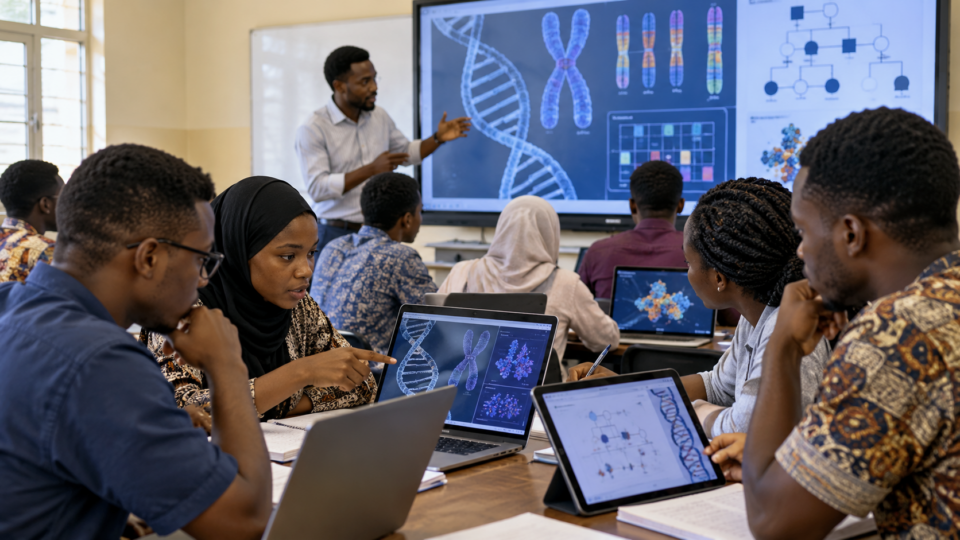
Genetics is one of the subjects where memorising terminology can quickly stop being enough. Future biology teachers need to interpret inheritance patterns, connect molecular mechanisms to observable traits and explain why genetic evidence matters outside an examination room. A new study from Nigeria suggests that changing how those concepts are taught can make a substantial difference.
Researchers working with pre-service biology teachers in North-Central Nigeria found that an edutainment package produced much larger gains in both scientific literacy and higher-order thinking than conventional teaching. The study, published in Discover Education on 3 October 2026, followed 372 third-year teacher trainees drawn from four Colleges of Education.
The finding matters beyond one genetics course. Teacher-training programmes face a double challenge: they must help future teachers master difficult scientific content while also developing the analytical skills those teachers will later be expected to cultivate in their own classrooms. The results suggest that well-designed digital material combining instruction with engaging media may help on both fronts, although the quasi-experimental design means the results should not be treated as definitive evidence for every classroom or country.
A 12-week test of a different way to teach genetics
The researchers used a pre-test, post-test, non-randomised control-group design. The wider population comprised 11,546 pre-service biology teachers, from which 372 NCE III students were selected through a multi-stage process. Four Colleges of Education were included, with two assigned to the experimental condition and two to conventional instruction.
The intervention was not simply entertainment added around a lecture. The edutainment package was developed using the ADDIE instructional-design model and delivered digitally. Lecturers in the experimental group were trained to use the material, while participating students installed a video player and received the package on their phones or computers. The overall data-collection process lasted 12 weeks, with treatment taking place over several weeks between the initial and final assessments.
Two outcomes were measured. Scientific literacy was assessed with a 15-item test. Higher-order thinking was assessed across analysis, synthesis and evaluation using a 45-item instrument. The researchers reported reliability indices of 0.836 for the scientific-literacy measure and an average of 0.812 for the higher-order-thinking measure. Analysis of covariance, or ANCOVA, was then used to compare outcomes while accounting for baseline differences.
Scientific literacy showed the largest separation
The experimental group began with a mean scientific-literacy score of 35.71 and finished at 73.72, a reported gain of 38.01 points. The conventional group moved from 33.69 to 40.34, a gain of only 6.65 points.
That produced a 31.36-point difference in mean gains in favour of the edutainment group. The adjusted comparison was statistically significant, with F(1,324) = 343.615 and p < 0.001.
The pattern is notable because scientific literacy is broader than recalling biological facts. It concerns the ability to understand scientific ideas, interpret evidence and use scientific knowledge when reasoning about real-world problems. Genetics is particularly relevant because concepts such as heredity, mutation and gene function increasingly appear in public discussions about health, biotechnology and reproduction.
The results therefore point to a possible advantage of making abstract genetic concepts more concrete and interactive. Digital demonstrations, narrative structures and visually engaging material can give learners additional ways to organise difficult information rather than relying entirely on verbal explanation.
Higher-order thinking also improved
The same broad pattern appeared for higher-order thinking. Students receiving the edutainment intervention moved from a pre-test mean of 42.90 to a post-test mean of 71.83. The conventional group increased from 36.28 to 47.58.
The paper reports gains of 23.93 and 11.30 respectively, with the difference in gains favouring the experimental group by 17.63 points. ANCOVA again found a statistically significant treatment difference, F(1,324) = 268.443, p < 0.001.
These skills matter especially in teacher preparation. A future teacher who can analyse evidence, evaluate competing explanations and synthesise information is better positioned to design lessons that demand more than factual recall from pupils. That is closely aligned with the broader move in education towards problem-solving, reasoning and application rather than simply reproducing content.
Research Today has previously covered how student engagement can change rapidly during collaborative science learning. The new Nigerian study approaches the classroom from another direction: instead of measuring moment-to-moment engagement, it asks whether a deliberately more engaging instructional format translates into measurable cognitive outcomes.
The gains were not confined to one gender
The experimental group included 108 male and 88 female students. Male participants’ scientific-literacy scores rose from 40.07 to 73.81, while female participants rose from 30.37 to 73.61. Although the raw gain was larger among women because they started from a lower baseline, the adjusted gender comparison within the edutainment group was not statistically significant, F(1,193) = 2.898, p = 0.090.
The same applied to higher-order thinking. The study reported no significant adjusted difference between male and female participants taught with edutainment, F(1,193) = 0.121, p = 0.728.
That is useful because it suggests the intervention’s overall advantage was not obviously driven by one gender group. It does not, however, prove that edutainment eliminates gender differences across other settings, subjects or age groups.
Why the design still calls for caution
The size of the differences is striking, but the study has important limitations. Students were not individually randomised. Intact classes were used, and entire colleges were assigned to experimental or control conditions. Differences between institutions, lecturers or student cohorts could therefore contribute to the observed results even though ANCOVA was used to adjust for baseline scores.
The research also focused on third-year pre-service biology teachers in four Colleges of Education in one Nigerian region. It cannot establish that the same package would generate similar gains among school pupils, university students in other disciplines or teacher trainees in different education systems.
There is also a broader implementation question. “Edutainment” covers many possible designs, from video and storytelling to games and interactive simulations. A strong result for one carefully developed package should not be interpreted as evidence that adding entertainment elements to any lesson will automatically improve learning. The educational content, sequencing, feedback and fit with the learning objective remain central.
What it could mean for teacher education
The practical message is less about replacing teachers with screens and more about instructional design. Abstract scientific concepts can impose a heavy cognitive burden when students have few concrete representations to work with. Well-designed media can potentially provide those representations while prompting learners to analyse and apply what they see.
For teacher-training institutions, that creates a second benefit. Pre-service teachers who experience such approaches as learners also gain exposure to alternative ways of presenting difficult content. If those methods are later adapted thoughtfully for their own classrooms, the intervention can influence not only what future teachers know but how they think about teaching science.
The next step is stronger experimental replication. Randomised studies across more institutions, longer follow-up periods and assessments of whether gains persist would help establish how much of the advantage comes from the edutainment package itself and whether it transfers into actual teaching practice.
Source Information
Study: “Effect of edutainment on pre-service teachers’ higher-order thinking skills and scientific literacy in genetics in North-Central, Nigeria”
Authors: Halima Ndatsu Usman, Adamu Evuti Zubairu, Eustace Manayi Dogo and colleagues
Journal: Discover Education
Published: 3 October 2026
DOI: 10.1007/s44217-026-02236-9
Design: 12-week, non-randomised, non-equivalent control-group quasi-experiment involving 372 third-year pre-service biology teachers from four Colleges of Education in North-Central Nigeria.