







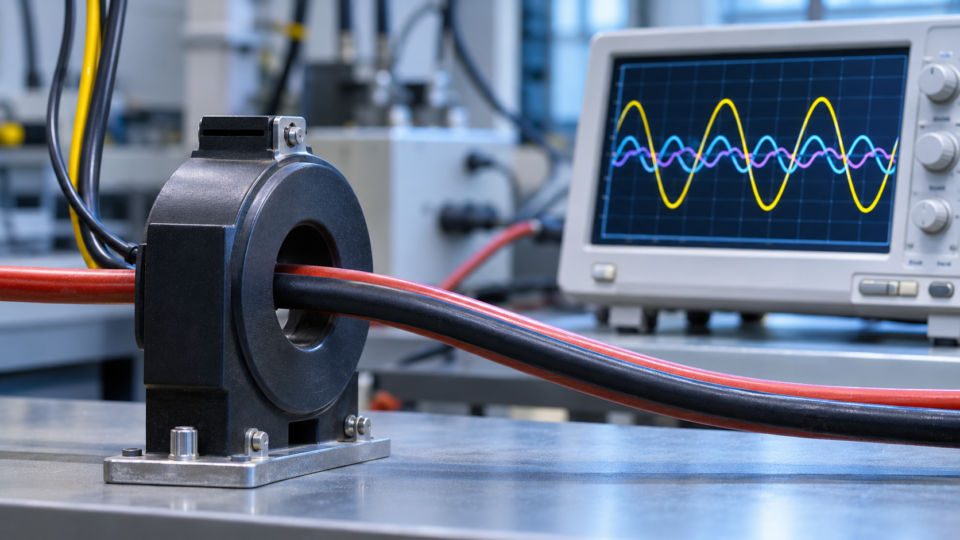
Why an electricity meter may miss part of the signal
Electricity flowing through a power network is not always a perfect sine wave.
Modern industrial drives, power electronics and other nonlinear loads can alter its shape, creating additional frequency components called harmonics.
Instruments used to measure current must represent those components accurately if engineers want dependable information about power quality. A new paper in Scientific Reports, published on 5 November 2026, proposes a preliminary way to assess whether an inductive current transformer is likely to reproduce distorted currents accurately.
Rather than performing every complex distorted-current test from the outset, the researchers examine the voltage distortion that appears when the transformer’s magnetic core is excited under a no-load condition.
Their method aims to reveal how much the device’s own magnetic nonlinearity may contribute unwanted harmonics.
The evidence comes from tested transformer units and is limited to the third and fifth harmonics.
It is an engineering screening proposal, not a claim that a new meter has been proven accurate across every grid condition.
What a current transformer does
An inductive current transformer is an instrument used to produce a smaller, measurable representation of a larger electrical current.
The primary conductor carries the current of interest, while the transformer’s magnetic core and secondary winding create a related output suitable for measurement or protection equipment.
Accurate transformation requires preserving the magnitude and timing of the relevant signal components within specified limits.
For a clean sinusoidal current at the fundamental power frequency, well-established tests can assess current error and phase displacement. A distorted waveform is more demanding.
It contains the fundamental component plus harmonics at multiples of that frequency, and the transformer may respond differently to each.
Engineers therefore need to know whether the output reproduces the original distortion or introduces distortion of its own.
The latter problem is especially important when the measured harmonics are small, because even a modest instrument-generated component can alter their apparent size or phase.
Why magnetic cores introduce error
The magnetic relationship inside a transformer is not perfectly linear.
As magnetic conditions change, the core’s magnetization response can deviate from a simple proportional relationship.
That nonlinearity can generate additional frequency components in the secondary current, even when the original input has a different harmonic composition.
The authors refer to this as self-generation of higher harmonics.
A device may therefore report a harmonic that is partly caused by the instrument rather than the electrical network.
The resulting measurement error depends on operating conditions, including current level and the load connected to the secondary winding.
Understanding this mechanism is crucial because a transformer that passes a conventional fundamental-frequency accuracy check may not necessarily provide equally reliable measurements of distorted current.
The study asks whether a more accessible test of the magnetic core can provide advance information about this risk.
The proposed indirect assessment
The research team developed an approach based on measuring distortion in the secondary voltage while applying an excitation current to the magnetic core in the no-load state.
This allows the degree of magnetic nonlinearity to be assessed indirectly.
The procedure also uses information obtained from routine testing performed under IEC 61869-2, an international standard for instrument transformers.
Specifically, the researchers describe determining the root-mean-square value of the main excitation-current component from measured current error and phase displacement under a specified sinusoidal-current condition and secondary load.
These elements help connect a conventional test environment to the proposed assessment of harmonic behaviour.
The approach does not eliminate the need for careful instrument characterization.
It seeks to identify a useful indicator that may help engineers judge which operating conditions or devices deserve closer examination before undertaking more extensive distorted-current tests.
What the experiment actually established
The paper reports that, for the tested units, the proposed factor ranked operating points in the same order as the self-distortion current error measured in full distorted-current testing whenever the compared values differed by more than 25 percent.
This is a conditional agreement, not a universal accuracy figure.
The threshold refers to the separation between compared values, not to an overall improvement in transformer accuracy or a 25 percent reduction in error.
It is also not evidence that the method classified every operating point correctly.
The researchers specifically verified the approach for the third and fifth harmonics.
Higher-frequency components, other transformer designs and different load conditions require additional study.
The result supports the narrower claim that the indirect factor can track relative self-distortion behaviour in sufficiently separated comparisons within the reported experimental scope.
Why the third and fifth harmonics matter
Harmonics are described by their frequency relative to the fundamental electrical frequency.
The third harmonic occurs at three times that frequency and the fifth at five times.
These lower-order harmonics are useful targets for evaluating how a magnetic core can create unwanted signal components.
But a modern electrical installation may contain many more harmonics, with amplitudes and phases that vary over time.
A measurement technique that performs well for two selected harmonics cannot automatically be assumed to work across the full spectrum.
This limitation is particularly relevant for power-quality investigations, where the interpretation of a waveform may depend on multiple frequencies and their interactions.
The paper’s scope is therefore an important part of its conclusion.
It establishes an initial experimental check of an indirect indicator, rather than a complete standard for wideband measurement.
How engineers could use a screening factor
If further research confirms the approach, a screening factor could help laboratories prioritize detailed testing.
Engineers might use it to identify transformer operating points where magnetic nonlinearity is more likely to compromise harmonic measurements.
They could then focus more resource-intensive tests on the most uncertain or problematic cases.
This would be valuable because testing every possible combination of current level, secondary load and waveform distortion can be demanding.
But screening is not certification. A transformer selected on the basis of an indirect factor would still need to meet relevant accuracy requirements for its intended use.
The new study does not provide evidence that a particular electricity utility can safely replace its existing quality-assurance procedures.
It offers a candidate measurement relationship that could become useful after broader validation and comparison with established methods.
A result that needs careful interpretation
The reported agreement depends on a condition: the compared factor values had to differ by more than 25 percent.
That matters because close measurements are often the most difficult to rank reliably.
If two operating points have similar levels of distortion, uncertainty and measurement noise may influence which appears better. A useful engineering tool needs a clearly described range of applicability, including what it cannot resolve.
The paper’s preliminary framing is appropriate because the experiment does not establish universal decision thresholds or comprehensive uncertainty bounds for every transformer configuration.
It would be misleading to present the result as proof that conventional current transformers are generally inaccurate, or as proof that the proposed factor solves the problem.
The evidence supports a narrower relationship between an indirect indicator and measured self-distortion under the tested conditions.
Relevance to changing power networks
Electrical networks are becoming more complex as power-electronic equipment becomes widespread.
This makes accurate information about waveform quality increasingly valuable for engineers who design, monitor and maintain equipment.
Yet the study did not directly measure the reliability of a national grid, the economic effect of harmonics or the performance of renewable-energy systems.
Its focus was the measurement instrument itself.
That distinction is important.
Better instrument characterization may improve the quality of information available for engineering decisions, but the downstream benefits depend on how measurements are used and whether the method generalizes to operational environments. A laboratory indicator is only one component of a larger measurement chain that includes sensors, data acquisition, calibration and interpretation.
What a stronger validation would involve
The next step would be to test more transformer designs, core materials and secondary loading conditions.
Researchers could examine a wider range of harmonic orders and compare the proposed indicator with direct measurements across different amplitudes and phase relationships.
Repeated tests across laboratories would help determine reproducibility. A particularly valuable evaluation would specify in advance how the factor should classify operating conditions and then measure its success on equipment not used to develop the method.
Such work could establish where the indirect assessment is reliable and where it is too uncertain to replace a more detailed test.
Standardization would require still more evidence, including agreement on uncertainty reporting and practical procedures.
The present study is a preliminary contribution to that process, not its final stage.
The wider lesson about measurement
The research illustrates a general engineering principle: a measuring instrument can influence the signal it reports.
In this case, magnetic-core nonlinearity can introduce harmonics into the secondary current and complicate interpretation of distorted waveforms.
The authors propose an indirect way to assess that behaviour using secondary-voltage distortion and conventional test information.
Their experimental results indicate a useful ranking relationship for selected harmonics when compared values are sufficiently different.
That is meaningful progress toward understanding instrument performance, but its applicability remains limited.
For utilities, laboratories and equipment designers, the practical takeaway is to consider harmonic accuracy explicitly rather than assume that good performance at the fundamental frequency guarantees accurate transformation of a complex waveform.
Related coverage includes solar forecasting research and battery-material recovery research.
Source Information
Study title: Preliminary evaluation of inductive current transformers applicability for accurate transformation of distorted current
Authors: Michał Kaczmarek, Sławomir Wiak and Paolo Di Barba
Journal: Scientific Reports
Publication date: 5 November 2026
Study design: Laboratory measurement and indirect evaluation of magnetic-core nonlinearity against full distorted-current tests
Sample or scope: Tested inductive current-transformer units and operating points; verification restricted to third and fifth harmonics
Key finding: The proposed factor ranked operating points consistently with measured self-distortion error when compared values differed by more than 25%