









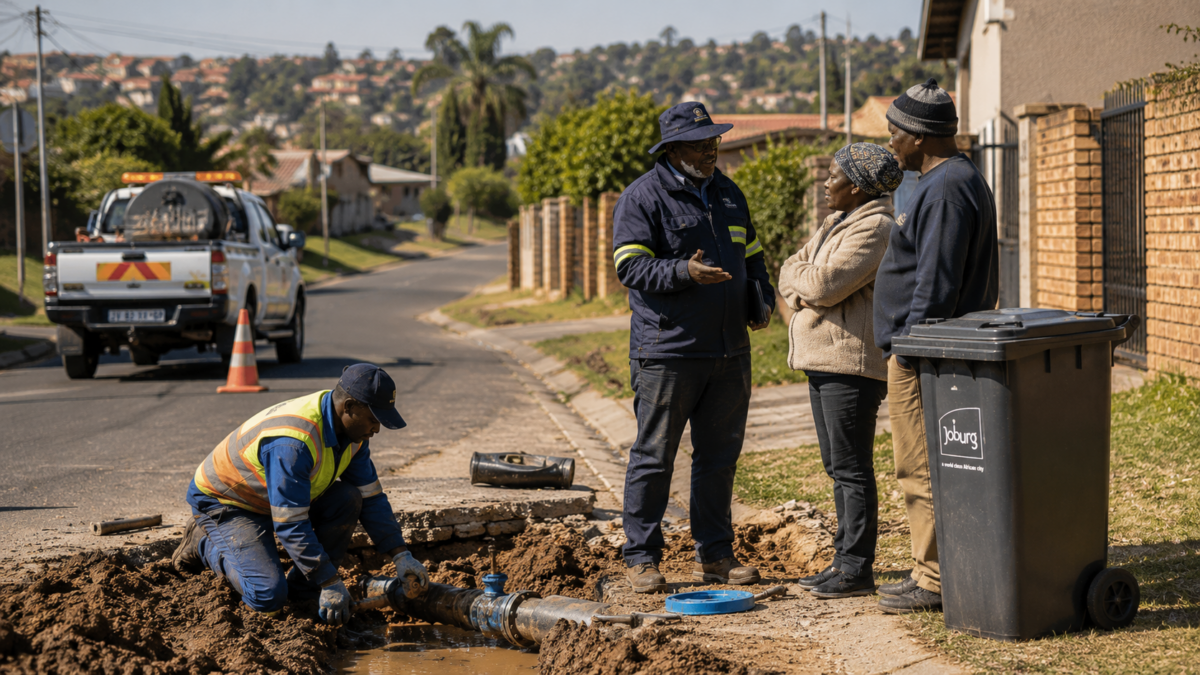
A municipality can collect the rubbish, repair a pipe or improve a clinic.
But if residents no longer trust the people running it, better services may not immediately restore confidence.
New South African research suggests that this distinction matters considerably in Gauteng.
A study examining government satisfaction among 9,946 residents found that experiences with services such as sanitation and healthcare were strongly associated with how people rated government performance.
Yet the researchers found something broader underneath those evaluations.
Distrust in leadership emerged as the strongest negative predictor of satisfaction across provincial government, municipalities and ward councillors.
The findings suggest that South Africa’s service-delivery challenge is not only about whether government provides a service.
It is also about whether citizens believe the institutions and people providing it are competent, accountable and acting in their interests.
Researchers compared three periods of life in Gauteng
The study, published in Frontiers in Sociology, used data from the Gauteng City-Region Observatory’s Quality of Life Survey.
Researchers analysed three survey rounds covering 2017/18, 2020/21 and 2023/24.
These periods provided a useful comparison between life before the COVID-19 lockdown, during the disruption and several years afterwards.
The underlying surveys were considerably larger, involving 24,889 respondents in 2017/18, 13,616 in 2020/21 and 13,795 in 2023/24.
For the statistical analysis of satisfaction across government levels, the researchers used an analytic sample of 9,946 adults.
Residents were asked how satisfied they were with the Gauteng Provincial Government, their local municipality and their ward councillor.
The researchers then examined how those responses related to people’s experiences of public services, crime, civic participation, employment, requests for bribes and their perceptions of government.
Only 22% were satisfied with government performance
The wider Gauteng Quality of Life data paint a difficult picture.
Only around 22% of residents reported being satisfied with government performance, according to the most recent data referenced in the study.
The researchers found that dissatisfaction intensified during the COVID-19 period and remained high afterwards, particularly at provincial and municipal level.
Ward councillors showed some recovery.
That difference is interesting because ward councillors represent the level of government closest to residents.
A national department can feel distant.
A councillor is someone residents may see at a community meeting, contact about a local problem or directly associate with what is happening in their neighbourhood.
The researchers suggest that this more localised form of governance may have greater potential to rebuild confidence where people feel that government is accessible and responsive.
Sanitation and healthcare mattered strongly
Trust cannot replace functioning services.
Residents who were satisfied with important services were substantially more likely to report satisfaction with government performance.
Sanitation was particularly important.
The researchers’ sanitation measure included people’s experiences of water, sewerage and rubbish removal, services that determine the quality of everyday life long before residents encounter government through a formal policy document.
Healthcare satisfaction also showed a strong relationship with perceptions of government performance.
This illustrates why service delivery has such political and institutional significance.
A broken traffic light or an unreliable refuse-removal schedule may appear operational on a municipal spreadsheet.
For the person encountering the problem repeatedly, it can become evidence about whether government works at all.
Electricity shows how quickly confidence can deteriorate
One statistic referenced in the research captures the scale of this problem particularly clearly.
Satisfaction with energy supply in Gauteng reportedly declined from approximately 78% to 42% over the past decade.
That is not simply a measure of electricity.
Reliable power affects businesses, household budgets, safety, food storage, studying and people’s ability to work from home.
When a service touches several parts of daily life, repeated failure can shape perceptions far beyond the service itself.
The same principle applies to water, roads, sanitation and public healthcare.
Government is experienced through these systems.
For many residents, they are the most tangible evidence available when deciding whether an institution deserves confidence.
But good services alone may not rebuild trust
This is where the study becomes more interesting than a conventional service-delivery scorecard.
The researchers found that distrust in leadership was the most powerful negative predictor of satisfaction across all three levels of government examined.
That means restoring a service does not automatically restore the relationship between citizen and state.
If people believe leaders are unaccountable, unresponsive or acting dishonestly, improvements may be interpreted through an already damaged institutional reputation.
The study also found that residents who had been asked for a bribe by a government official were more dissatisfied.
Crime victimisation and living in neighbourhoods affected by protest were also associated with poorer perceptions of government performance.
These experiences reinforce one another.
A resident may simultaneously experience unreliable services, fear crime and believe that government officials are unwilling to listen.
From that person’s perspective, these are not separate policy categories.
They become one experience of government.
Being heard appears to make a difference
The findings were not entirely negative.
Civic participation was associated with greater satisfaction in several parts of the analysis.
Residents who were registered to vote and those who believed officials followed the principles of Batho Pele were more likely to express satisfaction.
Batho Pele, meaning “People First”, is built around principles including consultation, service standards, access, courtesy, openness and transparency.
The finding matters because it suggests that government legitimacy is not created only through infrastructure.
Communication matters too.
People are more likely to trust institutions when they believe they can participate, receive information and have some meaningful influence over decisions affecting their communities.
A municipality can therefore improve a technical service while still damaging trust if residents feel ignored throughout the process.
South Africa’s protests are also a form of feedback
Service-delivery protests are often presented primarily as disruptions.
The study provides another way of interpreting them.
Living in an area affected by protest was strongly associated with dissatisfaction across government levels.
That means protests can also be read as an observable symptom of a deeper breakdown between residents and institutions.
By the time people take to the streets, dissatisfaction may already have progressed beyond a single broken service.
The underlying grievance can involve whether residents believe complaints will be acknowledged, promises will be kept and officials will ultimately be held accountable.
Preventing that breakdown therefore requires more than responding once protest begins.
It requires credible channels through which problems can be raised before frustration reaches that point.
Trust takes longer to rebuild than a broken pipe
The research has limitations.
The analysis is based on observational survey data, meaning it can identify strong relationships between citizens’ experiences and their satisfaction with government but cannot prove that any one factor directly caused changes in trust.
Survey responses also measure perceptions, and people living in the same municipality can evaluate the same institution differently.
But perceptions are not irrelevant simply because they are subjective.
Public institutions ultimately depend on citizens believing that they are legitimate, capable and responsive.
The study therefore points towards a difficult reality for governments trying to recover from prolonged periods of poor performance.
Infrastructure can sometimes be repaired relatively quickly.
Institutional trust cannot.
It has to be rebuilt through repeated experiences in which services work, officials communicate, citizens are heard and leadership demonstrates that accountability has consequences.
For Gauteng, the service-delivery challenge may therefore be bigger than fixing what is broken.
Government also has to convince residents that it can be trusted not to let it break again.
Source Information
Study Title: Government service delivery and citizen satisfaction in Gauteng, South Africa
Authors: Godswill Nwabuisi Osuafor, Salmon Likoko and Monica Ewomazino Akokuwebe
Journal: Frontiers in Sociology
Published: 30 April 2026
DOI: 10.3389/fsoc.2026.1779853