







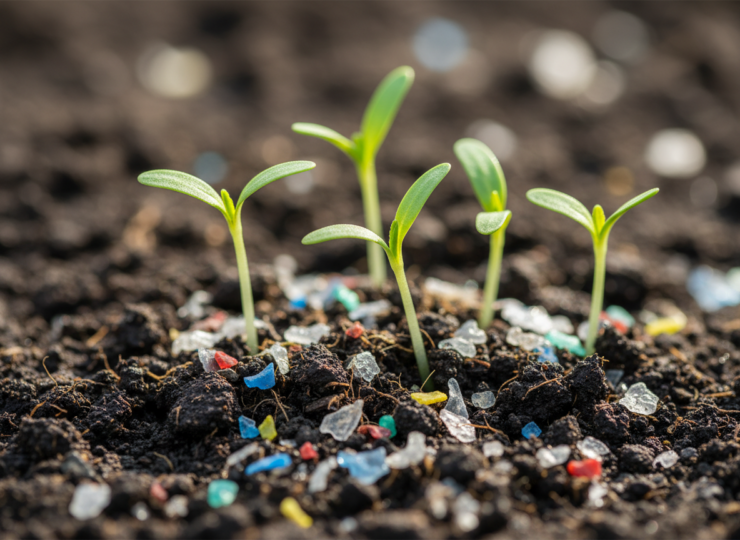
Microplastics are now found throughout terrestrial environments, but individual experiments have produced an uneven picture of what they do to plants. A new global meta-analysis brings that evidence together and suggests that the overall signal is adverse: exposure to microplastics was associated with lower plant growth and photosynthetic performance, alongside stronger indicators of oxidative stress.
The analysis, published in Plants, compiled 2,613 paired observations from 100 independent studies. Across that evidence base, microplastic exposure reduced growth traits by 12.31% and photosynthetic traits by 12.87% on average. Oxidative stress-related traits increased by 19.92%.
Those averages do not mean every plant responds in the same way. The researchers found substantial variation according to the plant trait being measured, microplastic concentration, environmental conditions and, for some outcomes, whether the plant was a monocotyledon or dicotyledon. The results therefore point to a broad ecological pressure rather than a single universal response.
A global synthesis of a fragmented evidence base
Microplastics can enter soils through multiple routes, including plastic mulches, sewage sludge, irrigation, atmospheric deposition and the breakdown of larger plastic materials. Once in soil, they may alter physical structure, water movement, nutrient availability and microbial communities. Plants can consequently be affected both directly and through changes in the soil environment surrounding their roots.
Yet experimental findings have not always agreed. Effects can differ by polymer, particle size, concentration, plant species, soil type and growing conditions. To quantify the broader pattern, Jinling Xu and colleagues systematically assembled paired treatment and control observations from 100 independent studies and analysed three major groups of plant responses: growth, photosynthesis and oxidative stress-related traits.
The researchers calculated effect sizes comparing microplastic-exposed plants with controls and used meta-analytic models to estimate overall responses. They then examined potential moderators, including plant group, microplastic biodegradability, concentration and particle size, as well as soil and environmental conditions. Random forest models were also used to compare the relative importance of candidate predictors.
Growth declined by about 12% overall
Across the compiled evidence, plant growth traits decreased by 12.31%, with a 95% confidence interval from 8.03% to 16.40% lower than controls. The size of the effect differed considerably across specific measures.
Shoot fresh biomass showed the largest average reduction at 20.70%. Root fresh biomass declined by 15.13%, shoot dry biomass by 14.13% and root dry biomass by 13.77%. Plant height was 9.65% lower. Root length declined by 6.25%, although this particular pooled change was not statistically significant.
These distinctions matter because a plant can alter how it allocates resources between roots and shoots when conditions become stressful. A decline in biomass is therefore not simply a cosmetic change in size. Sustained reductions could affect crop productivity, competitive ability and carbon accumulation, although the meta-analysis itself does not directly measure those larger ecosystem outcomes.
Photosynthesis showed an equally clear decline
Photosynthetic traits fell by 12.87% overall, with a 95% confidence interval ranging from a 4.60% to 20.43% reduction. Some individual measures showed substantially larger changes.
Net photosynthetic rate decreased by 30.45%, while stomatal conductance fell by 25.70%. Chlorophyll b declined by 13.86%. Transpiration rate was 13.96% lower, chlorophyll a was 8.22% lower and intercellular carbon dioxide concentration declined by 5.60%, although those latter three changes were not statistically significant in the pooled analysis.
The findings suggest that microplastic exposure can interfere with processes central to how plants capture carbon and regulate gas exchange. However, the mechanisms may differ among experimental settings. Changes in soil moisture, nutrient availability and root function can influence photosynthesis indirectly, while stress responses within plant tissues may also contribute.
Oxidative stress markers moved in the opposite direction
While growth and photosynthetic measures declined, oxidative stress-related traits increased by 19.92% overall. The 95% confidence interval ranged from an 8.27% to 32.83% increase.
Malondialdehyde, a commonly used indicator of lipid peroxidation and cellular oxidative damage, increased by 30.30%. Peroxidase activity increased by 19.91%. Hydrogen peroxide increased by 43.80%, catalase activity by 25.68% and superoxide dismutase activity by 11.97%, although the pooled changes for hydrogen peroxide, catalase and superoxide dismutase were not statistically significant.
Taken together, this pattern is consistent with plants activating antioxidant defence systems under microplastic exposure. It does not establish one biochemical pathway as the cause of the growth reductions, but it strengthens the case that microplastics can function as a physiological stressor rather than merely an inert material in soil.
Higher concentrations were linked to larger losses
Concentration emerged as an important source of variation. Root dry biomass decreased by 8.34% at concentrations below 0.1%, 7.31% at 0.1% to 1%, and 17.80% at concentrations of at least 1%. Differences among these concentration groups were statistically significant.
The pattern was even clearer for shoot fresh biomass. Average reductions were 12.94% below 0.1%, 14.67% between 0.1% and 1%, and 32.10% at 1% or higher. Shoot dry biomass declined by 9.98%, 6.31% and 20.67% across the same concentration categories. Plant height fell by 6.59%, 7.23% and 13.75%, respectively.
Among oxidative stress measures, superoxide dismutase activity showed its largest increase, 23.37%, at microplastic concentrations of at least 1%. Malondialdehyde increased from 20.21% in the lowest concentration category to 39.92% in the highest, although differences between concentration groups for this marker were not statistically significant.
Particle size and biodegradability were less straightforward
The study did not find a simple rule in which smaller particles consistently caused greater effects. Root length, for example, decreased by 12.64% for particles from 0 to 10 micrometres and by 13.08% for particles of at least 100 micrometres, but increased by 11.22% in the intermediate 10 to 100 micrometre category. For most other growth and oxidative stress traits with sufficient data, differences between particle-size classes were not significant.
Biodegradable plastics were not consistently less disruptive either. Root dry biomass declined numerically by 21.03% under biodegradable microplastics compared with 12.31% under non-biodegradable microplastics. Shoot dry biomass declined by 19.24% and 13.39%, respectively. Those differences were not statistically significant, however, so the results should not be interpreted as evidence that biodegradable particles are generally more harmful.
One significant difference appeared for hydrogen peroxide, which increased by 51.92% under non-biodegradable microplastics and 20.90% under biodegradable particles. Across the wider set of traits, biodegradability produced limited differences.
Environmental context matters
The random forest analysis reinforced the idea that plant responses cannot be predicted from the plastic alone. Temperature was related to responses across all three major trait groups and ranked highly among the predictors. Soil properties and exposure conditions also contributed to variation.
Plant-group differences were trait-specific rather than universal. Monocotyledons showed numerically larger reductions in root dry biomass and root length than dicotyledons, while dicotyledons showed a larger numerical decline in shoot fresh biomass. Some antioxidant enzyme responses were stronger among monocotyledons.
This heterogeneity is important for environmental risk assessment. A single laboratory result cannot be assumed to describe all crops, wild plants or soils. The meta-analysis instead provides a quantitative baseline for identifying where adverse effects are most consistently observed and which variables deserve closer attention.
What the findings mean
The clearest contribution of the study is its scale. Across thousands of paired observations, the direction of the average response was consistent across three biologically connected domains: growth and photosynthesis declined while oxidative stress indicators increased.
For agriculture, this raises questions about long-term plastic accumulation in cultivated soils, particularly where plastic mulch, sludge application or other inputs may repeatedly add particles. For ecology, reduced plant performance could potentially influence primary productivity and plant competition if comparable effects occur under field conditions over long periods.
The results do not establish that current environmental concentrations are causing a 12% reduction in plant growth globally. Meta-analyses combine experiments conducted under different concentrations and conditions, many of which are designed to detect biological effects rather than reproduce typical environmental exposure. The pooled percentages therefore describe the experimental literature included in the analysis, not a direct estimate of worldwide crop losses.
Important limitations remain
As with any meta-analysis, the conclusions depend on the studies available. Experimental designs, plant species, polymer types, concentrations, exposure durations, soils and environmental conditions varied considerably. Some subgroup comparisons contained less evidence than others, limiting confidence in fine-grained conclusions.
The study also primarily synthesises measured plant responses under experimental exposure. It cannot by itself determine how effects accumulate over decades, how microplastics interact with drought, pathogens and other pollutants in natural ecosystems, or how laboratory concentrations map onto the highly variable contamination levels found in real soils.
Random forest models can identify variables that are useful for explaining variation in the assembled data, but predictor importance is not equivalent to causal proof. Correlated experimental conditions and uneven representation across the literature can influence these rankings.
Even with those cautions, the synthesis indicates that microplastics in terrestrial systems deserve attention not only as a pollution problem but also as a potential influence on plant function. The next challenge is to connect the strong experimental evidence base to environmentally realistic concentrations, long-term field conditions and the diverse soils on which natural ecosystems and food production depend.
Source Information
Study: Effects of Microplastics on Growth, Photosynthesis, and Oxidative Stress-Related Traits in Terrestrial Plants: A Global Meta-Analysis
Authors: Jinling Xu, Dongwen Yu, Mufan Liu, Xuehan Zhang, Hangyu Liu and Yuzhen Liu
Journal: Plants
Published: 23 September 2026
DOI: 10.3390/plants15192911