





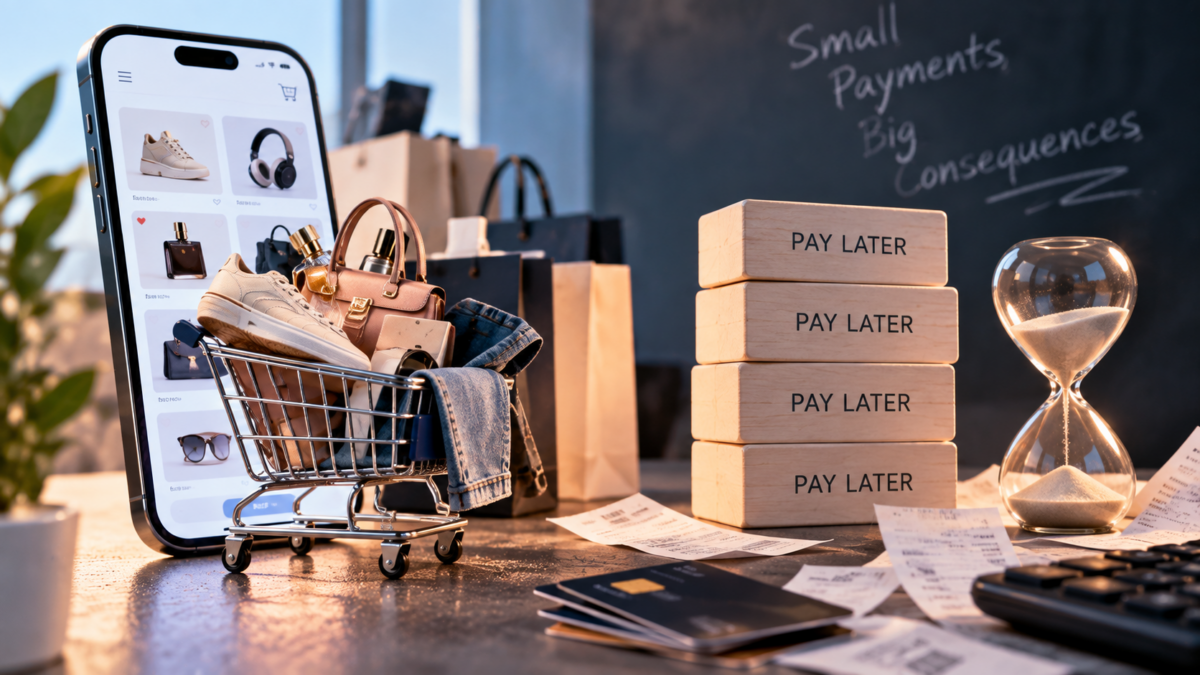
Buying something online has rarely required less effort.
A product appears while scrolling through social media, a button leads directly to the retailer and the full price can immediately be divided into several smaller payments.
Each part of that process is designed to make purchasing easier. New research suggests that when social-media shopping and Buy Now, Pay Later are combined, the financial consequences may be less comfortable than the checkout experience.
A 2026 study published in Finance Research Letters analysed a nationally representative dataset containing more than 7,000 US consumers and found that Buy Now, Pay Later use and greater exposure to shopping through social media were each associated with higher levels of financial stress.
The most notable results appeared among consumers exposed to both.
Compared with otherwise similar respondents who did not have the same exposure, people using Buy Now, Pay Later while also encountering shopping opportunities through social media showed particularly high levels of unsecured debt and greater reliance on alternative financial services.
The researchers describe the combination as a form of digital co-exposure: one technology continually presents opportunities to spend while another makes the cost of those purchases easier to postpone.
For South African consumers, that combination is becoming increasingly relevant.
Buy Now, Pay Later changes when the cost is felt
Buy Now, Pay Later, commonly shortened to BNPL, allows a customer to receive a product immediately while splitting the price into several future instalments.
Many popular versions charge no interest when payments are made on time. This makes BNPL look very different from traditional revolving credit, particularly to younger consumers who may dislike credit cards or store accounts.
The underlying economic commitment, however, has not disappeared. The customer has simply shifted part of today’s purchase into tomorrow’s cash flow.
That distinction matters because the psychological experience of paying can affect purchasing decisions.
A R1,200 product presented as R1,200 requires a consumer to evaluate the full cost.
The same item presented as three payments of R400 creates a smaller number at the moment of choice, even though the total obligation remains R1,200.
Previous experiments found that the smaller instalment can change how expensive something feels
A 2025 study in the Journal of Retailing investigated this effect using real purchase data and five experiments.
Researchers Rhys Ashby, Shahin Sharifi, Jun Yao and Lawrence Ang found that consumers spent more when using BNPL than when using several other payment methods, including credit cards.
The researchers identified the presentation of the instalment price as an important mechanism.
When consumers saw the smaller amount due per instalment, they perceived the purchase as less expensive. That lower perception of expensiveness subsequently increased spending.
The effect became stronger when a purchase was divided into more instalments or when the first instalment was smaller.
Importantly, simply displaying an instalment price did not produce the same effect when consumers were using a conventional payment method. The combination of the smaller displayed amount and the deferred-payment structure mattered.
Social media adds another layer to the decision
The 2026 Finance Research Letters study looked at what happens when this payment environment overlaps with social media.
The researchers used survey data collected by Prosper Insights & Analytics in December 2024. The sample contained more than 7,000 respondents and included information on BNPL use, exposure to shopping through social-media features, financial insecurity, credit-card debt and the use of services such as cheque cashing.
Social media is relevant because digital platforms do more than display advertising.
Products can be placed directly inside entertainment, influencer content and personalised feeds. Recommendation systems can repeatedly expose consumers to products selected according to their interests, previous behaviour and engagement.
In many cases, the distance between seeing an attractive item and being offered finance for it has collapsed to a handful of taps.
The researchers argue that this combination may weaken some of the natural friction that previously separated desire from purchase.
BNPL users reported greater financial strain
Using propensity-score matching, the researchers compared consumers with similar observable characteristics.
BNPL use was associated with a 0.272-point increase in reported financial insecurity on the study’s five-point scale.
It was also associated with an approximately 1.3-point increase on the study’s credit-card debt measure, which classified debt across ten categories.
Heavy social-media shopping exposure was independently associated with greater financial insecurity and higher debt as well.
The authors then examined consumers exposed to both BNPL and social-media shopping.
Joint exposure was associated with around a 0.335-point increase in financial insecurity and a 1.462-point increase on the unsecured-debt measure relative to comparable consumers without the same exposure.
The result was particularly pronounced for objective financial strain, including debt and the use of alternative financial services.
The findings are not as simple as saying social media plus BNPL always doubles the problem
There is an important nuance in the results.
The interaction between social-media exposure and BNPL did not produce a perfectly additive increase in every measure of subjective financial stress across every model.
In some specifications, consumers exposed to both appeared to report less subjective insecurity than their objective financial position might suggest.
The researchers propose that social normalisation could partly explain this pattern. If buying through instalments becomes common among peers or repeatedly appears in a person’s feed, carrying several small payment obligations may feel less unusual even while overall debt increases.
That possibility is particularly interesting from a behavioural-finance perspective because financial stress is not only about how much a household owes. It is also about how that obligation is perceived.
Several small payments can hide one large monthly commitment
One BNPL purchase can be relatively easy to understand.
Problems become more complicated when consumers have multiple purchases running simultaneously.
Three payments of R300, another purchase requiring R450, a subscription of R200 and a further R600 instalment may each look manageable when viewed individually.
Together they require R2,150 from the same month’s disposable income.
Consumers therefore need to keep track not simply of product prices but of a portfolio of future commitments, often spread across different dates and possibly different providers.
This can create what researchers in behavioural finance describe as fragmentation: individual payments appear small even though their combined effect on household liquidity may be substantial.
Financial literacy helps, but only to a point
A second 2026 study adds an important qualification to the idea that better financial education will solve the problem.
Miao Wang and M.C. Sunny Wong analysed more than 25,000 respondents from the 2024 US National Financial Capability Study.
They found that people with greater financial literacy were generally less likely to use BNPL.
But that relationship weakened substantially among financially vulnerable households.
The effect was particularly noticeable among people struggling to cover monthly expenses or those without an emergency savings buffer.
Among these consumers, knowing more about finance did not necessarily remove the need for short-term liquidity.
This is important because it separates two very different reasons someone may use BNPL.
One shopper may use it because the smaller instalments make an optional purchase feel cheaper.
Another may understand the financial implications perfectly well but still need to defer payment because their salary does not comfortably cover an immediate expense.
The policy response to those two consumers cannot necessarily be the same.
South Africa is becoming a major BNPL market
The findings arrive as BNPL becomes increasingly visible in South African retail.
TransUnion’s recent consumer research indicates that uptake is substantial, particularly among younger and thinner-file credit consumers.
Approximately 37% of South African BNPL users were either new to credit or underserved by the conventional credit market, according to TransUnion research released in 2026.
Gen Z represented the largest generational group among users.
The attraction is understandable.
BNPL products usually have simple repayment structures, short terms and, when used correctly, can allow consumers to manage cash flow without paying conventional credit-card interest.
That makes the product potentially useful rather than inherently harmful.
South African retailers are also seeing larger baskets
Retailers have strong commercial reasons to offer the payment option.
By mid-2026, Edgars reported that BNPL accounted for just under 10% of its sales mix.
The retailer also reported average BNPL basket values exceeding R1,000, while BNPL transactions in its cellular category were contributing more than traditional store-account purchases.
PayJustNow, one of the country’s largest BNPL providers, reported more than four million registered users and average transaction values of approximately R1,400.
These numbers do not prove that BNPL itself caused every additional rand of spending.
But they are consistent with the international experimental research showing that instalment structures can reduce perceived purchase expensiveness and encourage consumers to complete purchases they might otherwise delay or abandon.
The regulatory environment is now changing
South Africa’s rapid BNPL growth has also attracted regulatory attention.
The National Credit Regulator has examined whether these products fall within the National Credit Act and concluded that BNPL agreements generally do not constitute conventional credit agreements at inception when they carry no finance charge.
However, agreements may become incidental credit where fees or charges are imposed following default.
More significantly for consumers, the regulator has instructed providers to begin reporting BNPL repayment behaviour to credit bureaus from February 2027.
This could fundamentally change the financial consequences of using the product.
A payment method that has often operated largely outside consumers’ conventional credit profiles may increasingly become visible when lenders assess future borrowing behaviour.
That visibility could help as well as hurt
Credit reporting is not automatically negative for BNPL users.
Consumers who consistently repay on time may gain another source of data demonstrating responsible payment behaviour, potentially benefiting people with very limited conventional credit histories.
For someone new to credit, that could make BNPL a bridge into the formal financial system.
The opposite is also possible.
Missed instalments that previously remained relatively isolated within a BNPL provider could become visible to other lenders.
Consumers will therefore need to treat these commitments less like a checkout convenience and more like other financial obligations.
The most vulnerable consumers may be the ones who find BNPL most useful
This creates a difficult policy problem.
Removing BNPL entirely would also remove a potentially useful short-term liquidity tool.
A household facing a temporary mismatch between an expense and payday may prefer three interest-free instalments to revolving credit carrying a high interest rate.
But the same accessibility can become problematic when it is repeatedly used to make unaffordable discretionary purchases feel manageable.
The 2026 financial-literacy study suggests that vulnerability itself changes consumer behaviour.
Education can improve decision-making, but knowledge cannot create disposable income where none exists.
For financially constrained households, responsible regulation therefore needs to consider affordability and visibility alongside disclosure.
Social media makes the timing particularly important
The traditional credit decision usually occurred after a consumer had already decided to buy something.
Social commerce increasingly reverses that sequence.
The consumer may not have entered the platform intending to shop at all.
A product is algorithmically introduced, social proof makes it desirable and deferred payment makes it immediately obtainable.
Each step reduces a different barrier to spending.
The advertisement reduces the effort of discovering the product.
The influencer or recommendation reduces uncertainty.
One-click checkout reduces transactional friction.
BNPL reduces the amount that feels payable today.
The financial decision therefore takes place inside an environment designed to maintain engagement rather than encourage careful budgeting.
The study cannot prove that BNPL and social media caused all of the additional debt
The main 2026 study has an important limitation.
Its data are cross-sectional.
The researchers used several statistical methods, including propensity-score matching, doubly robust estimation and models intended to reduce problems created by endogeneity.
Those techniques strengthen the analysis, but they cannot reproduce the certainty of randomly assigning thousands of households to use BNPL or social media for several years.
Reverse causality is possible.
Consumers already under financial pressure may be more likely to seek deferred-payment products.
People carrying more debt may also shop differently online.
Unmeasured characteristics could influence both the choice of payment method and financial outcomes.
The strongest interpretation is therefore that the study finds a consistent relationship across several analytical approaches rather than proving that every additional debt burden was directly caused by digital shopping or BNPL.
Consumers should focus on the total commitment, not the instalment
The behavioural research nevertheless suggests one simple practical response.
When deciding whether a purchase is affordable, the most useful number may not be the instalment shown beside the product.
It is the total amount that will leave the household budget across all existing commitments.
A R400 instalment can feel small.
Four simultaneous R400 instalments are R1,600.
The psychological advantage of BNPL comes partly from separating the total cost into smaller pieces.
Good financial decision-making requires putting those pieces back together.
The future of credit may look less like borrowing
Perhaps the most important implication of the research is that the boundary between shopping and borrowing is becoming harder to see.
A conventional loan announces itself as finance.
Consumers usually complete an application, see an interest rate and understand that they are entering a credit relationship.
BNPL can feel different because it appears directly beside the product price and is often marketed as a payment method rather than debt.
That convenience is one of its strengths.
It is also the reason careful financial management becomes more important.
The new research does not show that consumers should never use Buy Now, Pay Later.
It shows that the context in which the product is offered matters.
When personalised social-media shopping, instant checkout and deferred payments converge, the decision to borrow can become almost indistinguishable from the decision to tap “buy”.
That may be excellent for conversion rates.
For household finances, it is worth remembering that making a payment feel smaller does not make the underlying purchase cheaper.
Source Information
Primary Study: Digital traps: The compounding impact of BNPL and social media on consumer financial stress
Authors: Ficawoyi Donou-Adonsou and Neleen Leslie-Piper
Journal: Finance Research Letters
Volume: 93
Published: March 2026
Article: 109636
Dataset: Nationally representative US household survey containing more than 7,000 respondents
DOI: 10.1016/j.frl.2026.109636
Supporting Study: Financial literacy, financial vulnerability, and buy now, pay later use
Authors: Miao Wang and M.C. Sunny Wong
Journal: Economics Letters
Volume: 267
Published: July 2026
Article: 113080
Dataset: 2024 US National Financial Capability Study, more than 25,000 respondents
DOI: 10.1016/j.econlet.2026.113080
Supporting Study: The influence of the buy-now-pay-later payment mode on consumer spending decisions
Authors: Rhys Ashby, Shahin Sharifi, Jun Yao and Lawrence Ang
Journal: Journal of Retailing
Volume: 101, Issue 1
Published: April 2025
Pages: 103–119
Methods: Purchase transaction data and five consumer experiments
DOI: 10.1016/j.jretai.2025.01.003
South African Context: Recent TransUnion research and 2026 South African retail data show rapid BNPL adoption, particularly among younger and thin-file consumers. The National Credit Regulator has also announced that BNPL repayment behaviour will begin being reported to credit bureaus from February 2027.