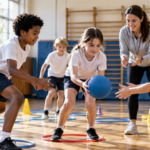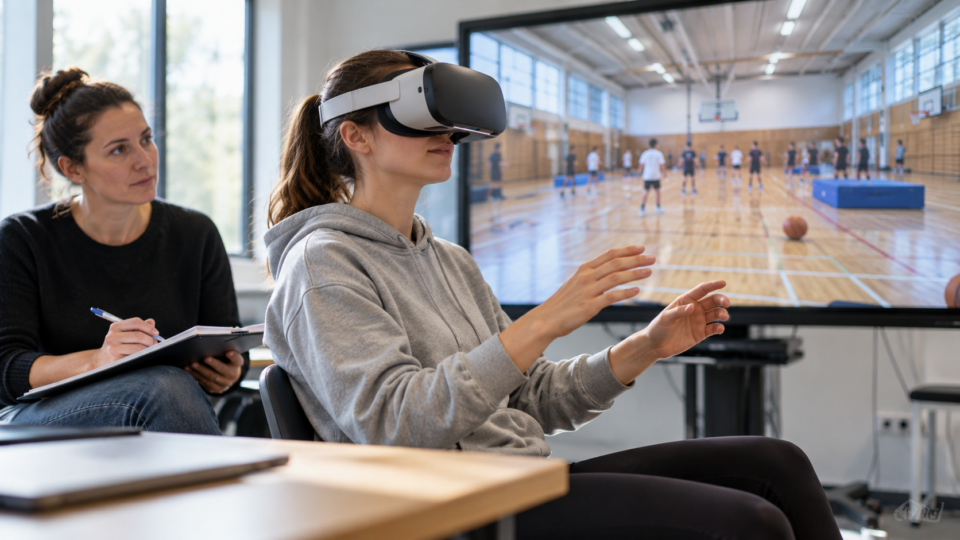
Putting on a virtual reality headset may make a future teacher feel closer to a busy school gym, but does it help them notice more of what matters? A new German experiment found that trainee physical education teachers using headsets wrote longer accounts of classroom events, without identifying significantly more events than peers viewing the same scenes on conventional screens.
The distinction matters for universities considering expensive immersive technology. Feeling present and writing more are measurable outcomes, but neither necessarily establishes that a trainee can make better teaching decisions.
What the researchers tested
Swantje Brandt and Tim Heemsoth, researchers at Europa-Universität Flensburg, investigated how three ways of displaying 360-degree physical education videos affected what prospective teachers noticed, and how they felt while watching. Their paper was published in Frontiers in Education on 7 October 2026.
The central skill is often called professional vision: noticing relevant events in a classroom, interpreting their significance and deciding what a teacher should do. In a gymnasium, several things can happen at once, including safety hazards, pupils needing help and disagreements between students.
A 360-degree camera can record activity around an entire room. But a panoramic recording is not the same as a fully interactive simulation: viewers cannot change what the recorded pupils do, and greater visual freedom can create new distractions.
A randomised comparison involving 123 trainee teachers
Between November 2024 and January 2025, the team recruited 123 prospective physical education teachers from master’s programmes at two German universities. Participants were 23.68 years old on average, with a reported standard deviation of 2.98 years.
The sample was approximately 47% female, 52% male and 1% diverse. Random assignment placed about 34% in a fixed-screen condition, 36% in an interactive-screen condition and 30% in a headset condition.
Everyone watched the same five 360-degree recordings of physical education lessons, each lasting three to five minutes. The presentation method changed, but the classroom material did not.
The fixed-screen group saw the scene split into screen views and could not choose a viewing direction. The interactive-screen group navigated the panorama using a mouse and keyboard. Headset users could change their viewpoint naturally by moving their heads.
The videos included a basketball warm-up, a small-sided basketball game, group acrobatics and cooperative games. Some potentially important events were deliberately staged, including student disagreements and difficulties following instructions, to give observers situations they might reasonably be expected to identify.
Participants could view each clip only once and were not allowed to pause or replay it. After each recording, they wrote what they had noticed. Questionnaires after the viewing tasks measured interest, pleasure, mental effort, self-efficacy and aspects of embodied presence.
The full experiment lasted about 90 minutes. Researchers compared groups statistically and explored whether feelings of presence or other experiences might help explain differences in written responses.
Headset users wrote substantially more
The clearest difference was in the length of participants’ written observations. Those wearing headsets averaged 114.47 words per response, compared with 85.67 in the fixed-screen group and 75.52 in the interactive-screen group.
That represents roughly 34% more words than the fixed-screen average and 52% more than the interactive-screen average. The overall difference was statistically significant, F(2,119) = 7.50, p below .001, with an eta-squared effect-size estimate of .11.
Word count was used as a proxy for how extensively participants described what they saw. It does not by itself measure whether their descriptions were more accurate, better reasoned or more useful to a teacher.
More words did not mean more events detected
When the researchers counted distinct classroom events that participants noticed, the pattern changed. The fixed-screen group averaged 4.26 events, the interactive-screen group 3.79 and the headset group 3.97.
These differences were not statistically significant, with p = .510. The numerical ordering even placed the fixed-screen group slightly ahead, although the study does not establish that it was superior.
This is the article’s most important caution. Immersion was associated with more elaborate written responses, not with a demonstrated increase in the number of classroom situations identified.
A trainee might spend additional words describing a single incident rather than notice another incident elsewhere in the room. The study’s event count and response-length measures help separate those possibilities, but they do not fully capture the quality of professional judgement.
Presence and interest improved, but not every outcome did
Participants using headsets also reported greater interest, pleasure, mental effort and aspects of embodiment, including feeling located within the virtual gym. Those results suggest immersive presentation changed the experience of watching, not merely the amount written afterward.
The researchers did not find corresponding effects on mental load or teaching-related self-efficacy. Greater engagement therefore should not be interpreted as a universal improvement across every learning or confidence measure.
A mediation analysis indicated a statistically significant indirect association linking presentation format to longer written responses through self-location, the sensation of being physically present in the scene. Other tested cognitive-affective factors did not show significant mediation effects.
Mediation modelling can support an account of how variables are related, but it cannot independently prove that a feeling of presence caused participants to write more. The experimental manipulation was the display format, while the proposed psychological mechanism was measured.
Why this matters for teacher training
Training with classroom footage can expose prospective teachers to complex situations before they are responsible for pupils. It also lets educators pause afterward, compare interpretations and discuss why one event might demand immediate action while another does not.
Physical education is a useful setting because activity spreads across a large space. A headset may allow a trainee to look naturally around the gym and experience its scale, whereas a conventional monitor makes the viewing process less immersive.
Yet an immersive scene can still leave observers uncertain about what deserves attention. A student dispute, an unsafe object on the floor and a pupil who has misunderstood a task may compete for the same limited attention.
For institutions, the practical question is not whether headsets feel more realistic. It is whether the additional expense, supervision, accessibility considerations and technical support produce stronger teaching skills than carefully designed screen-based observation and guided discussion.
The findings suggest headsets may be useful for stimulating engagement and richer descriptions. They do not support replacing pedagogical instruction with equipment or assuming that a more vivid learning experience necessarily produces better noticing.
What the study cannot tell us
The experiment involved 123 master’s-level prospective physical education teachers at two universities in Germany. It cannot establish that the same results would appear among experienced teachers, other subjects, school pupils or institutions with different resources.
The researchers tested a single session. Participants had limited opportunity to become familiar with the viewing technology, and the authors noted that no dedicated media training preceded the intervention.
Some recorded classroom situations were partly staged to include recognisable incidents. This helped standardise opportunities for noticing, but it also limits how closely the clips reproduce unpredictable real-life lessons.
The main significant professional-vision measure was response length. A longer response may reflect engagement, detail or verbosity, so it should not be treated as direct evidence of more accurate professional reasoning.
The study also combined questionnaire items from existing instruments into a new measurement approach. Further validation and longer follow-up would help establish how well those scales reflect durable learning.
Crucially, researchers did not test whether the headset group later taught lessons more safely, noticed problems more quickly in real classrooms or improved pupil outcomes. Those would be stronger indicators of educational benefit.
What should happen next
Future experiments could compare repeated headset sessions with repeated screen-based sessions, include technology familiarisation and evaluate the quality of participants’ interpretations rather than word count alone.
They could also measure whether observers recognise genuine safety issues, explain why they matter and choose appropriate interventions. Follow-up teaching observations would help determine whether immersive practice transfers into real classroom performance.
The study offers a useful middle ground between enthusiasm and scepticism about virtual reality in education. Headsets appeared to make the experience more engaging and prompted longer accounts, while the ability to identify more classroom events remained unproven.
Source Information
Original research: 360° video presentations, professional vision, and cognitive-affective experience in physical education teacher education
Authors: Swantje Brandt and Tim Heemsoth
Journal: Frontiers in Education
Publication date: 7 October 2026
Study type: Randomised between-participant experiment
Sample: 123 prospective physical education teachers at two German universities