



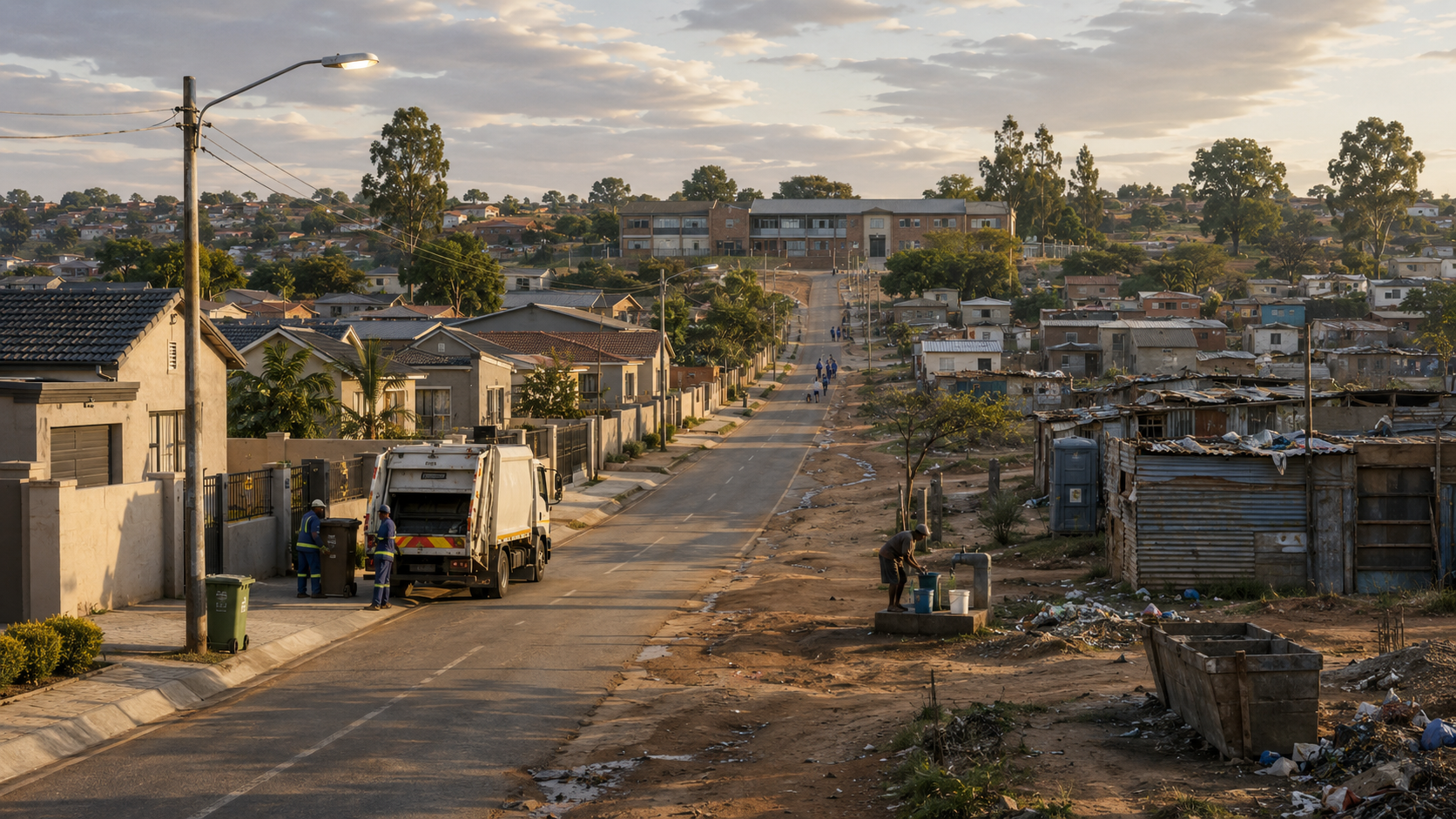
Electricity in the house. Water from a tap. A functioning toilet. Refuse collected from the street. A child finishing school.
These can look like separate parts of everyday life.
Taken together, however, they tell a much larger story about who has access to the basic systems that make social and economic progress possible.
More than three decades after apartheid ended, new research has attempted to measure how much South Africa’s racial gaps in these services have actually changed.
The answer is neither simple success nor simple failure.
Researchers analysing records from more than seven million people between 2001 and 2022 found that Black South Africans made substantial gains in electricity access, piped water and basic education. But progress was far less complete in sanitation, refuse removal and finishing upper-secondary school.
And behind the national averages lies another divide.
People who were employed, better off and living in urban areas were generally more likely to share in that progress than poorer and rural Black South Africans.
Some gaps became dramatically smaller
Published in the Journal of Economics, Race, and Policy, the study by Jörn Bachem, Gan Jin, Günther G. Schulze and Anthony Adepeko combined South African census and community-survey data covering the period from 2001 to 2022.
The researchers examined access to four basic services, piped water, electricity, flush toilets and refuse removal — alongside completion of primary, lower-secondary and upper-secondary education.
Electricity shows just how much can change over two decades.
In the raw data, access among Black Africans increased from 65% in 2001 to 95% in 2022, dramatically narrowing the difference with white South Africans. The researchers’ adjusted analysis concluded that the racial electricity gap had effectively been eliminated.
Primary education followed a similarly strong direction.
The raw difference in completion between Black and white children narrowed from 27 percentage points in 2001 to only three points in 2022. Lower-secondary completion also improved substantially.
Those changes matter because they represent more than improved statistics.
They mean millions more households connected to electricity and far more children progressing through basic schooling than at the beginning of the period studied.
But progress depended on what was being measured
The story changes when looking at other services.
The researchers found much slower convergence in access to flush toilets, while the gap in refuse removal actually widened over the period examined. Piped-water access improved substantially but continued to show a meaningful difference between Black and white households.
This creates an important distinction in how social progress is understood. A household can have electricity and still lack adequate sanitation.
A child can complete lower-secondary school while remaining much less likely to complete the level needed to enter tertiary education.
National progress in one area does not automatically remove disadvantage in another. That becomes especially visible in upper-secondary education.
The school gap becomes harder to close later
Black South Africans made substantial educational gains across the period.
But the strongest convergence happened earlier in the schooling journey.
In the study’s raw figures, upper-secondary completion among Black South Africans rose from just 13.5% in 2001 to 42% in 2022. Among white South Africans, it increased from 54% to 72%.
Progress was therefore real. So was the remaining gap.
The researchers’ adjusted analysis estimated that the Black-white upper-secondary completion difference fell from 22.6 percentage points to 15.1 points, considerably less progress than occurred at primary level.
There was also an important gender difference. Black girls made substantially greater progress relative to white girls, while the corresponding gap among boys proved far more persistent.
That matters because completing upper-secondary education is one of the main pathways into tertiary education and, ultimately, into many forms of skilled employment.
A society can therefore succeed in getting far more children through the early years of school while still retaining inequality at the point where education becomes especially important for upward mobility.
Where people live matters
Perhaps one of the clearest lessons from the research is that there is no single Black South African experience of post-apartheid progress.
The gains were uneven. Employment, higher incomes and urban residence were associated with stronger improvements in access, while poorer and predominantly rural Black populations were more likely to remain behind.
This means that national averages can conceal very different lived realities.
Two households may belong to the same racial group yet experience public infrastructure very differently depending on income, employment and geography. For society, that distinction matters.
Inequality does not only exist between historical racial categories. It can also deepen within them.
What the study cannot tell us
There are important limits to the findings. The researchers measured access, not necessarily the reliability or quality of each service.
Having an electricity connection does not reveal how consistently electricity is available. Access to piped water does not measure interruptions or water quality. Completing school does not tell us about the quality of education received.
The researchers also note that their analysis does not include other crucial services such as healthcare, vaccination or hospital access. Some of the community-survey data may contain quality limitations as well.
And although the paper was published in 2026, the most recent observations are from 2022.
The study should therefore be read as a detailed picture of how inequality changed over two decades, not as a measurement of conditions in every South African community today.
Progress can be real and incomplete at the same time
South Africa’s social story is often pulled towards one of two extremes.
Either nothing has changed. Or enormous change means the inequalities created by apartheid have largely been overcome.
The evidence in this study supports neither interpretation. Millions of people gained access to services and education that were far less evenly available two decades earlier.
At the same time, sanitation, waste collection, later-stage education and rural disadvantage show how difficult deeply embedded inequality can be to remove.
Perhaps the most useful way to understand the findings is not to ask whether South Africa has progressed.
It clearly has.
The harder question is where that progress has reached and who is still waiting for it.
Source Information
Study Title: Are All Men Served Equal(ly)? The Development of the Racial Gap in Public Services in Post-Apartheid South Africa
Authors: Jörn Bachem, Gan Jin, Günther G. Schulze and Anthony Adepeko
Journal: Journal of Economics, Race, and Policy
Published: 14 March 2026
DOI: 10.1007/s41996-026-00186-w