






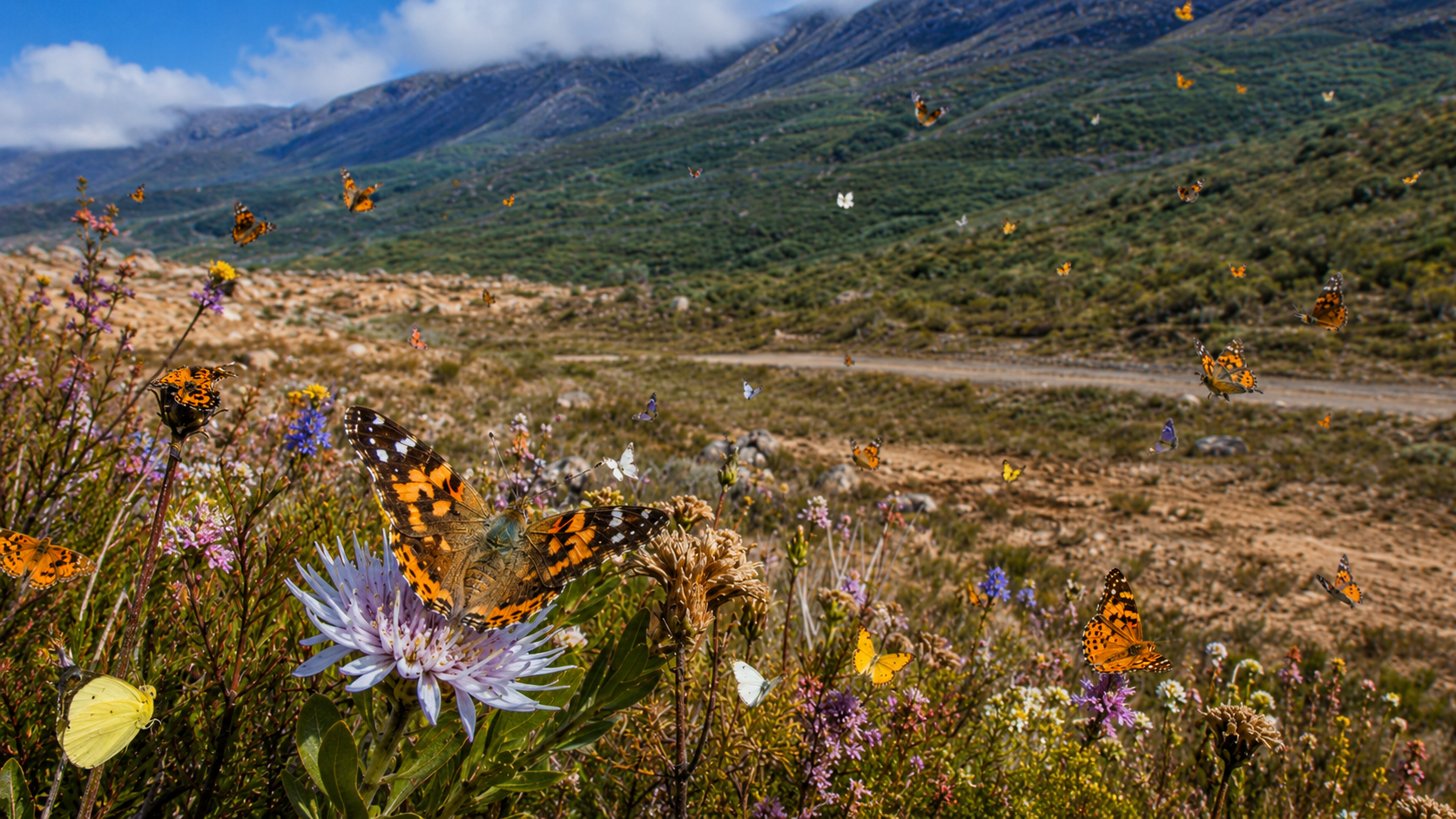
Butterflies are changing where they live on a global scale, with a new analysis documenting range shifts in 1,758 species across 105 countries and territories.
The study, published in Nature Ecology & Evolution, assembled 6,182 records from 567 studies alongside 68 expert assessments, covering roughly 10% of all known butterfly species. Eight in ten species in the dataset had expanded their recorded range somewhere, while 27% had also experienced range contractions and 22% had shifted along mountain elevations.
The movements are not random.
Climate change and extreme weather were associated with 79% of the species for which researchers could identify a likely driver.
Butterflies are useful early-warning systems
Butterflies respond quickly to environmental change.
Their short lifecycles, sensitivity to temperature and dependence on particular host plants mean that relatively small changes in climate or habitat can alter where populations are able to survive.
That makes their movements particularly useful to ecologists.
As temperatures change, a butterfly population may begin appearing farther north, move into new areas at higher elevations or disappear from parts of its previous range.
But the new analysis shows that there is no single direction in which butterflies are moving.
Some species are expanding.
Others are retreating.
And some are doing both in different parts of their distribution.
Climate does not simply push species towards the poles
The familiar picture of climate migration is straightforward: as the planet warms, species move towards cooler poles or higher mountains.
Reality is considerably messier.
In tropical regions, 80.3% of the documented shifts were horizontal range expansions. In Europe, the evidence was more evenly divided between expansions, contractions and movements along elevation gradients.
Researchers also found instances where the same species moved differently in separate regions.
That is because climate is only part of what determines whether a butterfly can occupy a new area.
A suitable temperature means little if the plants its caterpillars depend on are absent.
The same applies when roads, cities, farms or other altered landscapes separate one suitable habitat from the next.
A butterfly may theoretically be capable of surviving somewhere cooler.
It still has to get there.
Moving does not always mean a species is thriving
The finding that 80% of the species in the dataset showed range expansion could easily sound like good news.
It is not that simple.
An expanding northern or cooler edge can occur at the same time as populations disappear from warmer parts of the species’ range.
Researchers recorded contractions in 480 species and elevation changes in 381.
Range movement can therefore represent adaptation to changing conditions rather than an increase in overall security.
Some species may also accumulate what ecologists call climatic debt.
This occurs when suitable climate conditions move faster than the species itself. Populations remain in environments that are becoming progressively less suitable because they cannot disperse quickly enough to track the changing climate.
For species confined to islands, fragmented habitats or mountain tops, there may eventually be nowhere suitable left to move.
Habitat can determine whether escape is possible
This is where climate change and habitat loss begin to reinforce one another.
The researchers found climate change and severe weather were the most frequently reported drivers of range expansion and elevation shifts.
But agriculture, human disturbance and other land-use pressures were particularly prominent among species whose ranges contracted.
A warming climate may create suitable conditions somewhere new, while a fragmented landscape simultaneously makes that new habitat impossible to reach.
The study therefore argues that conservation cannot focus only on protecting isolated reserves.
Connections between habitats matter as well.
Small habitat patches, ecological corridors, shaded refuges and the availability of host plants can determine whether species are able to move through a changing landscape.
Africa has another problem: we may not be seeing the change
One of the study’s most important findings is not about butterflies themselves.
It is about the gaps in what scientists know.
Europe has extensive long-term butterfly monitoring programmes. Many tropical and African regions do not.
The researchers warn that apparently lower rates of range change in poorly monitored countries may reflect missing data rather than ecological stability. Central Africa remains particularly underrepresented, while long-term monitoring is also scarce across many arid and semi-arid regions.
A South African researcher from the Cape Peninsula University of Technology was among the international collaborators on the study.
The local conservation problem is familiar.
SANBI has previously identified habitat destruction, invasive vegetation, changing fire regimes, agriculture and urbanisation among the pressures capable of reducing or fragmenting butterfly habitat in South Africa.
Climate change now operates across those existing pressures rather than replacing them.
The map of biodiversity is becoming less permanent
There is an important limitation to the new analysis.
The researchers combined many different types of evidence gathered in different ways and at very different levels of intensity. A butterfly that has been monitored for decades in Europe is far more likely to have a documented range shift than one living in a poorly surveyed tropical region.
The authors therefore caution against treating their percentages as precise global rates of change.
What the study provides instead is the widest picture yet of how butterfly distributions are being reshuffled.
That matters beyond butterflies.
Species do not move independently of the ecosystems around them. Plants, predators, parasites and pollinators interact across ranges that evolved together over long periods.
When one part of that network begins moving, those relationships can be rearranged as well.
Conservation has traditionally been built around protecting places where species live.
A warming world complicates that idea.
Increasingly, protecting a species may also mean protecting the route to where it needs to live next.
Source Information
Study Title: Extensive climate-induced range shifts in butterflies across the globe
Authors: Shawan Chowdhury et al.
Journal: Nature Ecology & Evolution
Published: 5 August 2026
DOI: 10.1038/s41559-026-03117-y