








A teacher explaining a new topic before asking students to discuss it feels like the natural order of a lesson.
First, give students the information. Then allow them to talk about what they have learned.
But there is another possibility.
Give students the material first. Ask them to make sense of it themselves. Let them notice what they understand, what they do not, and where the gaps are. Only then bring them together to discuss it.
A new experiment with high-school students suggests that reversing the familiar sequence can make a substantial difference to what students remember and, more importantly, what they can do with what they have learned.
Researchers changed what happened before the discussion
The study, published in Instructional Science, involved 73 Grade 12 students at a South Korean high school.
Researchers randomly assigned the students to one of two groups.
One group watched an 18-minute video lecture explaining unfamiliar concepts from criminal procedure law before discussing the material with classmates.
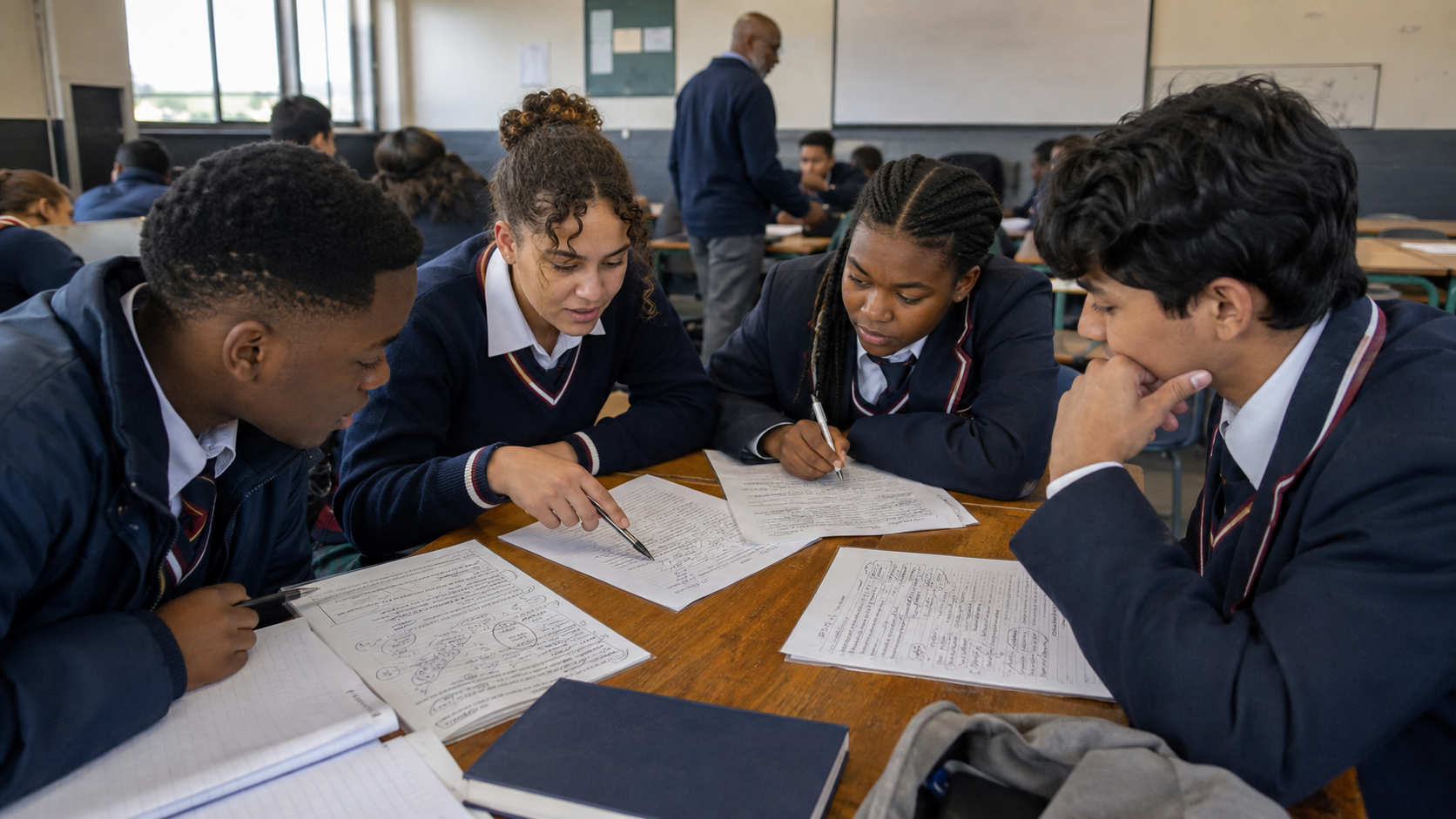
The other group received the same content as written material and studied it independently before taking part in the same kind of peer discussion.
The important difference was therefore not whether students eventually discussed the subject.
Both groups did. It was what happened before they started talking.
The students who studied first remembered more
Immediately after the lesson, the self-study group performed better on tests of both retention and what researchers call near transfer — the ability to apply what was learned to a new but related problem.
The difference became even more striking one week later.
Students who had studied independently before the discussion retained more of the material, while the lecture-first group showed a noticeable decline.
The largest difference appeared in the delayed transfer test. The self-study group achieved an average score of 8.82 compared with 4.74 for the lecture-first group.
That produced what researchers classified as a very large effect.
The result matters because remembering a definition is only one form of learning.
Being able to recognise when the same underlying idea applies in a different situation is considerably closer to understanding.
The discussion itself also changed
The researchers recorded what students said to one another during their discussions.
The two groups did not simply differ in how much they talked.
They differed in what they talked about.
Researchers classified comments as substantive when students contributed an idea about the concept rather than merely repeating information they had been given.
In the lecture-first groups, about 73% of student comments were substantive.
Among students who had studied the material independently first, that figure rose to about 94%.
The self-study groups also generated more than twice as many substantive comments per discussion group and considerably more moments where students actively built on one another’s ideas.
This offers an important clue about why the sequence worked.
The students arrived at the conversation with something of their own to contribute.
Being told the answer first can change the conversation
A lecture can make a difficult topic easier to follow.
That is often valuable.
But it can also decide, before a discussion begins, which ideas seem important and how students are expected to organise them.
Independent study creates a different starting point.
One student may misunderstand a concept. Another may notice a connection the first student missed. Someone else may know which part of the material they could not explain to themselves.
Those gaps become material for the discussion.
The researchers argue that self-study may encourage students to organise prior knowledge, detect uncertainty and form their own understanding before encountering other perspectives.
The conversation that follows can therefore become an attempt to resolve actual questions rather than a repetition of what everyone has just heard from the same lecturer.
Self-study alone was not the real advantage
This is where the finding becomes more interesting.
The researchers are not arguing that students should simply be given textbooks and left to teach themselves.
Previous experiments by the same research group found that self-study was not automatically better than a lecture when no discussion followed.
The advantage emerged from the combination and sequence.
Students first had to construct an understanding individually.
They then had an opportunity to test, explain and revise that understanding with other students.
In the new experiment, the quality of those discussions helped explain the self-study group’s advantage on the immediate learning test, although it did not fully explain why their advantage persisted a week later.
The lesson is therefore less about removing teachers and more about reconsidering when teachers do the explaining.
This fits an important South African education goal
South Africa’s national curriculum already describes active and critical learning as a core principle.
The Department of Basic Education says learners should be encouraged to take an active and critical approach to learning rather than simply receiving given information uncritically. Current education initiatives also increasingly emphasise critical thinking, collaboration, communication and problem-solving.
The new study provides an interesting example of what that can look like in practice.
A classroom does not necessarily become learner-centred because students are placed into groups.
If everyone enters the group discussion immediately after receiving the same explanation, there may be relatively little to debate.
Giving students time to wrestle with material independently first can create differences in understanding that make the subsequent discussion more productive.
That does not require abandoning direct instruction.
It suggests teachers may need to decide more carefully when direct instruction provides the greatest value.
The study was small and unusually specific
There are important reasons not to redesign classrooms around one experiment.
All 73 participants were Grade 12 boys attending a single South Korean high school. They were predominantly from middle-class backgrounds.
The learning material also covered criminal procedure law rather than a normal part of their school curriculum.
Researchers deliberately chose an unfamiliar subject so that students would begin with relatively little prior knowledge, but that makes it uncertain whether the same results would appear in mathematics, languages or subjects where misconceptions have developed over several years.
The students were also tested only one week later.
The study therefore tells us more about the promise of the teaching sequence than about its universal effectiveness.
There is, however, a reason to take the result seriously.
The experiment was designed to extend earlier work that had already found a similar advantage among university students, and related research has produced comparable results in science learning.
Sometimes the teacher may be most useful after students begin thinking
Education often treats explanation as the beginning of learning.
That makes sense when students need knowledge they could not reasonably discover for themselves.
But explanation can also arrive too early.
If students are given an opportunity to encounter a problem before receiving a polished account of how it should be understood, they have to make decisions about the material themselves.
- They notice uncertainty.
- They form questions.
- They discover where their own understanding stops.
A teacher or peer discussion then has something meaningful to work with.
The finding does not suggest that good teaching means explaining less.
It suggests something more subtle. Sometimes the explanation may become more valuable because students have already discovered why they need it.
Source Information
Study Title: Self-study followed by discussion enhances learning for high school students
Authors: Jaeseo Lim and Jooyong Park
Journal: Instructional Science
Published: 11 June 2026
DOI: 10.1007/s11251-026-09801-7