







Few battery demonstrations are more dramatic than deliberately driving a nail through a fully charged cell.
It is also one of the situations battery engineers would rather never encounter outside a laboratory.
A puncture can create an internal short circuit, allowing electrical energy to be released rapidly as heat. In conventional lithium-ion batteries, severe internal damage can sometimes trigger thermal runaway, a chain reaction in which rising temperature accelerates further chemical reactions and, in the worst cases, produces fire.
New research suggests that much higher-energy lithium-metal batteries may not necessarily have to accept that risk as the price of carrying more energy.
Researchers in China have developed an electrolyte that allowed experimental lithium-metal pouch cells to achieve a specific energy of more than 500 watt-hours per kilogram while also surviving aggressive safety tests.
When a fully charged pouch cell was pierced with a nail, the researchers reported no fire or explosion.
When the battery was deliberately charged to 200% of its intended capacity, it again avoided fire and swelling.
The study, published in Nature Communications, suggests that controlling the microscopic arrangement of molecules inside the electrolyte could address two of the biggest obstacles facing lithium-metal batteries: safety and lifespan.
Lithium metal promises far more energy
Most rechargeable lithium-ion batteries used in phones, laptops and electric vehicles do not use metallic lithium as the main negative electrode during normal operation.
Instead, lithium ions are stored inside materials such as graphite.
This approach has helped make modern lithium-ion batteries practical, rechargeable and increasingly reliable, but graphite also occupies considerable mass and volume.
Lithium metal offers a tempting alternative.
Metallic lithium can store an exceptionally large amount of charge for its weight, meaning batteries using lithium-metal anodes could potentially store substantially more energy without becoming proportionally heavier.
For electric vehicles, that could eventually mean longer driving ranges or lighter battery packs.
For aviation and drones, where every kilogram matters, the attraction is even clearer.
But lithium metal comes with a problem.
It is extremely reactive.
One of the biggest problems is dendrites
Charging a lithium-metal battery involves depositing lithium back onto the metal electrode.
Ideally, that lithium would form a smooth and uniform layer.
In reality, deposition can become uneven.
Tiny needle-like structures known as lithium dendrites can begin growing from the electrode surface.
If these structures become large enough, they can penetrate the material separating the positive and negative sides of the battery.
That can create an internal electrical connection where none should exist.
The result can be rapid heating, degradation or catastrophic failure.
Researchers have therefore spent years trying to make lithium deposit more evenly while simultaneously creating interfaces that remain chemically stable over hundreds of charging cycles.
The researchers changed the liquid surrounding the lithium
The new study approached the problem through the electrolyte.
An electrolyte is the medium through which lithium ions travel between the battery’s electrodes.
It may sound like a passive ingredient, but its chemistry strongly influences how lithium moves, how the electrode surfaces change and whether unwanted side reactions develop.
The researchers focused on what happens when lithium ions, solvent molecules and other electrolyte components organise themselves at extremely small scales.
Instead of allowing these components to collect into irregular aggregates, the team designed conditions that encouraged the formation of small, separated structures they describe as isolated solvation nanoclusters.
The difference exists at the molecular scale.
Its effects were visible across the entire battery.
The new ingredient does not strongly interact with lithium ions
The team introduced a cyclic fluorinated liquid that does not strongly coordinate with lithium ions and is also non-flammable.
Its role was not simply to dilute the electrolyte.
By reducing unwanted interactions between the diluent and the ion-containing portions of the electrolyte, the researchers were able to keep the ionic clusters more isolated from one another.
That structure made it easier for lithium ions to move through the electrolyte while reducing the conditions that encourage uneven lithium deposition.
In laboratory analysis, the electrolyte also helped create protective inorganic-rich layers on the electrode surfaces.
These layers contained compounds including lithium fluoride and lithium oxide.
Such interfaces can act almost like a controlled protective skin, allowing useful ion transport while reducing destructive reactions between the highly reactive lithium and the electrolyte.
The batteries lasted for hundreds of cycles
Safety would mean little if the battery quickly lost its ability to store energy.
The researchers therefore tested repeated charging and discharging.
Cells using a 50-micrometre lithium-metal electrode and a high-nickel NCM811 cathode retained approximately 80% of their original capacity after 800 cycles.
The cells also retained more than 95% of their capacity after eight months of calendar ageing.
Calendar ageing matters because batteries deteriorate even while they are sitting unused.
A technology intended for vehicles, electronics or grid storage therefore has to survive both repeated cycling and ordinary time.
The larger pouch cells are more interesting than tiny laboratory cells
Battery research frequently produces remarkable results in very small coin cells.
Those experiments are scientifically useful, but scaling a chemistry into a physically larger pouch cell introduces additional problems.
Heat has to move across a larger area.
Pressure must remain relatively uniform.
Manufacturing defects become more consequential.
More active material also means that a failure can release substantially more energy.
For this reason, demonstrations at the ampere-hour scale are an important step between a promising laboratory chemistry and something that might eventually become technologically useful.
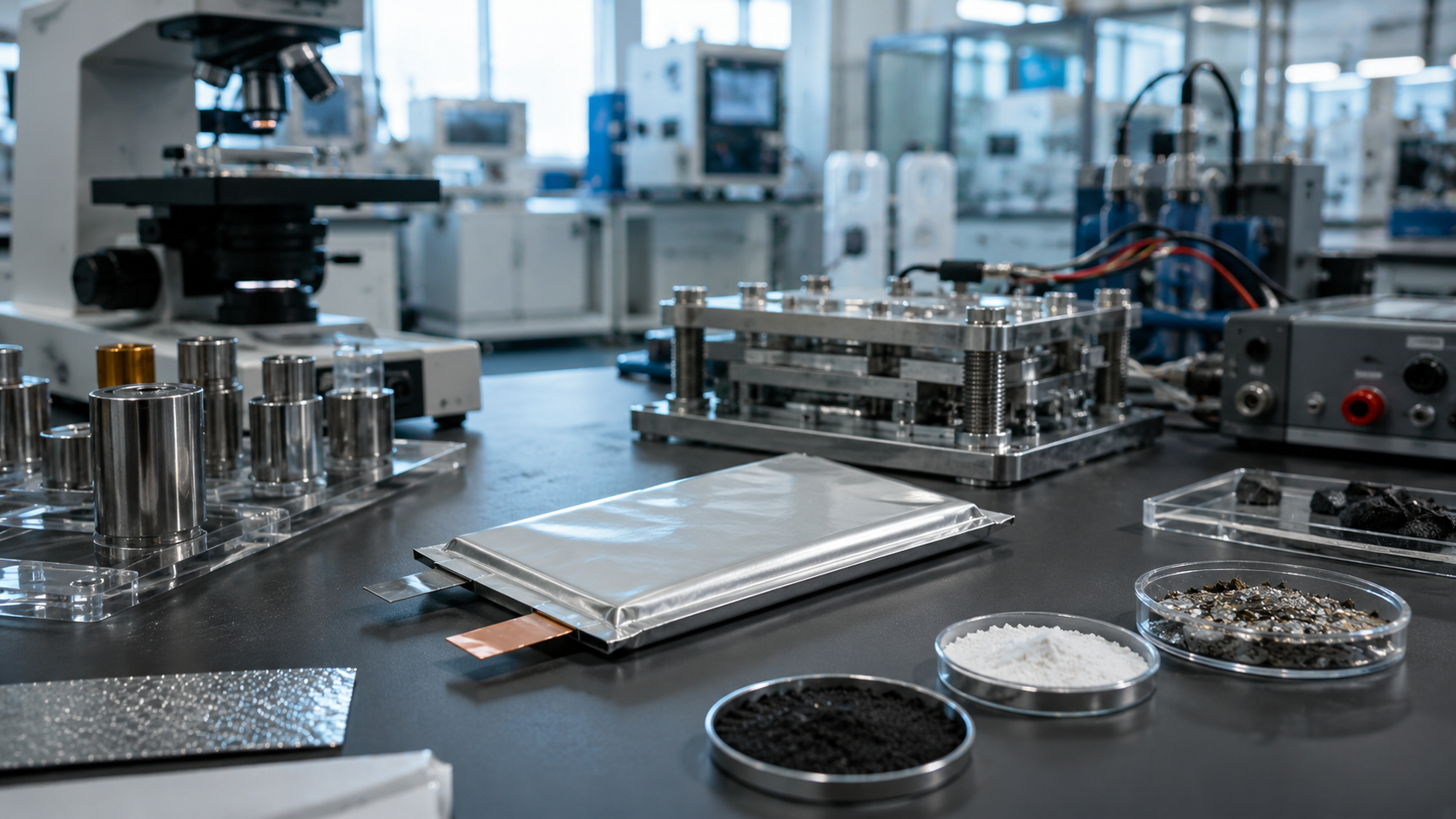
The research team produced pouch cells in this larger format.
According to the researchers, a 6 Ah pouch cell exceeded 500 Wh/kg when the complete pouch-cell mass was included.
That figure is particularly notable because specific energy determines how much electrical energy a battery can store for each kilogram of battery mass.
500 Wh/kg is a serious number
Increasing specific energy is one of battery engineering’s most difficult objectives.
Adding more active material can improve capacity, but every battery also requires separators, electrolytes, current collectors, packaging and other components that contribute mass without storing the same amount of usable energy.
This is why laboratory claims based only on the mass of one electrode can look much more impressive than the performance of an assembled battery.
The new study reports the value using the total pouch-cell mass.
That makes the result more relevant to real engineering discussions.
It still does not mean a commercial electric-vehicle battery pack would achieve 500 Wh/kg.
A complete pack also requires structural protection, cooling, electrical connections, sensors and a battery-management system.
Those components reduce the energy density of the finished system.
Then came the nail
The most visually striking part of the work was the abuse testing.
A nail-penetration test intentionally creates severe mechanical damage inside a charged battery.
It is designed to reveal what happens when internal layers are physically breached and an electrical short circuit becomes possible.
According to the university research team, the fully charged pouch cell did not ignite or explode during the test.
The temperature increased locally by around 30°C, but the failure did not develop into a fire.
That matters because high-energy batteries contain more stored energy that could potentially be released during a failure.
Increasing energy density while maintaining safety is therefore substantially harder than improving either characteristic independently.
The researchers also deliberately overcharged it
The battery was subjected to another extreme condition: overcharging.
Charging a battery beyond its intended voltage or capacity can destabilise electrode materials and accelerate unwanted chemical reactions.
The researchers pushed the pouch cell to 200% overcharge.
They reported no fire, significant swelling or leakage.
These tests do not prove that the battery is impossible to ignite.
No battery chemistry can be declared universally safe from a limited collection of laboratory tests.
But surviving both puncture and severe overcharge while maintaining unusually high specific energy is an encouraging combination.
The electrolyte appears to attack several problems simultaneously
One of the difficulties in battery development is that solving one problem can create another.
A more chemically stable electrolyte might conduct lithium ions too slowly.
An additive that suppresses dendrites might increase resistance.
A highly conductive electrolyte might be flammable.
The new design attempts to avoid this trade-off.
The fluorinated component itself is non-flammable.
The nanocluster arrangement improves ion transport.
The resulting interfaces help suppress unstable lithium growth.
And the protective chemistry formed on the electrode surfaces improves thermal and electrochemical stability.
The attraction is therefore not one spectacular material property but the ability to influence several failure mechanisms through the same electrolyte design.
This is not a solid-state battery
That distinction is worth making because lithium-metal batteries and solid-state batteries are frequently discussed together.
Many solid-state battery designs also aim to use lithium metal, and both technologies are often presented as possible successors to conventional lithium-ion batteries.
But they are not synonymous.
The new research focuses on a specially engineered liquid electrolyte rather than replacing the electrolyte entirely with a solid material.
The researchers are therefore attempting to make lithium metal practical while retaining the advantages of a liquid electrolyte.
That may ultimately provide a different route towards higher energy density than the widely discussed all-solid-state approach.
It is also not ready to appear in your phone next year
There is a large gap between a successful research pouch cell and mass production.
A commercial battery needs to be manufactured reliably by the millions.
The electrolyte components must be affordable and available at scale.
Manufacturing tolerances need to work on high-speed production lines.
The cells must survive vibration, temperature changes, repeated fast charging and years of unpredictable consumer use.
Safety testing also extends far beyond nail penetration and overcharge.
Commercial batteries face crush tests, thermal exposure, electrical faults and extensive certification requirements.
Even promising electrochemistry can fail commercially if production is too expensive or sensitive to tiny manufacturing variations.
The cycle life still has to improve at practical scale
The strongest long-term cycling result in the paper came from smaller cells.
The larger pouch-cell demonstrations remain less mature.
The university team reported that a 2 Ah pouch cell retained around 85% capacity after 180 cycles.
That is promising, but consumer electronics and electric vehicles require substantially longer and more extensively validated operating lives.
Battery researchers also need to determine whether the same molecular structure can be maintained consistently across large manufacturing batches.
What works in a carefully controlled laboratory electrolyte must eventually work despite ordinary industrial variation.
There is another reason the study matters
Battery progress is sometimes discussed as though researchers simply need to discover a new cathode material with a larger capacity.
The reality is increasingly about interfaces.
A modern battery contains several materials that may each perform well individually but become unstable when placed against one another for years.
The electrolyte sits at the centre of many of those interactions.
Changing its microscopic organisation can therefore alter how the entire cell behaves.
The new nanocluster approach reflects a broader change in battery science: researchers are increasingly engineering not only which chemicals are present, but precisely how those chemicals interact with one another at the molecular scale.
Higher-energy batteries would change more than electric cars
Electric vehicles are the obvious application.
A lighter battery could provide greater driving range without increasing vehicle mass, or allow manufacturers to achieve today’s ranges with smaller battery packs.
But the effect could be even more significant in technologies where mass is an especially severe limitation.
Electric aviation requires extraordinarily high specific energy because the aircraft must carry its energy source into the air.
Drones face the same constraint on a smaller scale.
Robotics, portable equipment and some defence technologies would also benefit from storing more energy in less mass.
That is why crossing the 500 Wh/kg level in an assembled experimental pouch cell attracts attention even though commercialisation remains uncertain.
The most impressive part is the combination
Battery headlines often focus on one record.
A battery charges exceptionally quickly.
Another achieves very high energy density.
Another survives thousands of cycles.
Another performs unusually well in a safety test.
The harder engineering challenge is achieving several of these characteristics simultaneously.
A 500 Wh/kg battery that fails after a handful of cycles is not particularly useful.
A perfectly safe battery with very low energy density may not justify replacing existing technology.
A high-performance chemistry that depends on unrealistic laboratory conditions may never reach consumers.
The significance of the new work is therefore not simply that researchers pushed a nail through a battery and it did not catch fire.
It is that the safety result appeared alongside high specific energy and promising cycling performance.
The real test now comes outside the laboratory
The study demonstrates a clever way of controlling battery chemistry at the nanometre scale.
It also shows that lithium-metal batteries do not necessarily have to choose between storing more energy and becoming dangerously unstable.
But battery history is filled with impressive prototypes that encountered unexpected problems during scale-up.
The next questions are therefore less dramatic than a nail-penetration test but ultimately more important.
Can the electrolyte be manufactured cheaply?
Can large cells retain the same performance for thousands of cycles?
Can factories reproduce the nanocluster structure consistently?
And can the chemistry remain safe after years of real-world abuse rather than a controlled laboratory test?
Those answers will determine whether this remains an impressive research battery or becomes part of the technology powering future vehicles and devices.
For now, however, a battery exceeding 500 Wh/kg that can be deliberately punctured while fully charged without bursting into flames is a useful reminder of how quickly battery engineering is changing.
Source Information
Study Title: Safe electrolyte design with isolated solvation nanoclusters for high-energy lithium metal batteries
Lead Authors: Jimin Tang, Zhuangzhuang Cui and Zhixuan Wei et al.
Senior Author: Fei Du
Journal: Nature Communications
Published: 7 September 2026
Technology: High-energy lithium-metal batteries using an isolated-solvation-nanocluster electrolyte
Cell cycling: 80% capacity retention after 800 cycles in tested 50 μm lithium/NCM811 cells
Calendar ageing: More than 95% capacity retained after eight months
Pouch-cell energy: More than 500 Wh/kg based on total pouch-cell mass
Safety tests: Fully charged nail penetration and 200% overcharge without fire
DOI: 10.1038/s41467-026-77589-8