





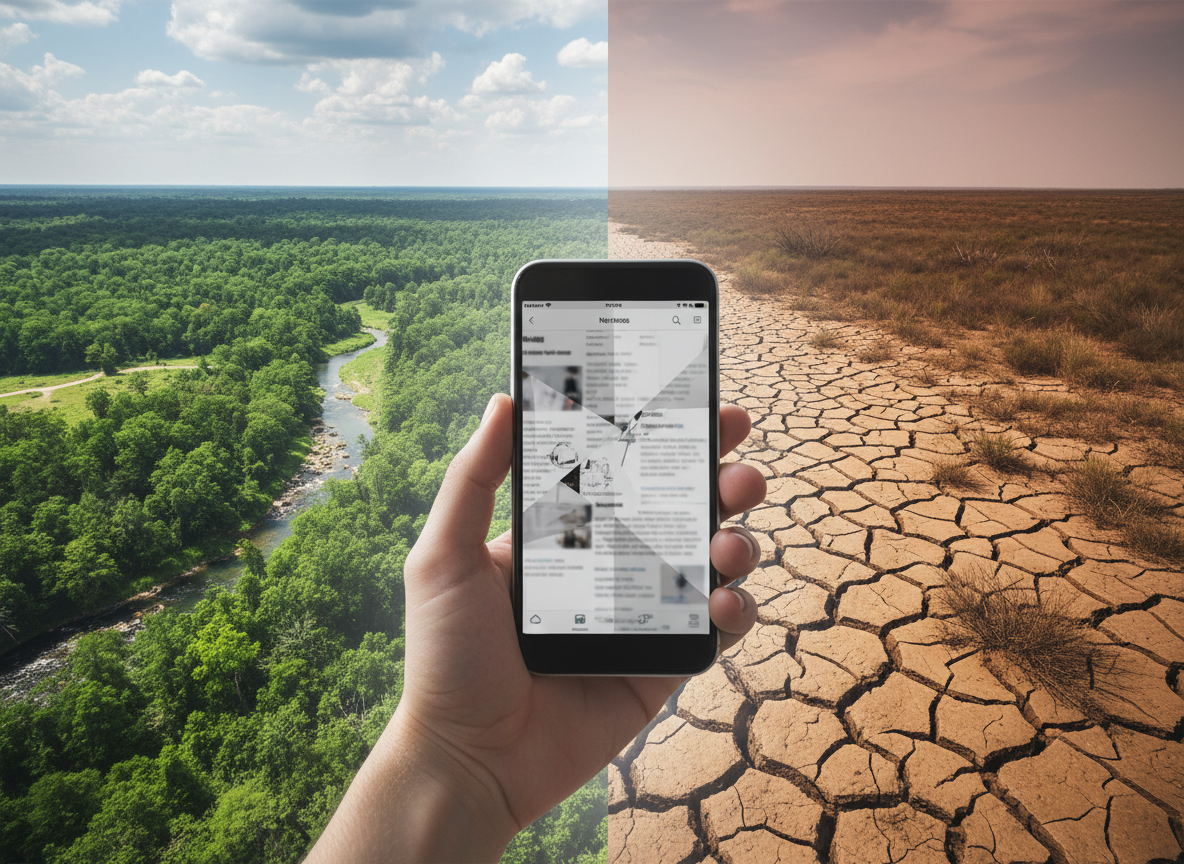
Climate change can be physically close while still feeling psychologically far away.
A person may read about record heat, floods or droughts and still think of the worst consequences as something that will happen somewhere else, to someone else, or much later.
A 2026 study published in the Journal of Environmental Psychology examined why that happens across eight countries and found that the information people encounter may help shape how near or distant the problem feels.
Surveying 8,254 people in Brazil, France, Germany, India, Japan, Pakistan, the United Kingdom and the United States, the researchers found that respondents who reported encountering more climate-related information they believed to be false or misleading also tended to perceive the serious consequences of climate change as further away.
The pattern was not equally strong everywhere, and the study cannot show that misinformation directly caused the change in perception. But across the pooled sample, greater reported exposure to climate misinformation was associated with greater psychological distance from climate change.
At the same time, people who used more mainstream climate news and those who expressed greater trust in scientists, climate news and environmental activists tended to see climate change as closer.
The result adds an important layer to the misinformation debate. False or misleading information may do more than change what people believe about whether climate change is happening. It may also affect whether the threat feels immediate enough to matter now.
What does it mean for climate change to feel “distant”?
The study focuses on a concept known as psychological distance.
In simple terms, psychological distance describes whether people experience an issue as close to their own lives or as something remote in time, place or social relevance.
Climate change can therefore be accepted as real while still being mentally placed in the future.
Someone may believe that global temperatures are rising but think the serious consequences will only emerge decades from now. Another person may think climate impacts are already serious, but mainly for people living in other countries. A third may see the effects as present and personally relevant.
These differences matter because an issue that feels remote may also feel less urgent.
The researchers therefore wanted to understand which factors were associated with climate change feeling nearer or further away, and whether those relationships looked similar across different national contexts.
The study deliberately went beyond wealthy Western countries
Much research on climate psychology has been conducted in what researchers describe as WEIRD populations: Western, educated, industrialised, rich and democratic societies.
That creates a problem when researchers try to draw conclusions about climate perceptions globally.
The new study deliberately included countries from both the Global North and Global South: Brazil, France, Germany, India, Japan, Pakistan, the UK and the US.
Ipsos conducted the online survey between 6 and 24 November 2024, recruiting roughly 1,000 respondents in each country and applying quotas for age, gender and region.
The samples were designed to represent the online populations of the countries rather than every resident. That distinction is especially important for India and Pakistan, where internet access is more uneven and the survey was administered in English. In those countries, the sample therefore skewed toward younger, urban, English-speaking internet users.
The researchers analysed the data using ordinary least squares regression models with country fixed effects, allowing them to examine whether factors such as media use, misinformation exposure, trust and climate concern were associated with psychological distance.
Almost half said serious climate consequences were already happening
Across the eight countries, 48% of respondents said the serious consequences of climate change were already affecting people in their country.
But there were large differences between countries.
Brazil recorded the lowest average psychological distance in the study, meaning respondents there were more likely to see climate change as immediate. Pakistan recorded the highest average distance, with the UK, India and the US also showing relatively higher scores.
Those national differences are important because they show that climate change is not psychologically processed in the same way everywhere.
People live in different media systems, experience different climate impacts and place different levels of trust in institutions. The same message may therefore produce a different reaction depending on the country in which it is received.
Reported misinformation exposure was linked to greater distance
The researchers asked participants how often they personally came across news or information about climate change that they believed to be false or misleading.
In the pooled model, greater reported misinformation exposure was associated with higher psychological distance.
Put differently, people who said they encountered more misleading climate information were also more likely to perceive the serious consequences of climate change as something further away.
The statistical relationship remained significant after the researchers accounted for demographic characteristics, climate concern, media use and other factors included in their models.
That does not prove that misinformation exposure caused people to see climate change as more distant.
The direction could be more complicated. People who already feel less concerned about climate change may seek out different information sources, interpret information differently, or be more likely to classify particular messages in certain ways.
The study is observational, so it identifies associations rather than a causal chain.
The misinformation effect was not the same in every country
One of the most useful findings was how much the country-level results differed from the pooled result.
When the researchers analysed countries separately, misinformation exposure was associated with greater psychological distance in Japan and the United States.
In India, the relationship moved in the opposite direction: people reporting more exposure to misinformation tended to see climate change as closer.
In several other countries, the relationship was not statistically significant.
The researchers suggest that the information environment surrounding misinformation may matter. In one country, misleading information may predominantly downplay climate risks. In another, people may encounter misinformation alongside intense reporting about extreme weather or disasters, which could paradoxically make climate change feel more immediate.
The finding is a useful warning against assuming that misinformation has one universal psychological effect.
Mainstream climate news was associated with climate change feeling closer
The researchers also separated respondents’ media use into mainstream and non-mainstream sources.
Mainstream media included television news, radio, printed newspapers, news magazines and the websites or apps of established news organisations.
Non-mainstream sources included social media, messaging apps and other online news outlets.
Across the pooled sample, greater use of mainstream climate news was associated with lower psychological distance. In other words, people who used more mainstream climate news tended to see climate change as more immediate.
Non-mainstream media use also pointed toward lower distance in the pooled analysis, but the relationship was only marginally significant.
Again, country-level results were more complicated. Mainstream media use significantly reduced psychological distance only in Germany and Japan, while non-mainstream media use was not a significant predictor in any individual country.
This is another reminder that large cross-national averages can hide very different patterns underneath them.
Trust in scientists mattered, but not everywhere
Trust was another important part of the study.
Across the pooled data, greater trust in scientists was associated with seeing climate change as closer. Trust in climate news and environmental activists also reduced psychological distance.
Trust in politicians and in people respondents personally knew did not show a significant overall effect.
The scientist result, however, also varied by country. The association was not significant in Brazil, India, Pakistan or Japan.
That variation matters because it shows why climate communication cannot be reduced to one simple rule such as “use trusted scientists”.
Scientists may be highly credible in many contexts, but credibility is shaped by national institutions, media systems, culture and previous experiences.
Climate concern was the most consistent predictor
Of all the variables examined, climate concern emerged as the most consistent predictor of lower psychological distance.
People who were more concerned about climate change generally saw its consequences as nearer.
This relationship appeared in every country except Pakistan.
Women and more highly educated respondents also tended, in the pooled sample, to perceive climate change as closer.
The study therefore suggests that psychological distance is not determined by media exposure alone. It emerges from a mixture of personal concern, demographic characteristics, information habits, trust and national context.
What people think others believe also mattered
The researchers also examined meta-perceptions: what people believe other groups think about climate change.
For example, respondents were asked about how concerned they thought politically left-leaning and right-leaning groups were about climate change.
These perceptions can act as social cues. If someone believes that people around them take an issue seriously, that may influence their own interpretation of how urgent it is.
But the effects again differed substantially across countries.
Perceptions of right-leaning groups’ concern were associated with greater distance in India and Brazil, while perceptions of left-leaning groups’ concern mattered in the UK and Pakistan.
Interaction effects with respondents’ own political orientation were generally weak.
The broader lesson is that people do not form climate attitudes in isolation. They also interpret what they think other groups believe.
The study does not show that every piece of misinformation pushes climate change into the future
The headline result needs an important qualification.
The study did not independently verify every piece of information that respondents had encountered.
Participants were asked how often they personally came across climate-related information they believed to be false or misleading.
That means the variable measures perceived misinformation exposure, not an audited record of objectively false claims.
Two people could see the same content and disagree about whether it is misinformation.
The survey was also conducted at one point in time, making it impossible to determine whether misinformation changed psychological distance or whether people who already saw climate change as remote encountered and interpreted information differently.
These limitations do not make the result unimportant, but they do define what the evidence can support.
South Africa was not part of the study
South African readers should be particularly careful about treating the eight-country averages as though they automatically apply locally.
South Africa was not one of the countries surveyed.
The study itself shows why that distinction matters: many of the strongest relationships changed substantially from one country to another.
A South African replication could therefore produce a different pattern, especially given the country’s own combination of climate exposure, inequality, news consumption, political trust and highly active social-media environment.
The useful takeaway is not that one global communication strategy will work everywhere. It is almost the opposite.
The same information environment can shape climate perceptions differently depending on where people live.
Why psychological distance matters
Climate communication often focuses on whether people believe climate change is real.
That is only one part of the problem.
A person can accept the scientific consensus while still treating climate change as an abstract future issue.
If serious consequences are mentally placed decades away, public urgency may remain low even when belief in the basic science is high.
This makes psychological distance a useful concept for understanding why factual agreement does not always translate into immediate concern or action.
The new research suggests that misinformation, trust and media habits can all play a role in that sense of distance, but not in exactly the same way across countries.
The strongest message may be about context
At first glance, the study appears to tell a simple story: more misinformation is associated with climate change feeling further away, while mainstream climate news and trust in scientists are associated with it feeling closer.
The country-level results make the story more complicated.
Some relationships were concentrated in only a handful of countries. Others reversed direction. Several disappeared when each national sample was examined separately.
That complexity may be the study’s most important contribution.
Climate communication is often treated as a global challenge requiring a global message. The evidence here suggests that effective communication may depend just as much on understanding the local information environment.
People do not encounter climate change as an abstract global average.
They encounter it through the news they follow, the institutions they trust, the misinformation they believe they see and the society around them.
Whether climate change feels like a problem for today or a problem for some distant future may therefore depend partly on the information world in which people are living right now.
Source Information
Study Title: What makes climate change feel distant? Evidence from eight countries in the Global North and South
Authors: Waqas Ejaz, Emily Kubin and Richard Fletcher
Journal: Journal of Environmental Psychology
Volume: 114
Article: 103180
Published: September 2026
Sample: 8,254 online respondents across Brazil, France, Germany, India, Japan, Pakistan, the United Kingdom and the United States
Method: Cross-national online survey analysed using ordinary least squares regressions with country fixed effects
DOI: 10.1016/j.jenvp.2026.103180