







The next generation of wearable technology may not need a battery strapped to your wrist, clipped to your clothing or hidden inside a sensor patch.
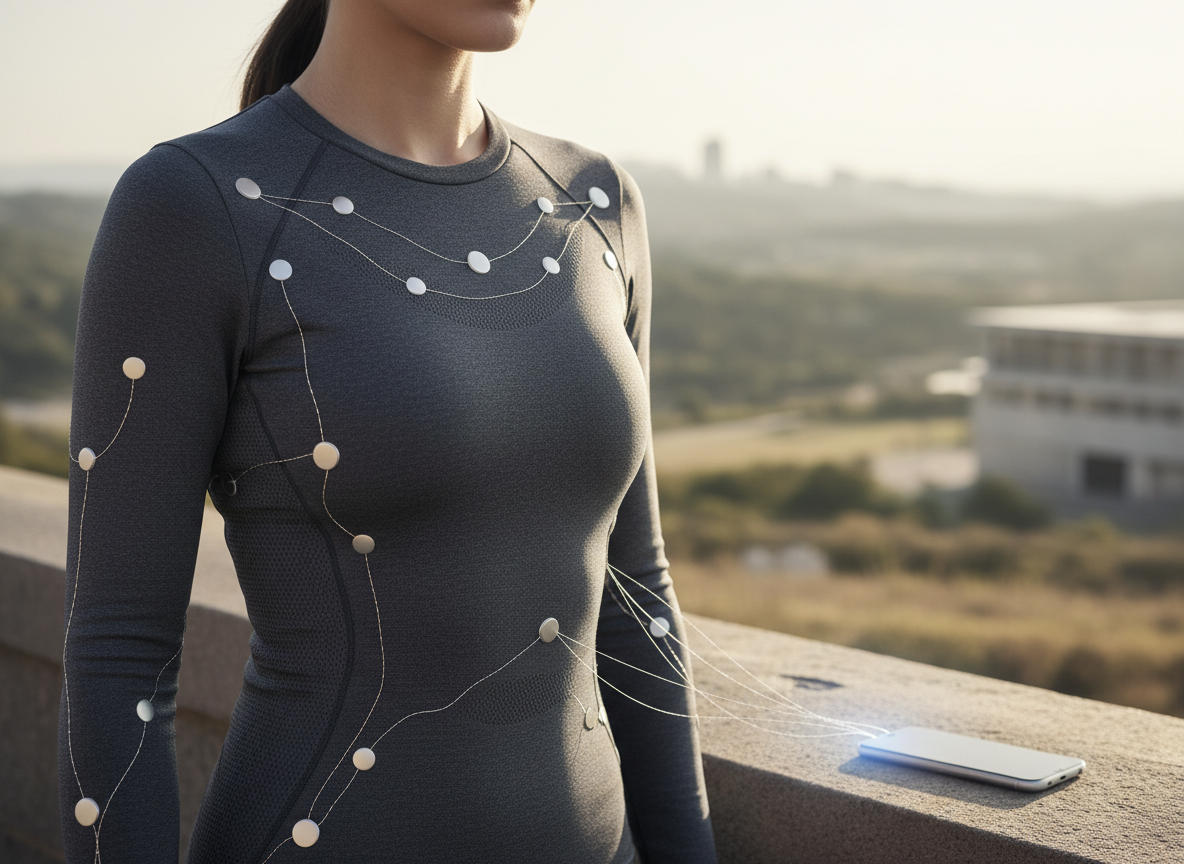
Researchers have developed a body-wide sensor network that uses specially engineered clothing to move both power and data around the wearer, allowing small sensors to operate without their own batteries.
The system, reported in Nature Communications on 14 September 2026, uses a dual-mode metamaterial textile embroidered with liquid-metal fibres. When worn, the textile acts as an electromagnetic pathway across the body, allowing a nearby smartphone to power distributed sensors while also receiving their data.
The researchers demonstrated the platform in applications including robotic control, virtual reality and human digital twins. Compared with emerging near-field clothing approaches, the system increased data throughput by 37.8 times and doubled wireless power-transfer efficiency.
The result is not simply another wearable sensor. It is an attempt to solve one of the most persistent problems in wearable technology: every extra sensor normally brings another battery, another charging requirement and another point of failure.
The problem with putting more sensors on the body
Wearables have steadily moved beyond step counting.
Smartwatches, fitness bands, medical patches and experimental electronic skins can now measure heart rate, motion, muscle activity, temperature and a growing range of other physiological signals.
But building a network of sensors around the entire body is much harder than building a single device.
Each sensor needs power. It also needs a way to communicate its data. Batteries add weight, bulk and maintenance, while conventional wireless links can lose efficiency when signals have to travel around or through the human body.
That creates a basic trade-off. Designers can make devices small and unobtrusive, or they can give them enough battery and radio hardware for reliable continuous operation. Doing both at once is difficult.
The new textile architecture is designed to change that equation by turning the clothing itself into part of the wireless infrastructure.
The shirt becomes the network
The team created what it describes as a dual-mode metamaterial textile.
Metamaterials are engineered structures designed to control electromagnetic waves in ways that ordinary materials do not. In this case, the textile guides electromagnetic energy along the wearer’s body rather than forcing every sensor to communicate independently through open space.
The conductive pathways were digitally embroidered using liquid-metal fibres.
These fibres allow the textile to remain flexible enough for clothing while still providing controlled electromagnetic transmission.
The result is a wearable network in which the garment is not just holding the electronics. The fabric itself becomes the route through which energy and information move.
One textile carries both power and data
The most important part of the design is that it supports two different wireless functions at the same time.
One mode handles near-field power transfer. This allows energy from the smartphone hub to reach sensors distributed around the body.
The second mode supports Bluetooth communication, allowing those sensors to send their measurements back through the network at much higher data rates.
Combining both functions matters because previous wearable approaches often have to choose between efficient power delivery and fast communication.
Near-field systems can be useful for powering battery-free devices, but their data rates are limited. Bluetooth provides much higher communication speeds, but individual Bluetooth sensors usually need their own power source.
The new architecture attempts to combine the advantages of both.
A smartphone acts as the central hub
The system does not require a dedicated base station.
An NFC-enabled smartphone can serve as the hub for the network.
The phone provides wireless power to the wearable sensors through the textile and receives multimodal sensor data in return.
That is significant because smartphones already contain the wireless hardware, computing capability and battery capacity needed to manage wearable devices.
Instead of adding another charging case or control unit, the researchers use a device the wearer is already likely to carry.
The concept also makes the system easier to imagine outside a laboratory. A user could theoretically put on a sensor-enabled garment, carry a compatible smartphone and have multiple small body sensors operating without charging each one individually.
Data throughput increased almost 38-fold
The researchers compared their design with emerging near-field clothing systems.
The metamaterial architecture increased data throughput by 37.8 times.
That difference matters because richer forms of sensing produce far more data than basic step counting.
Motion tracking, muscle signals and other multimodal measurements may need to be sampled frequently and transmitted continuously.
A network that can only support slow data transfer quickly becomes a bottleneck as more sensors are added.
Higher throughput therefore creates room for more sensors, higher sampling rates and more responsive human-machine interactions.
Power-transfer efficiency also doubled
Faster data transmission would be much less useful if it came at the cost of inefficient wireless power.
The researchers report that their architecture doubled wireless power-transfer efficiency compared with the near-field clothing systems used as a benchmark.
That is particularly important in a battery-free network.
Every sensor has to operate on the energy it receives wirelessly, so losses across the garment directly affect how practical the system can become.
Improving both data transfer and power delivery at the same time is therefore a central part of the advance.
The sensors kept working while the wearer moved
Wearable electronics are easy to demonstrate on a stationary mannequin or a person sitting still.
Real clothing bends, stretches and shifts constantly.
The team reports that the network remained robust during motion, an essential requirement for any system intended for everyday human-machine interaction.
This is where textile-based systems can have an advantage over rigid electronic assemblies.
If the communication pathway is integrated into the garment itself, sensors can remain distributed across different parts of the body without requiring long external wires or multiple bulky radio modules.
The researchers used it to control robots
One of the demonstrations involved robotic control.
Body sensors can capture movement or other human signals and translate them into commands for a machine.
For robotics, low-latency communication is especially important.
A system that responds too slowly makes control feel unnatural and can become unsafe in applications where timing matters.
The high-throughput textile network gives multiple sensors a common communication pathway, allowing the wearer’s movements to become a more direct input for robotic systems.
This could eventually be useful in teleoperation, industrial robotics, rehabilitation or assistive devices, although the current work is a research demonstration rather than a finished commercial platform.
Virtual reality is another natural use
Virtual-reality systems often rely on cameras, handheld controllers or a small number of tracking points.
Adding more body sensors could make digital avatars respond more accurately to the wearer’s posture and movement.
The problem is that covering a user with battery-powered trackers quickly becomes cumbersome.
A battery-free network embedded in clothing offers a different model.
Instead of attaching a collection of independently powered devices, the garment could support multiple sensing points while the smartphone provides the shared power and communications hub.
The researchers demonstrated the platform in virtual-reality interaction, showing how the network can support continuous, unencumbered control.
The same idea could feed human digital twins
The paper also demonstrates applications involving human digital twins.
A digital twin is a continuously updated virtual representation of a physical system.
For a human body, that could mean a digital model receiving live information about movement, posture or physiological state.
The more sensors a system can use comfortably, the richer that representation can become.
Battery-free sensor networks could therefore be useful in areas ranging from sports analysis and rehabilitation to workplace ergonomics and immersive computing.
The technology does not automatically create a complete digital twin, but it addresses one of the practical obstacles: collecting distributed body data without turning the person into a bundle of batteries and wires.
This is different from simply putting electronics into fabric
Smart clothing is not a new idea.
Researchers have developed conductive fibres, textile electrodes, flexible sensors and garments capable of measuring body signals for years.
What distinguishes this work is the role of the textile as a network infrastructure.
The fabric is designed to actively guide both energy and communication across the wearer.
That shifts the design philosophy from “electronics attached to clothing” toward clothing that participates in how the electronics function.
If the approach can eventually be manufactured reliably, it could simplify wearable systems by allowing small sensor modules to plug into a shared textile network rather than each operating as a complete standalone device.
The liquid-metal fibres are important
Rigid conductors are poorly suited to clothing because they can crack, restrict movement or create uncomfortable structures.
Liquid-metal fibres offer a way to maintain electrical conductivity while preserving flexibility.
Digital embroidery also means the conductive pathways can be patterned into garments rather than assembled as separate circuit boards.
This could potentially make it easier to place the network around shoulders, arms, torso or other parts of the body where normal electronic hardware would be awkward.
However, translating a laboratory textile into an everyday garment will require more than electrical performance.
Comfort, repeated washing, long-term mechanical wear, manufacturing consistency and cost will all matter before a system like this becomes a consumer product.
Battery-free does not mean energy-free
The phrase “battery-free” can be misleading if taken too literally.
The sensors do not contain their own batteries, but they still require energy.
That energy comes from the smartphone through near-field wireless power transfer.
The practical advantage is therefore not that the system uses no electricity. It is that multiple small sensors no longer need separate rechargeable batteries.
This could reduce device size and eliminate the need to charge each sensor independently.
The energy burden is effectively consolidated into the smartphone or another central hub.
There are still questions before this becomes everyday clothing
The research demonstrates an engineering platform, not a finished retail product.
Real-world adoption would require the system to remain reliable after repeated bending, sweating, laundering and long periods of wear.
Manufacturers would also need to standardise how sensors connect to the textile network and ensure compatibility across phones and devices.
Privacy and security would become increasingly important as the number of body sensors grows.
A garment capable of continuously collecting movement or physiological information could generate highly personal datasets.
Any commercial version would therefore need secure communication, clear user control and careful handling of biometric information.
The most interesting part may be what disappears
Wearable technology usually becomes more noticeable as more capability is added.
More sensors mean more devices. More devices mean more batteries, chargers and straps.
This research points in the opposite direction.
The network becomes more capable while individual sensors can become simpler because the clothing and smartphone take over functions that would otherwise need to be duplicated in every device.
That is a potentially important shift for wearable computing.
The long-term goal of human-machine interfaces is often described as making technology feel less intrusive.
A garment that quietly carries power and data around the body moves closer to that idea than a collection of gadgets that all need to be charged separately.
Source Information
Study Title: Metamaterial-enabled battery-free wireless sensor networks for unencumbered human-machine interactions
Authors: Yimeng Zhang, Fengman He, Tianyiyi He, Qianrui Luo, Juerui Lin, Qinghao Xu, Changqing Guo, Xinyue Chai, Yuchen Wang, Tong Wu, Yiru Jiang, Chun Jin, Xiping Hu, Wenbo Ding and Xi Tian
Journal: Nature Communications
Published: 14 September 2026
Main finding: A dual-mode metamaterial textile enabled battery-free body sensors to receive wireless power and communicate through clothing, increasing data throughput by 37.8 times and doubling power-transfer efficiency compared with emerging near-field clothing approaches.
Applications demonstrated: Robotic control, virtual reality and human digital twins
DOI: 10.1038/s41467-026-77600-2