





Remote farms can produce food and support local livelihoods, but their potential can be constrained when roads, refrigeration and electricity are missing at the same time. New peer-reviewed research has developed an integrated design framework intended to address those infrastructure gaps using methods that local technicians can adapt with free and open-source tools.
The study used a 419-hectare agro-pastoral farm near Mpangala in the Democratic Republic of the Congo as its case study. The farm is approximately 43 km from Kinshasa and 9 km from Kasangulu, and combines food production with training and research activities.
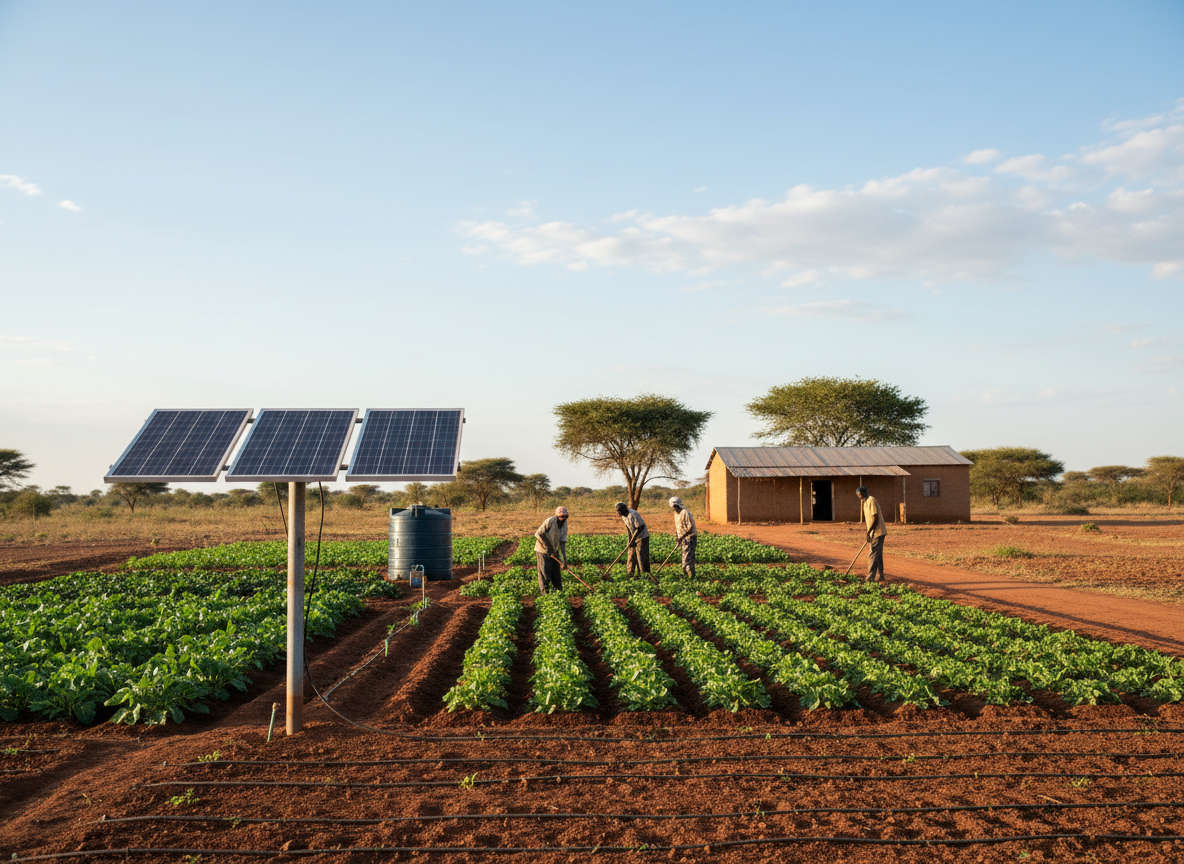
Rather than testing a single technology, the researchers combined three infrastructure problems into one planning approach: small river crossings to improve access, off-grid refrigeration to preserve food, and photovoltaic electricity generation to support farm operations. The central aim was to make the design process simple enough to be reproduced in other resource-constrained rural settings.
A farm facing several infrastructure constraints at once
The Mpangala farm provides a practical example of the interconnected problems that can limit agricultural development in remote areas. Access routes include poorly maintained sandy roads, while an unstable wooden river crossing restricts heavier transport. The site also lacks connection to the national electricity grid and faces constraints in food preservation and internal infrastructure.
These limitations matter because food production is only one part of a functioning agricultural system. Produce must also be stored, transported and distributed. A farm that increases production without improving refrigeration or access can still lose food or struggle to reach markets.
The researchers therefore treated transport, cold storage and electricity as parts of the same rural development problem rather than as isolated engineering projects.
How the study was conducted
The work formed part of the Intelligent Infrastructure Design for Multifunctional Efficient Farm project. Researchers from Politecnico di Milano developed simplified preliminary design procedures for three systems: low-cost small river crossings, refrigerated cold rooms and stand-alone photovoltaic generation.
The methods were selected for simplicity, robustness and adaptability. The researchers prioritised approaches that could be implemented with free or open-source software and adjusted using locally available materials and locally collected information.
The procedures were then applied to the Mpangala farm to examine their practicality in a real remote-farm context. This makes the study primarily an engineering design and case-study investigation. It is not a randomised intervention and does not measure whether the proposed infrastructure subsequently increased farm income, crop yields or household nutrition.
The case study covered a 419-hectare farm
The case-study farm covers 419 hectares and supports several agricultural and livestock activities, including cattle and pig farming, aquaculture and palm oil production. It also serves as a practical training site connected to the Université Catholique du Congo.
For the electrical demand assessment, the researchers estimated through site information and discussions with local staff that no more than 22 people would normally live and work on the farm. Appliance use and lighting requirements were then incorporated into stochastic load profiles used for preliminary energy-system sizing.
The lighting assumptions illustrate the level of practical detail in the framework. The design targeted 300 lux in dormitories, rooms and the shop, 500 lux in the dining area, 400 lux in the chapel and 200 lux in barns. For sizing, the researchers considered 36-watt LED lights producing 2,700 lumens.
Transport design focused on small river crossings
The transport component addressed a common rural infrastructure problem: crossings that are too temporary or fragile to provide reliable vehicle access during changing weather and river conditions.
Instead of relying on highly specialised bridge-design workflows, the researchers developed a streamlined preliminary method using simplified calculations, design tables and practical guidelines. The intention is not to eliminate professional engineering verification, but to lower the technical barrier at the early planning stage so that local engineers, contractors and government technicians can evaluate feasible options.
Improved crossings could have effects beyond transport convenience. More reliable access can influence whether agricultural inputs reach a farm, whether produce reaches markets and whether infrastructure upgrades can physically be delivered to the site.
Cold storage addresses post-harvest losses
The second component focused on refrigerated storage that can operate where conventional grid electricity is unavailable. Food preservation is particularly important for meat and other perishable products because the economic value of increased production can be lost if products spoil before reaching consumers.
The framework links refrigeration requirements to off-grid energy planning, allowing the cold room to be considered as part of the farm’s broader electrical system rather than as a separate appliance added later.
Related experimental work within the same project has demonstrated the scale of the engineering challenge. A cold-room configuration designed for Kinshasa conditions to freeze 100 kg of meat to minus 20 degrees Celsius within 16 hours required average daily energy of about 3.60 kWh with electric defrosting and 3.38 kWh with hot-fluid defrosting. Those values illustrate why refrigeration strategy and electricity storage need to be designed together in an off-grid setting.
Solar generation was designed around local demand
The third component involved a stand-alone photovoltaic system because the farm is not connected to the national electricity distribution network.
Rather than assuming a generic electricity demand, the procedure builds a load profile from expected occupants, lighting, appliances and patterns of use. The researchers noted that many people living on the farm are also workers, reducing expected day-to-day variation in the load profile. The farm’s proximity to the equator also produces comparatively stable annual solar and weather conditions, which informs the sizing process.
This demand-led approach is important for affordability. Oversizing an off-grid system increases capital requirements, while undersizing it can leave essential equipment without sufficient energy. The framework is intended to give local planners a transparent route from estimated demand to preliminary system size.
Why integration matters
The most important contribution of the study is arguably not any single bridge, refrigerator or solar calculation. It is the decision to treat the three systems as interdependent parts of a multifunctional farm.
Reliable road access makes construction and distribution possible. Refrigeration extends the usable life of perishable food. Electricity powers refrigeration and other farm activities. Together, these systems could create conditions in which agricultural production is more useful to both the farm and surrounding communities.
The researchers also designed the methods around capacity building. Supporting materials have been incorporated into an open online course on sustainable farm design in developing countries, extending the project beyond the single case-study site.
Important limitations
The study should not be interpreted as evidence that the proposed infrastructure has already reduced poverty, improved nutrition or increased agricultural productivity. Those are intended development outcomes, not outcomes established by a controlled impact evaluation.
The analysis is centred on one farm in the Democratic Republic of the Congo. Terrain, rainfall, solar resources, labour patterns, available materials, local prices and regulatory requirements can differ substantially between locations. The authors explicitly designed the procedures to be adaptable, but each new application still requires local data and engineering judgement.
Simplification also creates a trade-off. Accessible preliminary tools can help communities and local technicians explore options, but final bridges, electrical installations and refrigeration systems still require appropriate safety assessment, detailed design and compliance with local standards.
Finally, the paper focuses on technical feasibility and replicable design methods. Long-term evidence on maintenance, financing, local ownership, equipment failure and realised social or economic benefits will be necessary to determine whether the integrated model remains sustainable after implementation.
What the study adds
Rural development projects can fail when infrastructure is planned in fragments. This study provides a practical alternative by bringing transport access, food preservation and renewable electricity into one farm-level framework.
Its emphasis on free software, locally available materials and simplified sizing procedures is particularly relevant for communities where specialist engineering capacity and project budgets are limited. The Mpangala case study shows how those principles can be translated into concrete preliminary designs for a large remote farm.
The next question is whether implementation produces the intended outcomes. Future evaluation should measure changes in food losses, farm productivity, market access, energy reliability, operating costs, employment and nutrition after infrastructure upgrades are completed.
Source Information
Study: Multidisciplinary strategies for the sustainable development of community farms in remote areas
Authors: Nicola Toscani, Matteo Benvenuti, Igor Matteo Carraretto, Arianna Cavallo, Greta Cornaggia, Chiara D’Ignazi, Marco Carlo Rampini, Giulio Zani, Gisella Tomasini and Francesco Castelli-Dezza
Journal: Scientific Reports
Published: 25 September 2026
DOI: 10.1038/s41598-026-71349-w
Study type: Multidisciplinary engineering design study and case study
Case study: 419-hectare Mpangala agro-pastoral farm, Democratic Republic of the Congo