






African swine fever is unusually difficult to manage once it reaches pig populations because rapid identification matters, yet molecular confirmation can depend on laboratory infrastructure that is not always available where an outbreak begins. A newly published study has tested a compact alternative that combines isothermal DNA amplification with CRISPR-based detection inside a specially designed reaction tube.
Writing in Scientific Reports, Liwei Xu and colleagues at Nanjing Agricultural University describe a portable ERA-CRISPR/Cas12a assay targeting the B646L gene of African swine fever virus, or ASFV. Under the researchers’ optimized laboratory conditions, the platform detected a plasmid standard at 1.21 × 101 copies per microlitre. It also produced no detected cross-reactivity with six other common swine pathogens included in the specificity experiment.
The result is technically promising because the researchers were not simply trying to make another sensitive molecular test. Their design tackles a practical problem in combining amplification and CRISPR chemistry: the reactions can interfere with one another if they are mixed too early, while opening tubes between stages creates an opportunity for amplified DNA to contaminate the testing environment.
Why a field-ready test is difficult
ASFV causes a severe infectious disease of domestic pigs and wild boar and remains a major threat to swine production. Fast diagnosis is important for surveillance and outbreak control. Conventional nucleic-acid methods can be highly sensitive, but field deployment becomes harder when testing depends on sophisticated thermal cycling, laboratory workflows or bulky detection equipment.
Isothermal amplification offers one route around part of that problem. Enzymatic recombinase amplification, or ERA, amplifies target DNA without the repeated heating and cooling cycles used in conventional PCR. CRISPR/Cas12a can then add a second recognition step. Once the Cas12a-crRNA complex recognizes its intended target, activated Cas12a cleaves a fluorescent reporter, turning molecular recognition into a measurable signal.
Putting those stages together, however, creates an engineering trade-off. A fully open, sequential workflow can expose amplified material to the surrounding environment. A fully mixed one-pot reaction can make the amplification and CRISPR components compete or interact before the amplification stage has done its job.
A two-layer tube separates the chemistry before detection
The researchers addressed that trade-off with a customized dual-layer reaction tube. The physical arrangement keeps the ERA amplification mixture and CRISPR/Cas12a detection system apart during the initial stage, reducing direct interaction between the two reaction systems. The design is intended to preserve the benefits of sequential chemistry while reducing the need to repeatedly open and transfer amplified products.
The molecular target was the conserved ASFV B646L gene, which encodes the major capsid protein p72 and is widely used in ASFV detection. The team designed three forward primers, three reverse primers and a CRISPR RNA, then experimentally screened combinations to identify the best-performing assay conditions rather than assuming a single primer pair would work optimally.
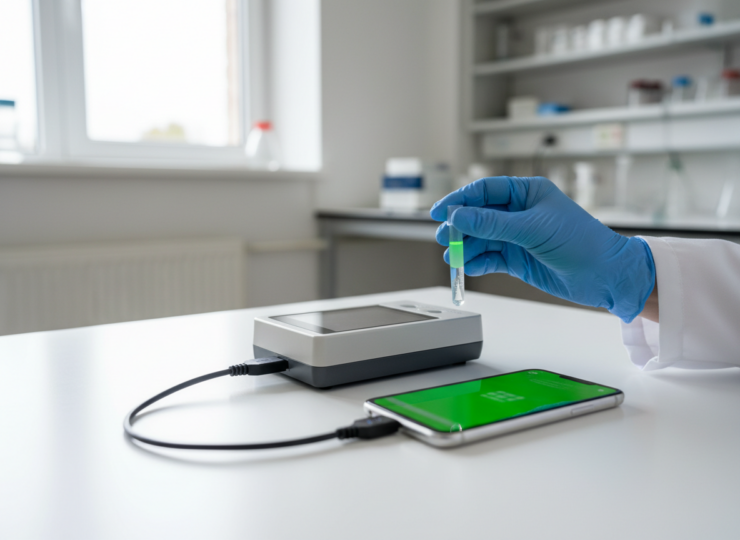
Detection was performed with a portable thermostatic nucleic-acid amplification analyser connected to a smartphone. That matters for the intended use case. Portability is not only about shrinking the reaction itself. A field-oriented diagnostic system also needs a practical way to control temperature and read the signal without a full laboratory instrument.
Sensitivity reached about 12 copies per microlitre
Using a plasmid standard containing the target sequence, the optimized assay reached an analytical limit of detection of 1.21 × 101 copies per microlitre. In practical terms, that is approximately 12.1 target copies per microlitre under the study’s analytical conditions.
A limit of detection is not the same as clinical sensitivity. It describes the lowest concentration that the analytical system can reliably identify under the test conditions. Real samples introduce additional complications, including extraction efficiency, sample quality, inhibitors and variation in viral load. The study therefore supports a claim about analytical sensitivity, not yet a population-level estimate of how often the assay will identify infected pigs in routine field surveillance.
The researchers also examined repeatability and reproducibility. Reported coefficients of variation were below 6.9% for repeatability and below 6.75% for reproducibility. These values indicate that fluorescence measurements remained relatively consistent across the repeated experimental conditions used by the authors. Consistency is particularly important for a portable assay because a method that occasionally produces a strong signal but varies widely between runs would be difficult to interpret outside a tightly controlled laboratory.
Six other swine pathogens did not trigger the ASFV signal
Specificity was tested against porcine epidemic diarrhoea virus, porcine reproductive and respiratory syndrome virus, pseudorabies virus, Senecavirus A, classical swine fever virus and porcine circovirus type 2. Under the experimental conditions, the ASFV assay did not show cross-reactivity with those six pathogens.
That result is important because several infectious diseases can circulate in pig populations, and a useful molecular screen needs to respond to the intended genetic target rather than merely to the presence of viral material. The CRISPR stage provides sequence-specific recognition in addition to the selectivity already introduced by ERA primers.
Still, a specificity panel of six pathogens is not equivalent to testing every organism, ASFV genotype, sample matrix or field condition the assay might encounter. The result demonstrates specificity against the comparison panel chosen for this experiment.
Simulated serum samples were all classified correctly
The team next evaluated simulated clinical serum samples. In that controlled set, all positive and negative samples were correctly identified. This is an encouraging bridge between purified analytical standards and more realistic sample conditions because serum contains biological material absent from a simple plasmid dilution.
It is also where careful interpretation becomes essential. The study used simulated clinical samples rather than a large prospective collection of naturally infected and uninfected pigs tested under routine farm or veterinary conditions. Perfect classification in a limited controlled set should therefore not be translated into claims of 100% clinical sensitivity or specificity in the field.
The serum used in the work came from archived diagnostic material held by the Veterinary Diagnosis and Testing Center of Nanjing Agricultural University. The authors report that no live-animal experiment was conducted for the study.
The real innovation is integration
None of the individual ideas behind the assay is entirely new. Isothermal amplification, CRISPR-based nucleic-acid recognition and portable fluorescence readers already form an active diagnostic research field. The contribution here is the way those pieces are integrated around a practical constraint.
The dual-layer tube physically separates amplification from CRISPR detection at the stage when premature interaction could impair performance. It also aims to reduce handling of amplified material, which can be a source of carry-over contamination in highly sensitive nucleic-acid assays. Meanwhile, a smartphone-connected reader shifts signal acquisition away from conventional laboratory instrumentation.
For veterinary surveillance, this combination could be valuable if later field validation confirms the laboratory performance. Faster testing closer to farms or collection points could shorten the distance between sampling and an actionable result. That possibility is especially relevant for infections where containment decisions may need to be made quickly.
What the study does not yet establish
The strongest evidence in this paper concerns analytical performance. The assay identified the ASFV target at low copy concentrations, remained consistent in repeat testing, avoided detected cross-reactivity with the six-pathogen panel and correctly classified the simulated serum samples used by the researchers.
Several questions remain before those results can be treated as evidence of routine field performance. Large blinded studies using naturally infected animals would be needed to estimate clinical sensitivity and specificity with confidence intervals. Testing should also span different sample types, viral loads, ASFV genetic diversity, operators and environmental conditions. A field device must remain reliable when temperature control, sample preparation and handling are less standardized than in a research laboratory.
The study also does not demonstrate that the new assay outperforms established reference diagnostics in outbreak control. A portable screening platform and a laboratory reference method can serve different purposes. The important future question is whether the assay can preserve sufficient diagnostic performance while delivering a meaningful advantage in speed, accessibility, contamination control or cost where conventional testing is difficult.
A promising step toward decentralized molecular surveillance
The study shows how diagnostic innovation can depend as much on workflow engineering as on molecular sensitivity. By physically managing when ERA and CRISPR chemistry interact, the researchers created a compact system that detected ASFV DNA at approximately 12.1 copies per microlitre and worked with a portable smartphone-connected reader.
That is not yet evidence that the assay is ready to replace established diagnostic pathways. It is evidence that sensitive ASFV detection can be packaged into a more field-oriented architecture without obvious loss of specificity in the pathogens tested. The next stage is less about proving that the chemistry works and more about determining whether the complete workflow remains dependable in the places where rapid diagnosis is most needed.
Source Information
Study: Xu, L., Wang, S., Zhang, D. et al. “A portable one-tube ERA-CRISPR/Cas12a assay for rapid detection of African swine fever virus.”
Journal: Scientific Reports
Published: 28 September 2026
DOI: 10.1038/s41598-026-72034-8
Study type: Laboratory development and analytical validation of a portable molecular diagnostic assay