







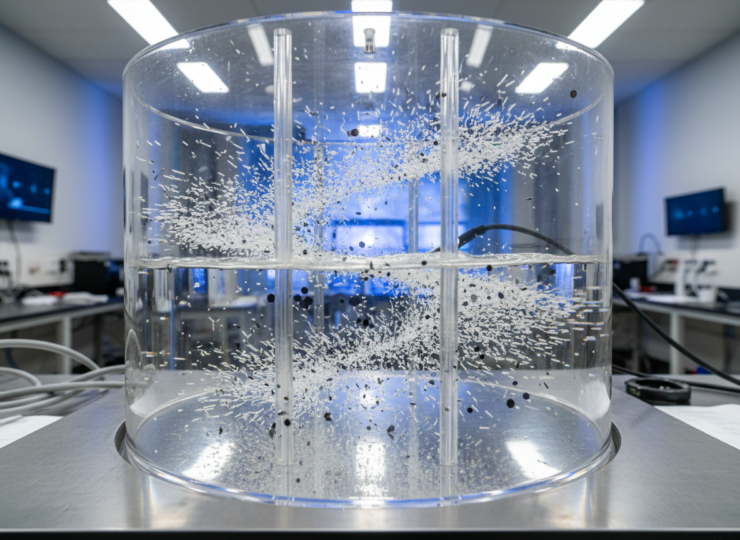
A particle suspended in a flowing liquid might seem as though it should simply follow the motion around it. New experiments show that this intuition can break down at the nanoscale.
Researchers studying two very different nanoparticle suspensions found that particle shape and rotational dynamics determined whether microscopic motion mirrored the visible flow. Plate-like graphene oxide particles tracked large-scale vortex waves closely, while rod-shaped cellulose nanocrystals reoriented at frequencies roughly 2.6 to 3.0 times higher than the macroscopic wave motion.
The work, published in Nature Physics on 29 September 2026, demonstrates a time-resolved X-ray microscopy method capable of connecting behaviour across seven orders of magnitude in length scale. That matters because many industrial and natural fluids contain particles whose microscopic dynamics help determine how a material flows, mixes and ultimately forms structure.
Watching a classic flow problem at two scales
The team used Taylor-Couette flow, a classic physics experiment in which fluid sits between two concentric cylinders while the inner cylinder rotates and the outer cylinder remains stationary. At low rotational speeds, the liquid follows a relatively simple laminar path. As the Reynolds number rises, the system develops counter-rotating Taylor vortices and then increasingly complex wavy and modulated vortex states.
These transitions are well understood at the macroscopic level. The unresolved question was whether actual anisotropic nanoparticles inside the fluid reproduce the same spatial and temporal dynamics as the idealised fluid elements used in continuum descriptions.
To investigate that question, the researchers combined polarized light imaging with small-angle X-ray scattering microscopy. Polarized light captured the large-scale flow patterns, while the X-rays revealed how the suspended particles were oriented at much smaller scales.
The X-ray method reached millisecond temporal resolution, a major improvement over earlier SAXS microscopy approaches that operated on timescales of roughly a minute. The team used the intense X-ray flux available from diffraction-limited synchrotron sources and analysed the signals in the frequency domain.
Two particle shapes produced two different stories
The experiments compared a 0.7% by weight suspension of platelet-like graphene oxide with a 3% suspension of rod-like cellulose nanocrystals. The graphene oxide platelets had an average thickness of about 1 nanometre and a characteristic lateral size of about 2 micrometres. The cellulose nanocrystals averaged about 6 nanometres in diameter and 230 nanometres in length.
Both materials experienced the same broad sequence of hydrodynamic instabilities, but they changed when those instabilities appeared. Graphene oxide destabilised the onset of Taylor vortices relative to the Newtonian reference, whose first critical Reynolds number was about 184. Cellulose nanocrystals instead stabilised the flow, pushing the transition to a higher Reynolds number.
The larger difference emerged once the flow developed time-dependent vortex waves. For graphene oxide, the nanoscale particle alignment closely matched the macroscopic dynamics in both space and time.
During one modulated wavy-vortex condition, polarized light identified a main macroscopic frequency of about 7 Hz and a slower modulation near 0.8 Hz. The dominant frequency measured by X-ray scattering from the graphene oxide particles was approximately the same as the main macroscopic wave frequency.
The cellulose nanocrystals behaved very differently. In an example where the macroscopic wavy-vortex frequency was about 10 Hz and its modulation frequency about 2.5 Hz, the dominant nanoscale orientation frequency reached about 29 Hz.
Across the instability modes where a comparison could be made, the cellulose nanocrystals’ dominant X-ray frequency was approximately 2.6 to 3.0 times the large-scale wave frequency. It was also around 2.7 to 4.2 times the rotational frequency of the inner cylinder.
Why the rods did not simply follow the wave
The researchers interpret the contrast through rotational Péclet numbers, which compare the influence of flow-driven rotation with rotational diffusion. The graphene oxide platelets operated at a high rotational Péclet number of roughly 100, while the cellulose nanocrystals were around 1.
Graphene oxide also had an estimated rotational relaxation time of about six seconds. The vortex-wave period was short relative to that relaxation time, allowing the platelets to retain orientational memory and track the wave.
The rods lost that orientational memory much more quickly. Their high-frequency motion could not be explained simply by the macroscopic travelling wave or by the rotation of the inner cylinder.
A simple kinematic model instead indicated that the measured frequency was consistent with the turnover frequency of a Taylor vortex, meaning the rate at which a fluid element circulates within one vortex. The observed nanoscale frequencies were also nearly an order of magnitude faster than the roughly 1 Hz scale associated with extensively studied shear-induced Jeffery orbits.
That interpretation is not the final word. The cellulose nanocrystal suspension had a larger reduced particle number density than the graphene oxide system, implying stronger interparticle interactions that may influence alignment dynamics. The authors also found that adding rotational diffusion at the experimentally estimated level suppressed the coherent spectral peak in their model.
A new way to connect microscopic structure with visible flow
The broader contribution is therefore both physical and methodological. The experiment shows that a macroscopic hydrodynamic transition does not necessarily translate into one universal nanoscale response. Two suspensions can display recognisable versions of the same large-scale vortex instability while their constituent particles behave very differently in time.
This distinction matters for complex-fluid processing because particle orientation can influence viscosity, optical properties, self-assembly and the structures formed during manufacturing. Treating suspended particles as passive markers of the surrounding flow may miss dynamics that occur at much higher frequencies than the visible motion.
The new microscopy approach offers a route to observing those differences directly. By linking polarized-light measurements of the whole flow with millisecond X-ray measurements of nanoparticle orientation, the researchers could compare scales that are normally studied separately.
There are important limits to the findings. The work is a proof of principle centred on Taylor-Couette flow and two specific nanoparticle systems. The exact frequency relationships should not automatically be transferred to other particle shapes, concentrations, solvents or industrial geometries.
The simple kinematic model also cannot capture every interaction occurring in a concentrated nanoscale suspension. More work will be needed to separate the contributions of vortex advection, particle interactions and rotational diffusion across different materials.
Even so, the experiments expose an important gap between what a complex fluid looks like from the outside and what its particles are doing within it. At the nanoscale, the same vortex can carry particles whose internal clocks run at very different speeds.
Source Information
Study Title: Multiscale transitional flow in anisotropic nanoparticle suspensions revealed by time-resolved X-ray scatter microscopy
Authors: Kesavan Sekar, Viney Ghai, Reza Ghanbari, Marko Bek, Marianne Liebi, Aleksandar Matic, Ann E. Terry, Kim Nygård and Roland Kádár
Journal: Nature Physics
Year: 2026
DOI: 10.1038/s41567-026-03467-1