








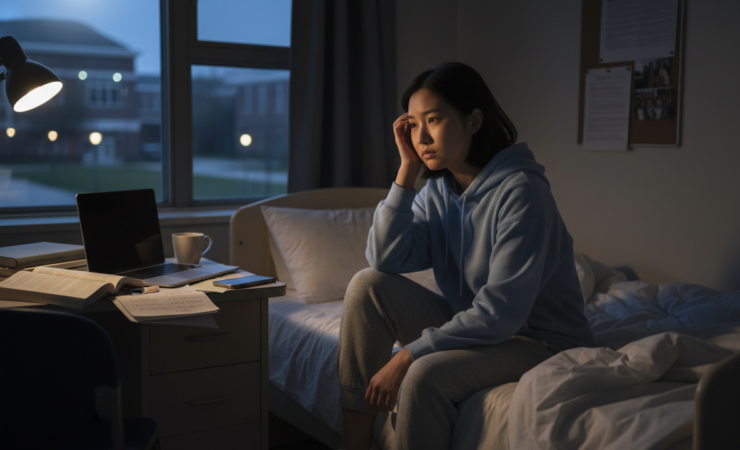
Sleep problems are common during the transition into university, when new routines, academic pressure and greater independence can disrupt habits that previously kept sleep relatively stable. A large study of first-year university students now adds another layer to that picture, finding that obsessive-compulsive symptoms were strongly associated with disturbed sleep and that anxiety and depression accounted for substantial indirect links between the two.
The research, published in Scientific Reports on 1 October 2026, analysed responses from 9,418 college freshmen aged 18 to 23. Rather than focusing on patients diagnosed with obsessive-compulsive disorder, the researchers studied obsessive-compulsive symptoms in a large nonclinical student population. That distinction matters because intrusive thoughts, checking behaviours and other symptoms can occur on a continuum even when they do not meet the threshold for a psychiatric diagnosis.
A large snapshot of students entering university
The participants had an average age of 19.60 years, with a standard deviation of 0.65 years, and 3,660 were female. They completed relevant subscales of the Chinese College Students’ Mental Health Screening Scale. The researchers examined obsessive-compulsive symptoms, sleep disturbance, anxiety, depression and problematic Internet use, while statistically adjusting their models for relevant covariates.
The main conditional-process analysis included 9,416 participants. This approach allowed the team to test not only whether obsessive-compulsive symptoms and sleep disturbance were associated, but also whether anxiety and depression statistically helped explain that relationship. The researchers additionally examined whether Internet addiction changed the strength of parts of the model.
The central association was clear. Higher obsessive-compulsive symptom scores were associated with greater sleep disturbance, with an unstandardised coefficient of 0.284. The result was highly statistically significant, with a t-value of 20.58, p below 0.001 and a 95% confidence interval from 0.257 to 0.311.
Anxiety and depression formed important statistical pathways
The analysis indicated that the relationship was not simply a direct one. Anxiety produced an indirect association estimated at 0.263, with a 95% bootstrap confidence interval from 0.232 to 0.293. Depression produced a separate indirect association of 0.098, with a confidence interval from 0.084 to 0.114.
A further serial pathway ran from obsessive-compulsive symptoms through anxiety and then depression before reaching sleep disturbance. That indirect estimate was 0.113, with a 95% bootstrap confidence interval from 0.098 to 0.130. Because each of these bootstrap intervals excluded zero, the statistical evidence supported all three indirect pathways in the researchers’ model.
These results point to a tightly connected cluster of symptoms rather than isolated problems. A student experiencing more intrusive or compulsive symptoms may also report more anxiety and depressive symptoms, which in turn are associated with poorer sleep. In practical terms, sleep complaints may therefore coexist with a broader pattern of psychological distress that is worth assessing rather than treating sleep as an entirely separate issue.
Why the findings matter for student support
The first year of university is an important period for identifying emerging difficulties because students are simultaneously adapting to new academic expectations, social environments and daily routines. A sample exceeding 9,400 students gives this study considerable statistical power and provides a detailed view of how several common mental-health and behavioural factors relate to one another at this stage.
The findings do not mean that obsessive-compulsive symptoms inevitably cause sleep disturbance. They do suggest that universities and health professionals may gain useful information by looking across symptom categories. Screening a student who presents with persistent sleep problems for anxiety, depression and obsessive-compulsive symptoms could reveal difficulties that would otherwise remain less visible.
Problematic Internet use is also relevant in this age group because digital activity can overlap with late-night wakefulness and psychological distress. The study incorporated Internet addiction into its conditional-process framework rather than assuming that all of the observed sleep relationship could be attributed to screen behaviour alone. This makes the model more informative, although it still cannot establish the direction in which these factors influence one another.
The study cannot prove cause and effect
The most important limitation is the cross-sectional design. All of the key variables were measured within the same broad assessment rather than tracked over time. As a result, the statistical mediation paths describe patterns in the data, not confirmed causal sequences. Poor sleep could worsen anxiety or obsessive-compulsive symptoms, psychological distress could disrupt sleep, or the relationships could operate in both directions.
The measures were also self-reported. Screening scales are useful for studying large populations, but they are not equivalent to clinical diagnoses or objective sleep measurements such as actigraphy or polysomnography. The participants were college freshmen in a specific cultural and educational context, so the size of the associations should not automatically be assumed to apply identically to students elsewhere.
Even with those limitations, the study provides unusually large-sample evidence that sleep disturbance among young adults can sit within a network of obsessive-compulsive, anxious and depressive symptoms. Longitudinal research will be needed to determine which changes tend to occur first and whether intervening on one part of the network produces meaningful improvements elsewhere.
Source Information
Study Title: Obsessive-compulsive symptoms and sleep disturbance in college freshmen: a cross-sectional conditional process analysis
Authors: Kaixiao Luo, Chang Li, Jiaojiao Huang, Lin Wang, Yuanxiang Liu, Chuanning Sun, Yanping Sun et al.
Journal: Scientific Reports
Year: 2026
DOI: 10.1038/s41598-026-74232-w