







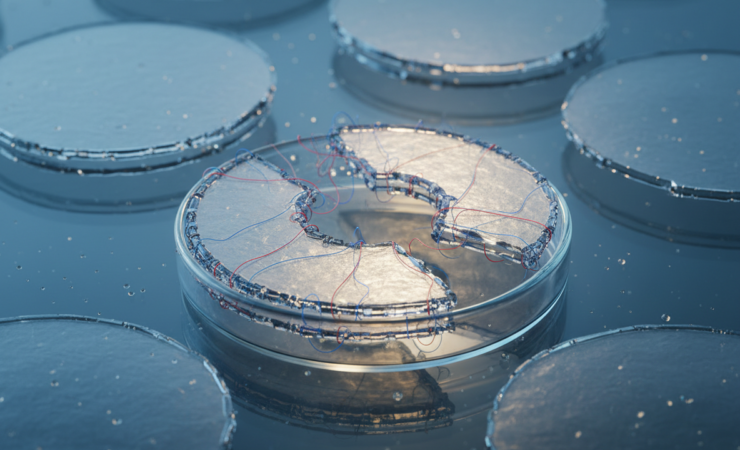
Materials that can change their internal architecture in response to a mild temperature shift could eventually support new approaches to responsive nanotechnology. A study published in Nature Communications on 3 October 2026 shows that the melting behaviour of polymer crystals can be used not merely as a property to measure, but as a practical control mechanism for reorganising two-dimensional nanostructures in solution.
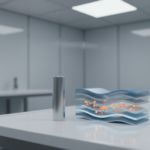
Emre Turan and Maria C. Arno at the University of Birmingham studied thin plate-like structures made using poly(ε-caprolactone), or PCL, through crystallization-driven self-assembly. By connecting platelet thickness to melting temperature, the researchers were able to design multilayer structures with different thermal stabilities. When heated to 37 °C, selected regions disassembled within minutes while more stable parts remained intact. Cooling then allowed released polymer chains to recrystallise within the surviving framework, producing reversible reconstruction and self-healing.
Turning melting into a design parameter
Crystallization-driven self-assembly is a method for building polymer nanostructures by exploiting the tendency of suitable polymer blocks to crystallise. Seeded living versions of the technique can provide unusually strong control over dimensions and morphology, including one-dimensional fibres and two-dimensional platelets.
The new work focuses on a less explored part of that process: how solution-grown polymer crystals melt. In bulk materials, melting temperature is often treated as a familiar physical property. At the nanoscale, however, the dimensions of a crystal can alter its thermal stability. Thin crystalline structures can melt at different temperatures from thicker ones because surfaces and finite crystal dimensions contribute more strongly to the system’s free energy.
Turan and Arno tested whether this relationship could be measured systematically in PCL platelets and then deliberately exploited to construct structures that respond in predictable ways to temperature.
Measuring thickness and melting together
The researchers produced two-dimensional PCL platelets using seeded living crystallization-driven self-assembly. They then used nano differential scanning calorimetry to examine their thermal transitions. This technique measures heat flow as a sample is heated or cooled and can reveal when crystalline material undergoes melting or recrystallisation.
The experiments established a quantitative relationship between platelet thickness and melting behaviour. The observed trend was consistent with Gibbs-Thomson theory, which predicts that melting temperature depends on crystal dimensions when crystals become sufficiently small. In practical terms, thicker and thinner lamellar regions did not have identical thermal stability.
That result mattered because it transformed a structural measurement into an engineering tool. If different platelet layers could be built with different thicknesses, their melting thresholds could also be separated. A temperature could then be selected that destabilised one region while leaving another sufficiently crystalline to preserve the larger architecture.
Selective disassembly at body temperature
The team used the thickness-melting relationship to engineer multilayer platelets containing programmed gradients in thermal stability. Heating these structures under mild conditions at 37 °C triggered rapid and selective disassembly. Less thermally stable material melted and was released while the more stable framework remained.
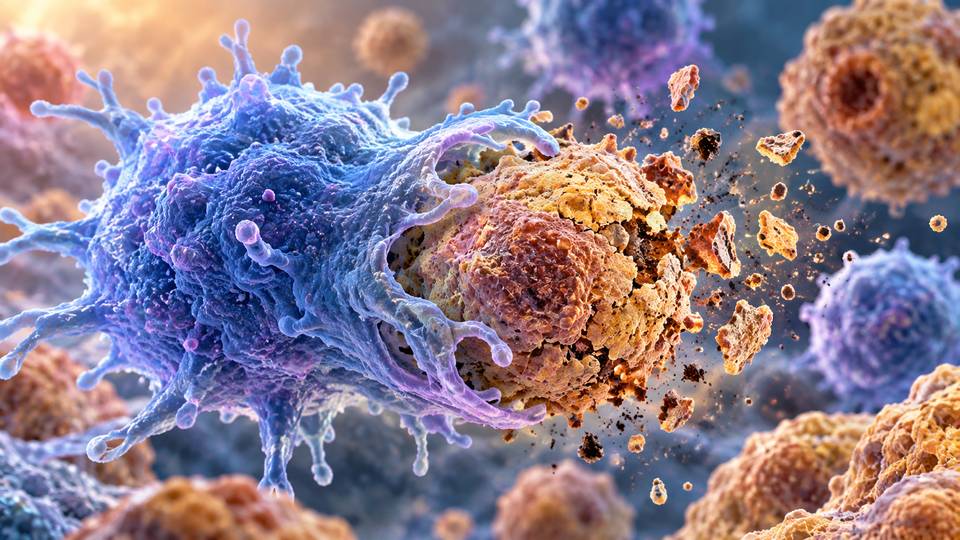
The transformation occurred within minutes and generated uniform hollow architectures. This is important conceptually because the researchers were not simply destroying a nanostructure with heat. The surviving crystalline regions acted as a spatial scaffold, determining where material was removed and retaining information about the original structure.
The use of 37 °C is also notable. It demonstrates that substantial nanoscale reconfiguration can be programmed under relatively mild thermal conditions rather than requiring extreme heating. The study does not, however, establish a biomedical application, and the similarity to human body temperature should not be interpreted as evidence that these platelets are ready for use in people.
Cooling reversed part of the transformation
After selective melting, the researchers lowered the temperature. The polymer chains that had been released during heating were then able to recrystallise. Crucially, this recrystallisation was spatially confined by the remaining platelet framework.
That confinement enabled the nanostructures to reconstruct rather than simply forming unrelated crystals elsewhere in solution. The process therefore provided a form of reversible reconfiguration and self-healing. A thermal cycle could remove selected crystalline regions and subsequently allow material to rebuild within the architecture.
The result highlights a broader distinction between responsive materials that merely change a measurable property and those whose physical organisation can be actively rewritten. Here, melting becomes a route for altering morphology, while recrystallisation provides a route back toward an organised state.
Why the finding matters
The study provides evidence that melting temperature can serve as both a diagnostic of nanoscale structure and an active design variable in crystallization-driven self-assembly. This adds another level of control to methods already capable of regulating platelet size and shape.
In principle, structures containing several regions with deliberately separated melting behaviour could support staged thermal responses. One region might reorganise at one temperature while another remains intact until a higher threshold is reached. The present study establishes the physical basis for such strategies rather than demonstrating a finished device.
The findings may also be relevant to the design of reconfigurable soft materials, nanostructured carriers and self-healing systems. Those possibilities remain prospective. Performance in a controlled solution experiment does not by itself establish stability, safety, manufacturability or useful function in complex biological or industrial environments.
Important limitations
This is a materials-science study centred on a specific polymer system and controlled laboratory conditions. The authors studied PCL-based platelets assembled through a particular seeded living crystallization-driven process. Other polymers, solvents, architectures and environmental conditions may produce different thickness-melting relationships or reconstruction behaviour.
The experiments demonstrate thermal disassembly and reconstruction, but they do not establish long-term durability over extensive repeated cycling, large-scale manufacturing performance or operation inside living organisms. The work should therefore be understood as a demonstration of a thermodynamic design principle rather than evidence for an immediately deployable technology.
Even with those constraints, the central advance is clear: nanoscale melting need not be treated only as the point at which an ordered polymer structure is lost. When crystal dimensions are deliberately controlled, melting and recrystallisation can become tools for programming how a material takes itself apart and how it builds itself again.
Source Information
Study: Turan, E. & Arno, M.C. “Thermally programmed disassembly and reconstruction of 2D polymer platelets via melting-governed crystallization-driven self-assembly.” Nature Communications (2026).
Published: 3 October 2026
DOI: 10.1038/s41467-026-77973-4