








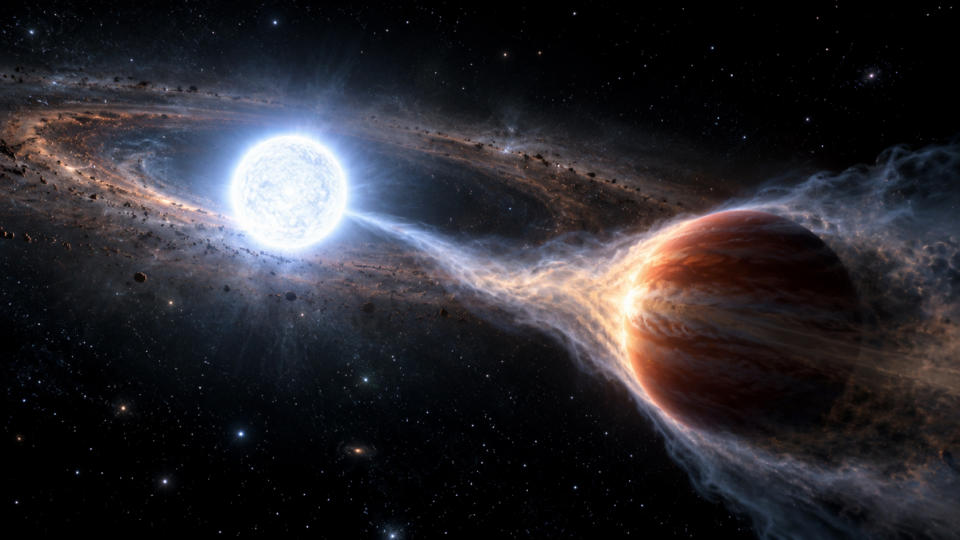
A white dwarf about five million years into its cooling life appears to be feeding on material from a planet unlike anything in our Solar System. The chemistry is so unusual that astronomers argue the companion may have formed only after its star died, creating a rare candidate for what is known as a second-generation planet.
The evidence comes from HS 0209+0832, a hot white dwarf with an effective temperature of about 35,800 K. Reanalysis of ultraviolet spectra revealed an atmosphere enriched in copper, zinc and especially niobium, while the familiar rock-forming elements silicon and iron are strongly depleted. Niobium is more than three orders of magnitude more abundant relative to calcium than in the Sun, and the inferred nickel-to-iron ratio exceeds 2.09, compared with roughly 0.05 in CI chondrites and the bulk Earth.
That chemical fingerprint does not resemble rocky debris, an icy body or any known Solar System material. Combined with helium that should rapidly sink out of the white dwarf’s atmosphere and a repeating 4.399-day brightness signal, the observations point instead to gas escaping from a highly irradiated giant planet candidate and falling onto the dead star.
The study, published in Nature Astronomy on 5 October 2026, matters because planets are normally thought of as survivors of stellar evolution. This system raises a more exotic possibility: some planets may be born after their host star has already shed its outer layers and become a white dwarf.
A dead star with a chemically strange atmosphere
White dwarfs are the compact remnants left when stars similar to the Sun exhaust their nuclear fuel and shed their outer layers. Their intense gravity rapidly pulls heavy elements below the visible atmosphere, which means metals detected at the surface usually require an external supply.
HS 0209+0832 has been puzzling astronomers for decades. A far-ultraviolet spectrum obtained in 1999 with the Hubble Space Telescope’s Space Telescope Imaging Spectrograph revealed carbon, aluminium, silicon, calcium, titanium, nickel and zinc, along with about 100 absorption lines that were not identified at the time. The star also contains helium despite being hot enough that helium should sink from its atmosphere on a timescale of months.
Jamie Williams, Boris Gänsicke and colleagues revisited those observations using archival data from Hubble, the Far Ultraviolet Spectroscopic Explorer and the UVES instrument on the Very Large Telescope. They also incorporated broadband photometry from Pan-STARRS, a Gaia parallax and time-series photometry from NASA’s TESS mission.
Atmosphere modelling gave an effective temperature of 35,800 ± 500 K, a surface gravity of log g = 7.90 ± 0.02 and a helium abundance of log(He/H) = -1.90 ± 0.20. The white dwarf has a cooling age of only about five million years, making it young by white-dwarf standards.
Old unidentified lines turned out to contain a major clue
The team generated grids of synthetic spectra and matched many of the previously unidentified ultraviolet features to copper and niobium. The niobium identification was particularly strong, drawing on five Nb III lines and 57 Nb IV lines.
To test how unusual that was, the researchers examined archival FUSE spectra from 33 other metal-enriched white dwarfs spanning temperatures from 20,000 K to 77,000 K. They found no corresponding niobium detections in that comparison sample.
Across HS 0209+0832, the team measured abundances for nine metals and calculated upper limits for another 15. They then accounted for an important complication in hot white dwarfs: radiation can support some elements against gravitational settling, a process called radiative levitation.
For calcium, titanium, nickel, copper, zinc and niobium, the modelling indicated that radiative support was negligible at the measured abundances. Those elements therefore provide a cleaner view of the material currently arriving at the star. Carbon, aluminium and silicon are more affected by radiative support, so their precise proportions in the incoming material are harder to infer.
The chemistry does not look like a destroyed rocky planet
Most polluted white dwarfs are understood as stars accreting the remains of asteroids or planetary bodies that were disrupted after being scattered inward. Those debris signatures often resemble rocky Solar System material.
HS 0209+0832 is different. Silicon and iron together account for about 48% of the bulk Earth’s mass, yet the researchers detected only trace silicon consistent with radiative support and no iron in the white dwarf’s atmosphere. Nickel, which normally tracks iron geochemically, is present at a dramatically different relative abundance. The inferred Ni/Fe ratio is greater than 2.09, compared with around 0.05 in both CI chondrites and the bulk Earth.
The strongest anomaly comes from elements heavier than iron. Niobium is enhanced by more than three orders of magnitude relative to calcium compared with solar abundances. Copper and zinc are also unusually prominent.
These are important clues because elements such as niobium can be produced by the slow neutron-capture process, or s-process, inside evolved giant stars. Material expelled late in a star’s life can therefore have a chemical signature very different from the protoplanetary disc from which its original planets formed.
A planet that may have formed after the star’s giant phase
The authors propose that the companion may be a second-generation giant planet. In this scenario, the progenitor star expanded during its asymptotic giant branch phase and interacted with a close companion. Ejected stellar-envelope material could have formed a new circumstellar disc enriched in s-process elements. A planet could then have formed from that processed material, rather than from the original disc that surrounded the young star billions of years earlier.
Another possibility is more complicated: an older first-generation sub-Neptune or super-Earth could have entered the newly formed disc and accumulated a second-generation atmosphere around an older core. Either route would create an object whose chemistry reflects the star’s late-life ejecta.
The evidence does not amount to a direct image of the planet. The object is therefore appropriately described as a candidate. But the chemical pattern is difficult to reconcile with ordinary rocky debris, and the presence of helium provides an additional clue that the star may be accreting an atmosphere rather than a solid body.
TESS detected a repeating 4.4-day signal
NASA’s TESS observations add an independent line of evidence. Across sectors 42, 43, 70 and 71, the researchers identified a sinusoidal brightness variation with a period of 4.399 ± 0.026 days and an amplitude of 0.120% ± 0.018%.
One interpretation is a phase curve from a close giant planet whose intensely heated day side and cooler night side rotate through view as it orbits the white dwarf. The researchers estimate that a planet producing the signal could orbit at roughly 0.04 astronomical units, within the approximately 0.02 to 0.07 AU range occupied by other known close-in white-dwarf planets.
There is another viable explanation. The signal could come from a comet-like tail of material streaming away from an evaporating planet. The white dwarf’s strong ultraviolet and X-ray radiation would strip gas from a nearby giant planet, providing a natural mechanism for delivering helium and metals onto the stellar surface.
The authors calculated an energy-limited evaporation rate of about 0.11 × 10¹³ g s-1 for a one-Jupiter-mass planet and 1.43 × 10¹³ g s-1 for a 13-Jupiter-mass object. Both exceed the measured metal accretion rate onto the white dwarf of more than 4.45 × 10⁸ g s-1.
That mismatch is not necessarily a problem. The measured stellar accretion rate excludes hydrogen, helium and undetected metals, while radiation pressure and orbital dynamics could eject much of the escaping atmosphere from the system before it reaches the star.
The white dwarf acts as a chemical detector
One of the most powerful aspects of polluted-white-dwarf research is that the star itself can reveal the composition of material too faint to study directly. Heavy elements sinking through the atmosphere effectively turn the white dwarf into a detector for whatever is currently falling onto it.
In this case, the researchers estimate a total accretion rate of about 4.3 × 10⁸ grams per second for the detected heavy material. Because gravitational sinking times can be as short as days for some elements, the unusual composition cannot simply be a fossil signature left in the atmosphere long ago. It requires continuing replenishment.
The absence of an infrared excess in earlier Spitzer observations also argues against a large, conventional fallback disc currently dominating the system. Meanwhile, the simultaneous enhancement of both zinc and niobium does not fit a simple scenario in which a post-AGB disc feeds the star sequentially according to condensation temperature.
Why second-generation planets would change the story of planetary systems
Planet formation is usually associated with young stars. Dust and gas in a protoplanetary disc collide, grow and eventually form planets during the early life of a stellar system. If HS 0209+0832 really hosts a planet assembled from material expelled during the death of its progenitor star, planet formation would not be confined to that first chapter.
It would mean that stellar death can, under some circumstances, create the raw material for another round of planet formation. Such planets would be chemically distinct because their building material had already passed through stellar nuclear processing.
The result also changes how astronomers might search for these systems. Instead of relying only on transits or infrared excesses, hot white dwarfs with unusually high carbon and strong s-process element enrichment could become chemical signposts for second-generation planets.
This is especially valuable because the system is difficult to observe directly. The candidate companion sits close to a very hot white dwarf, and the proposed planet is itself losing material. Atmospheric pollution can therefore reveal a system that conventional planet searches might struggle to characterise.
Important uncertainties remain
The planet has not been directly imaged, and the 4.399-day photometric signal is not unique to one physical explanation. A planetary day-night phase curve and an evaporating cometary tail can both produce periodic variability. Follow-up observations will be needed to determine which interpretation better fits the system.
There are also modelling uncertainties in hot white-dwarf atmospheres. Radiative levitation affects several detected elements, particularly carbon, aluminium and silicon, making their incoming mass fractions difficult to reconstruct. Thermohaline mixing could also alter the inferred accretion rate, but existing calculations do not extend cleanly to a white dwarf as hot as HS 0209+0832.
The proposed formation history is therefore not a complete reconstruction of the system. Several routes could potentially create the observed companion, including formation directly from an ejected envelope disc or the acquisition of a second-generation atmosphere by an older planetary core.
Most importantly, this is one unusual system. Demonstrating that second-generation planet formation is a meaningful population phenomenon will require finding more white dwarfs with the same combination of carbon enrichment and s-process elements.
A chemical signature of a planetary second act
HS 0209+0832 provides an unusually detailed example of how stellar archaeology can uncover planetary histories that are otherwise invisible. The star’s atmosphere contains metals that should sink away quickly, yet they are continuously replenished. Their proportions do not resemble the rocky or icy material seen around ordinary polluted white dwarfs.
The combination of extreme niobium enrichment, missing iron, accreted helium and a 4.4-day brightness cycle makes an evaporating giant planet a compelling candidate. The deeper implication is more striking: the material may have been processed inside the star itself before being expelled and assembled into a new planetary object.
If further observations confirm that interpretation, the system would show that the death of a star does not always mark the end of planet formation. Under the right conditions, it may provide the ingredients for a planetary second act.
Source Information
Study: Williams, J. T., Gänsicke, B. T., Stone, N. C. et al. “Discovery of a second-generation planet candidate accreting onto a white dwarf.”
Journal: Nature Astronomy.
Published: 5 October 2026.
DOI: 10.1038/s41550-026-02983-7
Study design: Reanalysis and modelling of archival Hubble/STIS, FUSE and VLT/UVES spectroscopy, combined with Pan-STARRS and Gaia measurements and TESS time-series photometry.
Key object: HS 0209+0832, a hot white dwarf with an effective temperature of 35,800 ± 500 K and a cooling age of about five million years.