








Europe could grow substantially more of its own soybeans without giving up as much maize production as conventional crop planning might suggest. The key, according to new modelling research, is to grow both crops in the same fields rather than always planting them separately.
A peer-reviewed study published in Nature Communications on 6 October 2026 estimates that maize-soybean intercropping could deliver the same combined output using approximately 20% to 21% less land than growing the two crops separately in the scenarios analysed. At a scale of 13.1 million hectares, the model projected 18.2 million tonnes of soybeans and 63.7 million tonnes of maize, equivalent to about half of the European Union’s soybean demand and three-quarters of its maize demand.
Those figures are projections, not harvests already achieved. Nevertheless, the analysis by Mathilde Chen, Nicolas Guilpart and David Makowski provides an unusually concrete estimate of what a familiar agricultural practice might accomplish if expanded across Europe.
Why Europe is looking for ways to grow more soybeans
Soybeans are an important source of protein and oil, particularly for livestock feed and food manufacturing. The European Union produces some soybeans domestically but relies on imported supplies to meet much of its demand. Maize is also an important crop for feed and other uses, so allocating substantially more land to soybeans can create competition with maize and with other crops.
Simply replacing maize fields with soybean fields therefore does not solve the broader land-use problem. The policy question is how to increase domestic soybean output while maintaining other agricultural production and avoiding unnecessary expansion of cultivated land.
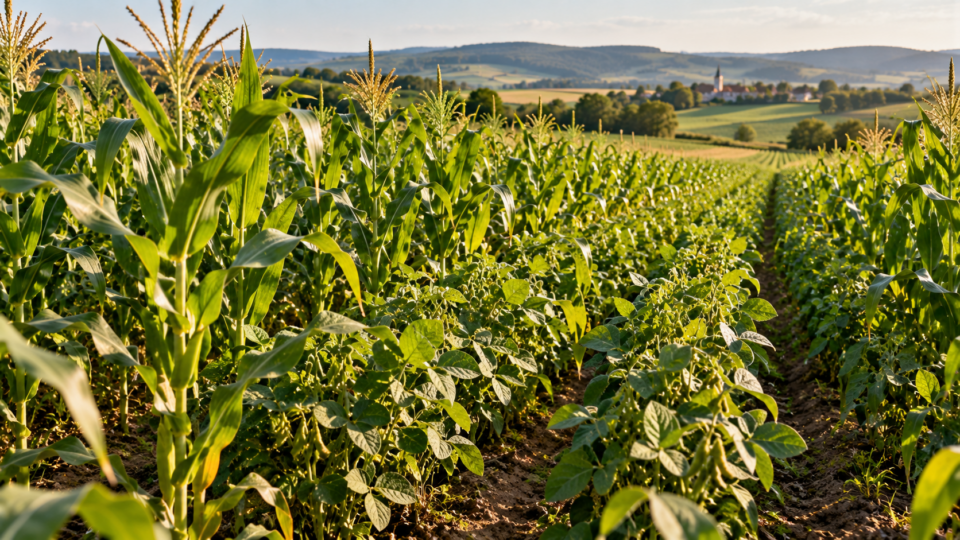
Intercropping offers a different approach. Farmers cultivate two species in the same field during overlapping growing periods. Maize grows tall and intercepts sunlight differently from the shorter soybean plant, while the two species can differ in how and when they use resources. Soybeans also belong to a plant family capable of forming relationships with nitrogen-fixing bacteria.
These differences create the possibility that a mixed field can produce more total crop output per hectare than the same crops grown separately. The crucial question is whether that advantage remains meaningful when scaled from field experiments to a continent with uneven climates, yields and land availability.
How the researchers modelled a continent-wide change
The team combined geographically varying estimates of potential maize and soybean yields with evidence about the relative performance of the crops when intercropped. They then modelled the amount and location of land required to reach different levels of European soybean self-sufficiency while continuing to produce maize.
A central measure was the partial land equivalent ratio, or partial LER. For each crop, this compares the yield produced on one hectare of intercropping with the yield that crop would produce on one hectare grown alone. Adding the partial ratios gives a combined measure of land-use efficiency.
For example, if one mixed hectare produces the equivalent of 0.56 hectares of sole-grown soybeans plus 0.79 hectares of sole-grown maize, the total land equivalent ratio is 1.35. That means the mixed hectare produces as much of the two crops together as 1.35 hectares of their respective sole-crop systems, under the assumed yield conditions.
This does not mean that soybean or maize individually yields more in the mixed field. Each crop can produce less than it would on a full hectare planted only with that crop. The advantage is in their combined production per unit of land.
The researchers tested several levels of soybean self-sufficiency and alternative assumptions about nitrogen fertilisation, overlap between growing periods and the relative yields of the two crops. A principal scenario assumed that maize-soybean intercropping returned to a given field once every four years, reflecting the importance of crop rotation rather than assuming continuous cultivation of the same mixture.
The analysis is a spatial modelling exercise informed by agronomic evidence. It is not a European-wide field trial, and the predicted output depends on the assumptions used to translate experimental yield relationships into large-scale production.
What 6.3, 13.1 and 20.1 million hectares could produce
The study’s headline scenarios illustrate how the trade-off changes as intercropping expands.
At 6.3 million hectares, the model projected 9.1 million tonnes of soybeans and 28.8 million tonnes of maize. Those quantities corresponded to approximately 25% of EU soybean demand and 34% of maize demand.
At 13.1 million hectares, projected output rose to 18.2 million tonnes of soybeans and 63.7 million tonnes of maize, covering approximately 50% of soybean demand and 75% of maize demand.
At 20.1 million hectares, the model estimated 27.2 million tonnes of soybeans alongside 99.0 million tonnes of maize. That would represent approximately 75% of soybean demand and 116% of maize demand.
The last percentage is especially important to interpret correctly. It does not mean that Europe’s maize demand would increase by 16%. It means that, in the model, maize output from the intercropping scenario alone would be equivalent to 116% of the reference level of EU maize demand.
These are alternative scenarios rather than three separate harvests to be added together. Their value is in showing how a strategy aimed at increasing soybean supply could also produce substantial maize instead of necessarily sacrificing it.
The estimated land saving was around one-fifth
To assess land efficiency, the researchers compared the intercropping scenarios with separate cultivation of maize and soybeans sufficient to deliver comparable combined production.
The resulting estimates suggested 20% to 21% land savings from intercropping under the modelled conditions. The study reports separate-crop land requirements of 11.1, 24.7 and 36.5 million hectares for the respective production comparisons, with the full modelling framework accounting for the associated crop allocation and rotation assumptions.
The essential result is not that a fifth of all European farmland could immediately be abandoned. Rather, the model indicates that producing a specified combination of maize and soybeans through intercropping could require roughly one-fifth less cultivated land than an equivalent separate-crop strategy under its assumptions.
Land that is not needed for those two crops could, in principle, remain available for other crops or different land uses. Whether any actual land would be restored to nature, planted with another crop or used more intensively is a separate policy and market question that the modelling does not resolve.
Could intercropping make Europe fully self-sufficient?
The researchers also considered much larger-scale adoption. Under their assumptions, intercropping on approximately 25 million hectares could reach as much as 91% soybean self-sufficiency and 145% maize self-sufficiency in the modelled scenarios.
Reaching the full reference level of soybean demand was more demanding. The authors estimated that more than 25 million hectares of annual intercropping could be needed, a scale representing a very substantial share of European cropland.
That distinction matters. Intercropping may sharply reduce import dependence without eliminating it. Complete self-sufficiency is not simply a matter of expanding a promising practice indefinitely, because land also supports wheat, barley, sunflower, vegetables and many other crops.
Crop rotation imposes another practical constraint. A field cannot necessarily support the same maize-soybean mixture every year without agronomic consequences. A continental strategy would therefore need enough suitable fields, rotation slots, equipment and farm-level incentives to make the projected annual area feasible.
Why the advantage depends on actual field performance
The study tested how sensitive its conclusions were to changes in fertiliser management and the timing of crop growth.
The overall advantage remained across a range of scenarios, but it was not unconditional. A key threshold was whether one hectare of intercropping produced more soybeans than half a hectare of sole-grown soybeans. If soybean performance fell below that level, the strategy’s capacity to increase soybean supply efficiently weakened.
There are biological reasons why the result might vary. A tall maize canopy can compete with soybeans for light. The crops can compete for water and nutrients. Planting density, row arrangement, sowing dates, harvest timing and local weather all affect whether the mixed system achieves useful complementarity or mainly creates competition.
Geographic differences are equally important. A field with excellent maize yields but poor soybean suitability is not automatically a good candidate for intercropping. The researchers therefore emphasise the need to account for the spatial distribution of yields when calculating land-use efficiency.
This is a more demanding test than simply assuming that a mixed crop works equally well everywhere. It is also a reminder that a continent-wide average can hide significant local winners and losers.
What the results mean for farmers and food policy
For policymakers, the analysis suggests that reducing dependence on imported soybeans may not require a one-for-one replacement of other productive crops. Mixed cropping could become one element of a broader food-security strategy that includes yield improvements, demand management, diversified sourcing and support for domestic protein crops.
For farmers, however, a higher combined yield is not the same as higher profit. Intercropping can complicate seed placement, fertiliser application, pest control, machinery use and harvesting. Two crops grown together may require different management and may mature at different times. Marketing and storage systems must also accommodate the resulting products.
A farmer will ultimately need to know whether the additional complexity pays after labour, machinery, inputs, crop prices and risk are considered. The study’s land-efficiency estimates are useful for policy design, but they do not constitute a farm-level business case for every European growing region.
There may also be ecological benefits beyond land efficiency, but these should not be assumed from the production figures alone. A separate recent Research Today analysis of biodiversity and ecosystem services examined how ecological diversity can support services such as food production and regulation. The new intercropping model is more specific: it estimates the production and land-use implications of combining two particular crops.
Important limitations behind the large numbers
First, the results are modelled potential. They do not show that European farmers have already achieved the predicted soybean and maize volumes. The model uses yield relationships and assumptions that may not hold equally across soil types, weather conditions and farm-management systems.
Second, partial land equivalent ratios summarise complex biological interactions. Real outcomes can change with cultivar choice, plant density, nitrogen input, drought, heat stress and the degree of overlap between the crops’ growing seasons.
Third, an efficient system for maize and soybeans is not automatically optimal for the entire agricultural economy. Expanding their cultivation can displace other crops, alter rotation options and affect feed markets, even if the two-crop comparison indicates a land saving.
Fourth, the model does not establish the cost of large-scale adoption or how quickly farmers could change equipment and practices. Economic incentives, extension support and suitable local trials would be necessary before the projected land savings could be treated as practical targets.
Finally, the article was released by the journal as an early peer-reviewed, citable version. The publisher notes that the text may undergo further editorial changes before the final Version of Record appears. Its central figures should therefore be attributed to the published study and read with the normal uncertainty surrounding modelling estimates.
A different way to think about European crop supply
The new research does not offer a simple prescription to plant maize and soybeans together everywhere. Its contribution is to show that the standard choice between growing more soybeans and preserving maize output may be too restrictive.
Under the modelled conditions, the same field can contribute meaningfully to both crops, with an estimated land-use advantage of roughly one-fifth over separate cultivation. At 13.1 million hectares, the projected harvest would cover half of EU soybean demand while producing maize equivalent to three-quarters of its demand.
Whether those gains can be realised will depend on field-level agronomy, local economics and the ability to fit intercropping into existing rotations. But the study gives European agriculture a testable proposition: better use of the same land may matter as much as choosing which single crop to grow on it.
Source Information
Study: Chen, M., Guilpart, N. & Makowski, D. “High potential contribution of intercropping to soybean and maize self-sufficiency in Europe.”
Journal: Nature Communications.
Published: 6 October 2026 (early peer-reviewed version).
DOI: 10.1038/s41467-026-78206-4.
Research approach: Spatial modelling of maize-soybean intercropping and separate-crop production across the European Union, using yield relationships, crop-area scenarios, rotation assumptions and sensitivity analyses to estimate potential crop self-sufficiency and land-use efficiency.
Original publication: Read the peer-reviewed study in Nature Communications.