

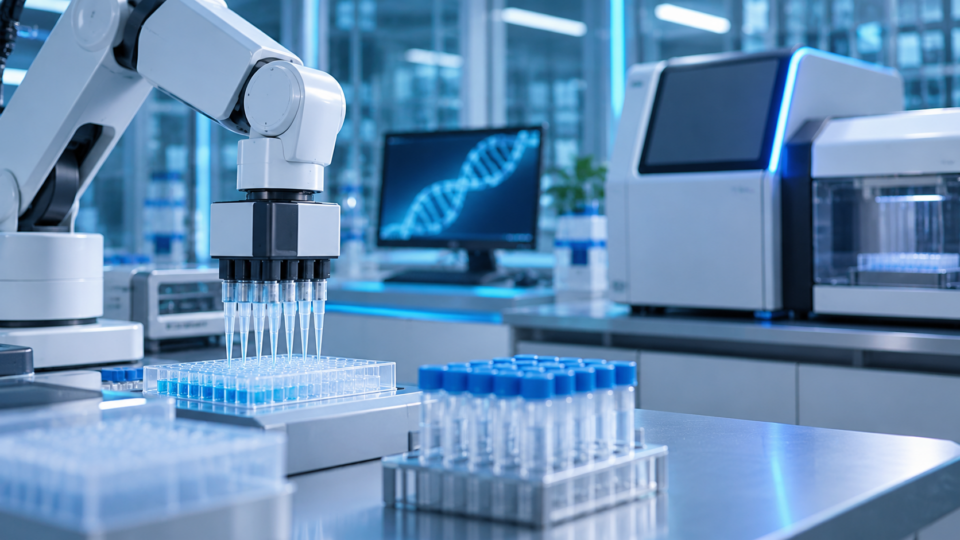
A laboratory that coordinates its own experiments
Scientific laboratories are filled with instruments that can perform individual tasks automatically, but a working experiment rarely consists of just one task.
Researchers prepare samples, move liquids, run reactions, check results, adjust protocols and maintain a chain of records.
Connecting those operations into a reliable sequence is much harder than automating a single pipette. A new study in Nature reports an artificial-intelligence-native biomolecular laboratory called AutoDNA that coordinated more than 20 kinds of instruments and executed more than 11,000 experimental steps.
The system was tested across four applications involving nucleic acids, including DNA synthesis, DNA data storage and mutation detection.
Its most striking contribution is not the claim that machines can replace scientists.
It is a demonstration that AI-based planning and laboratory automation can be integrated into a shared experimental environment with relatively little routine human intervention during operation.
The distinction matters because a successful demonstration in a specialised laboratory is not evidence that autonomous science is universally reliable or ready for every research setting.
Why laboratory automation remains difficult
Modern instruments already automate many repetitive processes. A sequencing machine reads genetic material, a liquid-handling robot dispenses solutions, and specialised devices control temperatures or amplify DNA.
But these tools often operate as separate islands.
Scientists still coordinate the sequence, translate a scientific goal into instrument instructions, and resolve dependencies between steps. A sample cannot be sequenced before it has been prepared; a reaction cannot be evaluated until the relevant output exists.
An end-to-end system must know what each instrument can do, what materials are available and how one operation changes the requirements for the next.
The researchers argue that earlier autonomous systems frequently targeted narrow, well-defined objectives, whereas real biomolecular workflows demand different instruments and sometimes competing goals.
AutoDNA was developed around this broader orchestration problem.
Its architecture sought to connect experimental planning with physical execution rather than merely attaching an AI assistant to an existing single-purpose machine.
How AutoDNA was evaluated
The research team described AutoDNA as an AI-native platform for biomolecular engineering.
It coordinated more than 20 instrument types across more than 11,000 operational steps.
The reported experiments covered synthesis, transcription, amplification and sequencing of nucleic acids.
The authors tested four representative applications, rather than claiming exhaustive performance across biology.
These applications were chosen to show whether the system could carry out complex sequences, coordinate concurrent protocols, handle digital information stored in DNA and support mutation detection.
Such demonstrations are useful engineering evidence, but they do not constitute a randomized comparison of every automated laboratory against every human-operated alternative.
The article reports particular tasks in a configured environment.
Its results should be read as performance within those workflows, not a general score for scientific intelligence or an estimate of the proportion of all laboratory work that can be automated.
DNA synthesis was one benchmark
One application evaluated enzymatic DNA synthesis. DNA synthesis is important because it provides material for genetic engineering, data storage and other experimental workflows.
The researchers reported that AutoDNA matched yields from an expert-optimized enzymatic DNA synthesis approach.
That comparison suggests the automated workflow could achieve a useful laboratory benchmark in the reported setting.
It does not show that the platform will match expert performance for every sequence, reagent combination, instrument configuration or quality requirement.
Yield is also only one dimension of performance.
Accuracy, repeatability, contamination control, reagent consumption and the cost of failed runs can all matter in production or clinical contexts. A practical evaluation therefore needs to look beyond a single successful outcome and consider whether the method remains dependable when inputs, operators and operating conditions change.
A measured speed advantage
The team also reported that concurrent protocol execution was accelerated by 3.2-fold.
This result speaks to one potential advantage of coordinating multiple instruments: activities that would otherwise wait for human scheduling or serial handoffs may be organised more efficiently.
The comparison was made within the authors’ reported experimental setup.
It should not be translated into a promise that every research project will finish three times faster.
Some experiments are limited by reaction time, biological growth, expensive materials or the need for human interpretation.
Other processes may already be highly optimized. A system that can schedule tasks efficiently may still face physical bottlenecks.
Nevertheless, the reported acceleration illustrates why end-to-end coordination can matter independently of improvements to any one instrument.
The engineering opportunity is often in the gaps between machines, not just in making an individual machine faster.
Storing information in DNA
Another demonstration completed an end-to-end DNA data-storage cycle and recovered the original digital content exactly. DNA data storage is a research approach in which digital information is encoded into sequences of nucleotides, written into physical DNA and subsequently read back.
The idea attracts interest because molecular media could offer unusual information density and potentially long storage lifetimes under suitable conditions.
But turning a digital file into molecules and recovering it again requires multiple operations and careful error handling.
The AutoDNA demonstration showed that its coordinated system could complete such a cycle in the reported experiment.
Exact recovery in one demonstration does not establish commercial viability, storage economics or universal error-free retrieval.
Those questions depend on many factors, including synthesis costs, reading accuracy, environmental stability and the handling of much larger datasets.
The result is best understood as evidence that the platform could integrate a technically demanding sequence of operations.
A clinically observed mutation as a test case
The fourth reported application identified and validated a KRAS G13D mutation that had been detected clinically. KRAS is a gene involved in cell signalling, and mutations in it can be relevant to cancer biology.
In this context, mutation detection provided a concrete test of whether a coordinated laboratory could move through a multi-step analytical workflow.
The authors reported successful identification and validation in their experimental system.
That does not make AutoDNA an approved clinical diagnostic platform, nor does it establish diagnostic sensitivity and specificity across a representative patient population.
Clinical deployment would require much more evidence, including rigorous validation, quality systems, traceability, safeguards and regulatory review where applicable.
The demonstration is scientifically interesting because it links autonomous workflow coordination to a biologically meaningful target.
It should not be mistaken for proof that an autonomous laboratory can independently diagnose patients.
What autonomy did and did not mean
The authors stated that human intervention was limited mainly to hardware maintenance tasks, such as replenishing reagents and labware.
This is a meaningful reduction in routine handling during the demonstrated workflows, but it is not the absence of human involvement.
Scientists still designed the research programme, built and configured the platform, selected evaluation tasks and interpreted the results.
Instruments also require calibration, consumables, repairs and safety oversight.
The phrase autonomous laboratory can sound as though an AI system invents hypotheses, decides which research questions matter and independently validates its conclusions.
AutoDNA’s reported achievement is narrower and more concrete: coordinated execution of biomolecular operations across instruments within a designed environment.
That distinction protects against overstating what the evidence shows while recognising the engineering complexity of the accomplishment.
Reliability is more than completing a sequence
A laboratory system must produce not only outputs but also evidence that those outputs can be trusted.
In biological research, contamination, sample swaps, reagent degradation and software configuration errors can undermine apparently successful experiments.
Connecting many instruments may reduce some manual handoffs while introducing new software and integration risks.
An error in a central planner could propagate across multiple devices.
Researchers therefore need clear audit trails, instrument-level checks, sample identity controls and safe recovery procedures.
The paper provides a demonstration of a functioning integrated platform, but the reported applications cannot settle every question about reliability under extended, unattended operation.
Independent replication across laboratories and more varied conditions would help establish whether the architecture is robust rather than merely impressive in the development environment.
Researchers must also distinguish technical task completion from scientific validity: an automated workflow can execute correctly while the underlying hypothesis or interpretation remains wrong.
The implications for research institutions
If systems like AutoDNA prove reliable, they could change how some laboratories allocate scarce time.
Researchers may spend less effort moving samples between instruments and more effort defining questions, reviewing evidence and designing controls.
Shared facilities might eventually offer standardized experimental workflows to multiple teams, making some sophisticated operations more accessible.
But adoption would bring trade-offs.
The initial equipment and integration costs may be substantial, and the platform may depend on specialist maintenance and software expertise.
Institutions would need policies for data security, accountability and handling failed or ambiguous runs.
The economics will differ sharply between well-funded facilities and smaller laboratories. A successful demonstration is therefore a starting point for procurement and governance discussions, not proof that all laboratories should immediately adopt autonomous infrastructure.
Why the comparison with AI software matters
Public discussion of artificial intelligence often focuses on systems that generate text or images.
Research Today has also examined how people respond to service robots in a very different setting, underscoring the importance of context when evaluating automated systems.
Physical laboratory automation presents a different challenge. A language model can propose a procedure almost instantly, but a real instrument must safely execute it, use the correct reagents and generate verifiable measurements.
In other words, fluent planning is not equivalent to successful experimentation.
AutoDNA illustrates a possible route toward connecting digital decisions with physical operations.
The team described co-designing models, experiments and instruments so the software could operate with awareness of the workflow as a whole.
That architecture is important, but its performance still depends on the quality of the underlying hardware, protocols and evaluation.
The most valuable future comparisons will measure reproducibility, failure rates, scientific throughput and total costs, rather than merely counting automated steps.
What remains to be established
The study was published on 4 November 2026 and describes four representative applications.
The next questions concern scale, generality and independent verification.
Can the platform transfer to a laboratory with different equipment?
How often does a run fail, and how quickly can the system recover without losing sample integrity?
Does the reported throughput advantage persist across more complicated or less predictable protocols?
Can independent groups reproduce the findings?
And what level of human review is necessary when an experiment may influence clinical or safety-critical decisions?
These questions do not diminish the reported accomplishment.
They define the evidence needed to move from an integrated demonstration to a dependable scientific service.
For now, AutoDNA provides a concrete example of how AI-based coordination might make biomolecular laboratories more capable, while leaving scientific judgement and accountability firmly in human hands.
Related Research Today coverage includes the use of genomic evidence to study endangered wildlife.
Source Information
Study title: An AI-native experimental laboratory for autonomous biomolecular operations
Authors: Mingyu Wu, Zhaoguo Wang, Jiabin Wang, Zhiyuan Dong, Jingkai Yang, Qingting Li, Tianyu Huang, Chi Zhang, Ping Song, Lei Zhao, Mingqiang Li, Xiaolei Zuo, Fei Wang, Chunhai Fan and Haibo Chen
Journal: Nature
Publication date: 4 November 2026
Study design: Experimental development and evaluation of an integrated autonomous biomolecular laboratory across four representative applications
Sample or scope: More than 20 instrument types and more than 11,000 operational steps; nucleic acid synthesis, transcription, amplification, sequencing, DNA data storage and mutation detection
Key finding: Matched expert-optimized enzymatic DNA synthesis yields, accelerated concurrent protocols 3.2-fold, recovered original DNA-stored digital content exactly and validated a KRAS G13D mutation