








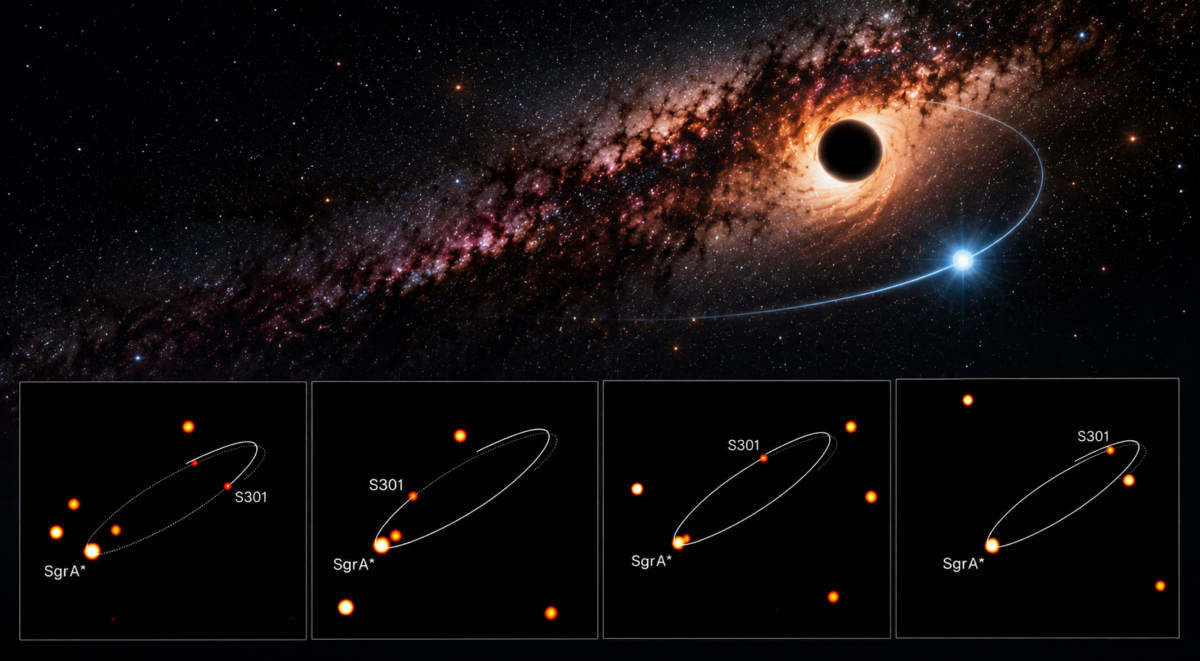
A newly identified star is travelling around the black hole at the centre of the Milky Way at speeds reaching 25,000 kilometres per second.
That is more than 90 million kilometres per hour, or over 8% of the speed of light.
Named S301, the star completes an orbit around Sagittarius A*, the supermassive black hole at the centre of our galaxy, every 8.7 years. At its closest point, it passes only about 1.7 billion kilometres from the black hole, making it the closest known star that astronomers can use to test its gravitational field.
But its speed is not the most important part of the discovery.
S301 may finally give astronomers something they have never had before: a practical way to directly measure how fast the Milky Way’s central black hole is spinning.
A star caught in an extreme orbit
Sagittarius A* sits approximately 26,000 light-years from Earth and contains about 4.3 million times the mass of the Sun.
Stars orbiting close to it have already become some of the most precise laboratories for testing Einstein’s theory of general relativity.
Astronomers have measured how the black hole’s enormous gravity changes stellar orbits, causes light to lose energy as it escapes and produces effects that cannot be explained using Newtonian gravity alone.
S301 takes this experiment considerably closer to the black hole.
Researchers from the GRAVITY+ Collaboration discovered the faint star in observations from the European Southern Observatory’s Very Large Telescope Interferometer in Chile. After identifying it in 2023, they traced it back through earlier observations and reconstructed its highly elongated orbit.
The result was unusual.
S301 travels from comparatively distant parts of its orbit to a closest approach of only around 11.5 times the distance between Earth and the Sun.
At that point, its speed rises to roughly 25,000 kilometres per second.
The black hole should drag space around with it
Black holes are surprisingly simple objects from the perspective of general relativity.
They can be described largely by their mass, electrical charge and spin.
Astronomers already know the mass of Sagittarius A* extremely precisely. Its spin is much harder to determine.
According to Einstein’s theory, a rotating black hole should not simply sit inside spacetime. Its rotation should drag the surrounding spacetime with it, an effect known as frame dragging or the Lense-Thirring effect.
Imagine stirring a spoon through thick liquid. Material close to the spoon is pulled around by its rotation.
The comparison is imperfect, but a spinning black hole does something conceptually similar to spacetime itself.
The problem is that the effect becomes weaker extremely quickly with distance.
Most stars orbiting Sagittarius A* simply do not get close enough for astronomers to measure it over a practical period.
S301 does.
It is 100 times more sensitive to the black hole’s gravity
At its closest approach, S301 is about 10 times closer to Sagittarius A* than the next nearest star considered useful for probing the black hole’s spin.
Because the relevant relativistic effects increase rapidly at smaller distances, researchers estimate that S301 is roughly 100 times more sensitive to the black hole’s gravitational field.
Its orbit should therefore change slightly depending on whether Sagittarius A* is spinning and in which direction.
The dominant relativistic effect already predicted for S301 is substantial. General relativity indicates that the closest point of its orbit should shift by approximately 1.9 degrees every revolution even if the black hole were not rotating.
Spin would add a much smaller additional shift.
For a maximally rotating black hole, the researchers calculate that the extra orbital change caused by frame dragging could reach around 0.11 degrees per orbit, depending on the orientation of the black hole’s spin relative to S301.
That sounds tiny.
At the centre of the galaxy, however, it could provide one of the clearest measurements yet of how a rotating black hole changes spacetime.
The decisive observations may come within a decade
The researchers have not measured Sagittarius A*’s spin using S301 yet.
The discovery is important because they now believe such a measurement may actually be possible.
Computer simulations using expected future observations suggest astronomers could become directly sensitive to the black hole’s spin within roughly the next decade. In favourable conditions, simulations indicate that its spin strength could eventually be constrained with an uncertainty below 0.2 on the dimensionless spin scale, while its orientation could be narrowed to roughly 30 degrees.
S301 is expected to make another close approach to Sagittarius A* around 2031, giving astronomers an especially valuable opportunity to watch the star as relativistic effects become strongest.
Future instruments will help.
The upgraded GRAVITY+ system and spectroscopy from the Extremely Large Telescope should allow astronomers to track the star with greater precision and measure motion that current instruments cannot yet resolve completely.
S301 may have lost a companion to the black hole
There is another mystery surrounding the star.
Its orbit is extremely elongated, suggesting S301 probably did not form in its current trajectory.
The researchers propose that it may once have belonged to a binary system containing two stars orbiting one another.
If that binary passed sufficiently close to Sagittarius A*, the black hole’s gravity could have torn it apart.
One star would have been thrown away at enormous speed while the other became trapped in a tight orbit around the black hole.
This process, known as the Hills mechanism, provides a plausible explanation for how S301 ended up where it is today.
A moving probe of spacetime
Black holes cannot be observed in the same way as ordinary stars because no light escapes from inside their event horizons.
Scientists therefore learn about them through what they do to the universe around them.
The Event Horizon Telescope gave humanity an image of the glowing material immediately surrounding Sagittarius A*. Stellar observations provide something different. They allow astronomers to use individual stars as test particles moving through the warped spacetime created by the black hole.
S301 is the most extreme example yet.
For a few moments during every orbit, an otherwise ordinary star moves through one of the strongest gravitational environments accessible to astronomers.
If its path changes in exactly the way Einstein’s theory predicts, scientists may be able to measure not only the mass of the object at the centre of our galaxy, but how that object is rotating through spacetime.
The fastest known star in the Milky Way may therefore become something much more useful than a record holder.
It could become a measuring instrument for the black hole our entire galaxy revolves around.
Source Information
Study Title: Discovery of a star sensitive to the spin of Sagittarius A*
Authors: K. Abd El Dayem, R. Abuter, N. Aimar et al., GRAVITY+ Collaboration
Journal: Nature
Published: 19 August 2026
DOI: 10.1038/s41586-026-10894-w