


A surprising pattern in planetary systems
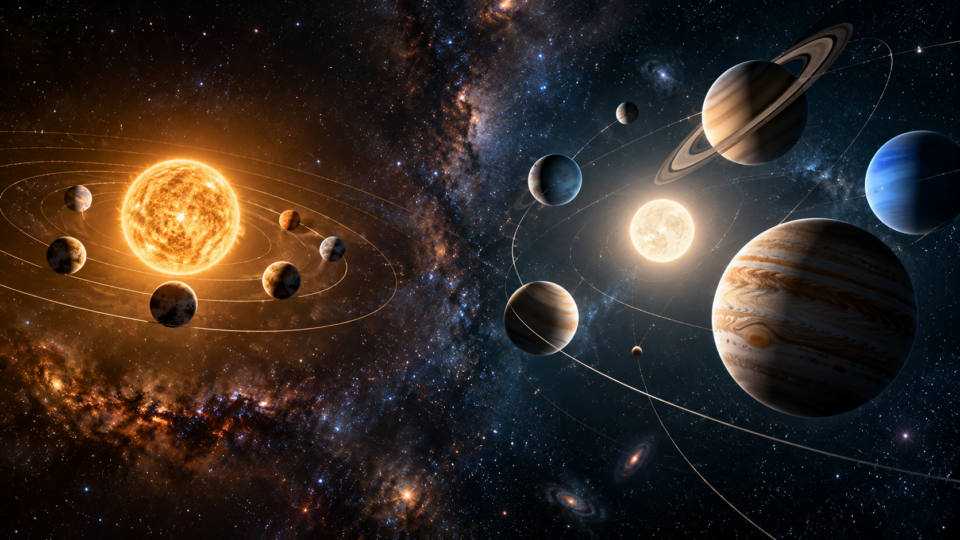
Astronomers studying planets beyond the Solar System have identified two broad families of multi-planet systems, suggesting that the properties of a star and its early planet-forming environment can influence the arrangement of planets billions of years later.
The findings were published in Nature Astronomy on 13 October 2026 by Diego Turrini, Camilla Danielski and colleagues. The research compares known planetary systems using measurements of planetary mass, orbital spacing and dynamical behaviour.
The team found a pronounced division between systems with relatively low total planetary mass and systems containing substantially more massive planets.
These families differ not only in how much mass their planets contain but also in the characteristics of their host stars and the apparent violence of their orbital histories.
The study does not claim that every planetary system belongs neatly to one of two rigid categories. Instead, it identifies statistically distinct populations within the systems astronomers can currently measure.
Why planetary architecture matters
Our Solar System has a familiar arrangement: smaller rocky planets orbit closer to the Sun, while giant planets occupy more distant orbits.
However, the thousands of exoplanets discovered around other stars reveal a much wider range of configurations.
Some systems contain several planets packed into orbits much closer to their star than Mercury is to the Sun. Others contain giant planets with dramatically different orbital periods and masses.
A planetary system’s architecture describes the arrangement of these worlds, including their masses, spacing, orbital shapes and number.
Those properties offer clues to how planets formed and how their orbits changed afterward.
A system may begin with planets growing within a disk of gas and dust, then evolve through gravitational interactions, migration and occasional collisions.
Understanding the relationship between formation and later evolution is central to explaining why our Solar System looks different from many discovered systems.
How the team analysed the data
The researchers used archived observations of known multi-planet systems and examined four independently defined samples.
Planetary measurements were obtained from the NASA Exoplanet Archive, while a complementary stellar catalogue provided more consistently measured properties for selected host stars.
The researchers developed metrics designed to compare systems with different architectures without assuming in advance that one arrangement was the standard.
These metrics included the distribution of mass among planets, orbital spacing, the extent of the system and a measure of orbital dynamical excitation.
Statistical tests were used to assess whether the observed division into two families could be explained as a single underlying population.
The team also used dynamical simulations to investigate how different starting conditions might produce the observed patterns.
Because the study combines archived measurements with modelling, it reconstructs plausible histories rather than directly observing planetary systems over billions of years.
The approach is valuable because human observations cover only a tiny fraction of the timescales over which planetary orbits evolve.
The lower-mass family
One identified family consists of systems with relatively low combined planetary mass, commonly orbiting stars with masses comparable to or below that of the Sun.
These systems often contain planets with broadly similar masses arranged in relatively tight configurations.
The pattern is related to what astronomers call ‘peas in a pod’, a description of neighbouring planets that resemble one another in size.
Such systems can emerge when planets migrate through their original disks while growing, producing compact arrangements of worlds.
The study reports that systems containing more than two planets account for as much as 45% of the lower-mass family in the analysed samples.
That does not mean every low-mass system is stable or that its planets all follow perfectly circular orbits.
Rather, the group tends to be less dynamically excited than the high-mass family, suggesting a comparatively less violent average history.
The authors also note that the typical dynamical excitation of this family is comparable to that of the Solar System under their chosen measure.
The high-mass family
The second family contains systems with larger combined planetary masses and different orbital histories.
These systems are more commonly associated with stars at or above the Sun’s mass and with environments richer in heavy elements, often described by astronomers as metal-rich.
In astronomy, ‘metals’ refers to elements heavier than hydrogen and helium, not only familiar metallic materials.
Metal-rich planet-forming disks can provide more solid material from which planetary cores may grow.
The researchers find that high-mass systems are substantially more dynamically excited, by roughly an order of magnitude relative to the lower-mass family and the Solar System.
This excitation is consistent with stronger gravitational interactions, including the possibility that planets scattered one another into altered orbits.
Some systems may have experienced close encounters, collisions or the ejection of planets, although the study does not directly document those events for every system.
The high-mass family also contains a greater proportion of systems with only two detected planets, a pattern compatible with histories that removed or rearranged companions.
What it means for planets to be dynamically excited
Orbital excitation describes how strongly a system’s planetary orbits depart from a comparatively orderly configuration.
Planets moving in circular, similarly aligned orbits have a different dynamical structure from planets with elongated or significantly tilted paths.
The researchers use a measure called normalized angular momentum deficit to help quantify these differences.
That measure relates the actual angular momentum of the system to a reference arrangement with circular, coplanar orbits.
A greater deficit can indicate stronger orbital eccentricities or inclinations, although interpretation depends on the measured planets and their uncertainties.
This is not a direct measure of how often collisions occur today.
Instead, it offers a clue about the cumulative effects of gravitational interactions and possible instabilities over a system’s history.
The contrast between the two families is important because it connects present-day planetary arrangements with their likely formation and evolutionary pathways.
The host star provides clues
The study suggests that a planetary system’s architecture is linked to the mass and chemical composition of its host star.
Stars and planets form from related reservoirs of gas and dust, so their properties are not independent.
A more massive or metal-rich star may have formed within a disk containing a different quantity of planet-building material.
Those starting conditions can affect how rapidly planetary cores grow and how strongly planets interact with surrounding gas.
The researchers describe the environments associated with the high-mass family as having, on average, about three times more gas and solids under their planet-building-mass metric.
This figure describes a modelled comparison of formation environments, not a direct weighing of every ancient disk.
The finding reinforces the idea that stellar characteristics can preserve information about the processes that shaped their planets.
It also cautions against treating the Sun as a universal template for how all planetary systems form.
How simulations help reconstruct the past
Computer simulations allow astronomers to explore what happens when multiple planets interact gravitationally over long periods.
Researchers can vary the starting masses, orbital spacing and dynamical conditions, then compare the simulated outcomes with real observations.
In this study, the authors used simulations to test whether the high excitation of massive systems could arise from early instabilities.
Systems born with massive planets and unstable configurations can undergo scattering that substantially changes their orbits.
That provides a plausible route toward some of the observed high-mass architectures.
However, several formation pathways can sometimes produce similar present-day outcomes.
Simulations therefore support an interpretation rather than supplying a unique historical record for each observed planetary system.
Future observations may help distinguish among competing evolutionary scenarios.
A major challenge: detection bias
The authors emphasise that the catalogue of known exoplanets is shaped by what telescopes can detect.
Transit surveys favour planets that pass in front of their stars from Earth’s viewpoint, particularly those with relatively short orbital periods.
Radial-velocity measurements detect the gravitational wobble of stars and can be especially sensitive to more massive planets.
At large orbital distances, small planets are difficult to detect using current methods.
Consequently, a system with several known planets may still contain additional worlds that have escaped detection.
The study uses multiple independently selected samples and statistical tests to investigate whether the two-family pattern persists despite these limitations.
The consistency across samples strengthens the result, but it does not eliminate all selection effects.
The observed families should therefore be understood as patterns in current data rather than a final census of every planetary system in the Milky Way.
Does this change the search for habitable planets?
The research may eventually help astronomers decide which stellar environments and planetary architectures deserve closer investigation.
Long-term orbital stability can matter for a planet’s climate and the persistence of conditions potentially suitable for life.
Strong gravitational interactions can alter orbital distances and eccentricities, affecting the energy a planet receives from its star.
However, the study does not measure life, biological activity or the habitability of specific worlds.
A dynamically excited system is not automatically incapable of hosting a habitable planet, and a compact low-mass system is not automatically habitable.
Atmospheric composition, stellar radiation, water availability and many other factors also matter.
The value of the new work is in improving the broader context within which astronomers interpret individual planet discoveries.
It provides a statistical framework for asking how a system’s formation history may influence the environments its planets experience.
Where our Solar System fits
Our Solar System provides an unusually detailed example because astronomers can measure its planets and smaller bodies directly.
Yet its architecture does not represent the full diversity of systems found around other stars.
The study compares the Solar System with the detected exoplanet families and finds that many observed systems are more compact in their planetary spacing.
Both identified families also contain substantial fractions of systems with more excited orbits than those of our planets.
The Solar System’s position in these comparisons is informative, but it is not proof that our planetary neighbourhood is exceptionally rare.
Present detection methods undersample distant, relatively small planets resembling some members of our Solar System.
As observations improve, astronomers may discover more systems with architectures that are currently difficult to recognise.
The authors argue that the properties of host stars and the diversity of planetary formation environments should be considered together.
What the study cannot tell us yet
The two families are statistical groupings, not a law that forces every planetary system into one fixed evolutionary destiny.
The analysis depends on systems with sufficiently reliable measurements of planetary masses and orbital properties.
Undetected planets and measurement uncertainties can affect reconstructed architectures.
The dynamical simulations demonstrate possible routes to the observed patterns but cannot uniquely establish the history of any individual system.
The researchers also exclude certain complicated stellar configurations from their samples to reduce potential biases.
These choices improve comparability while limiting how directly the conclusions apply to every kind of planetary system.
More complete exoplanet surveys, longer observational baselines and improved measurements of stellar composition will be needed to test the result further.
Future discoveries could refine the boundaries between the two families or reveal additional subgroups.
Why the discovery matters
The study offers a new way to understand the diversity of planetary systems without assuming that the Solar System is the normal starting point.
By combining planetary masses, orbital structures, stellar properties and simulations, the researchers identify evidence for two broad evolutionary families.
One tends toward lower planetary masses and comparatively orderly compact configurations. The other contains more massive planets and shows signs of stronger gravitational reshaping.
The connection to host-star characteristics suggests that the seeds of these differences are planted early in planetary formation.
At the same time, the systems’ present-day arrangements reflect later interactions that may have dramatically altered their original structure.
The research does not close the debate over how planets form. Instead, it gives astronomers a more systematic way to investigate that question as the catalogue of discovered worlds continues to grow.
Source Information
Study: Two families of multi-planet systems with distinct architectures and stellar hosts
Authors: Diego Turrini, Camilla Danielski, Danae Polychroni and colleagues.
Journal: Nature Astronomy
Published: 13 October 2026
Methods: Statistical analysis of four samples of known multi-planet systems using NASA Exoplanet Archive observations, stellar data and dynamical simulations.