







When did Earth stop being repeatedly reset by impacts and become chemically stable enough for the earliest forms of life to persist? A new modelling study places that transition remarkably early in the planet’s history. Rather than treating the Hadean Earth as uniformly hostile, the researchers reconstructed how impact bombardment, crustal cooling and hydrothermal environments changed through time, then asked when the building blocks associated with a hypothetical RNA World could remain stable.
The analysis points to a critical interval after about 4.4 billion years ago. By roughly 4.33 billion years ago, the modelled near-surface environment had shifted from an impact-dominated thermal regime towards conditions in which persistent biochemistry became increasingly plausible. That timing overlaps with recent molecular-clock estimates for the Last Universal Common Ancestor, or LUCA, which place it between about 4.09 and 4.33 billion years ago.
Reconstructing an Earth that left almost no rocks behind
Direct evidence from the Hadean eon is exceptionally scarce because Earth’s crust has been repeatedly reworked. The researchers therefore approached the problem indirectly. They used an established three-dimensional numerical bombardment model to simulate the thermal effects of late accretion between 4.5 and 3.5 billion years ago, spanning one billion years of early Earth history.
The baseline simulations used a high-end late-accretion mass equivalent to 0.57% of Earth’s present mass, while additional runs tested delivered masses from 0.13% to 0.57%. The model incorporated changing impact rates and velocities and calculated how impact heating altered the crust through time. It also considered both a pre-formed crust and an initial global magma-ocean scenario.
To test whether the simulated thermal history was geologically credible, predicted zircon ages were compared with the Hadean zircon record from Jack Hills in Western Australia. This matters because those zircons provide one of the few surviving windows into conditions on the very early Earth.
The early crust was repeatedly heated, but the danger declined quickly
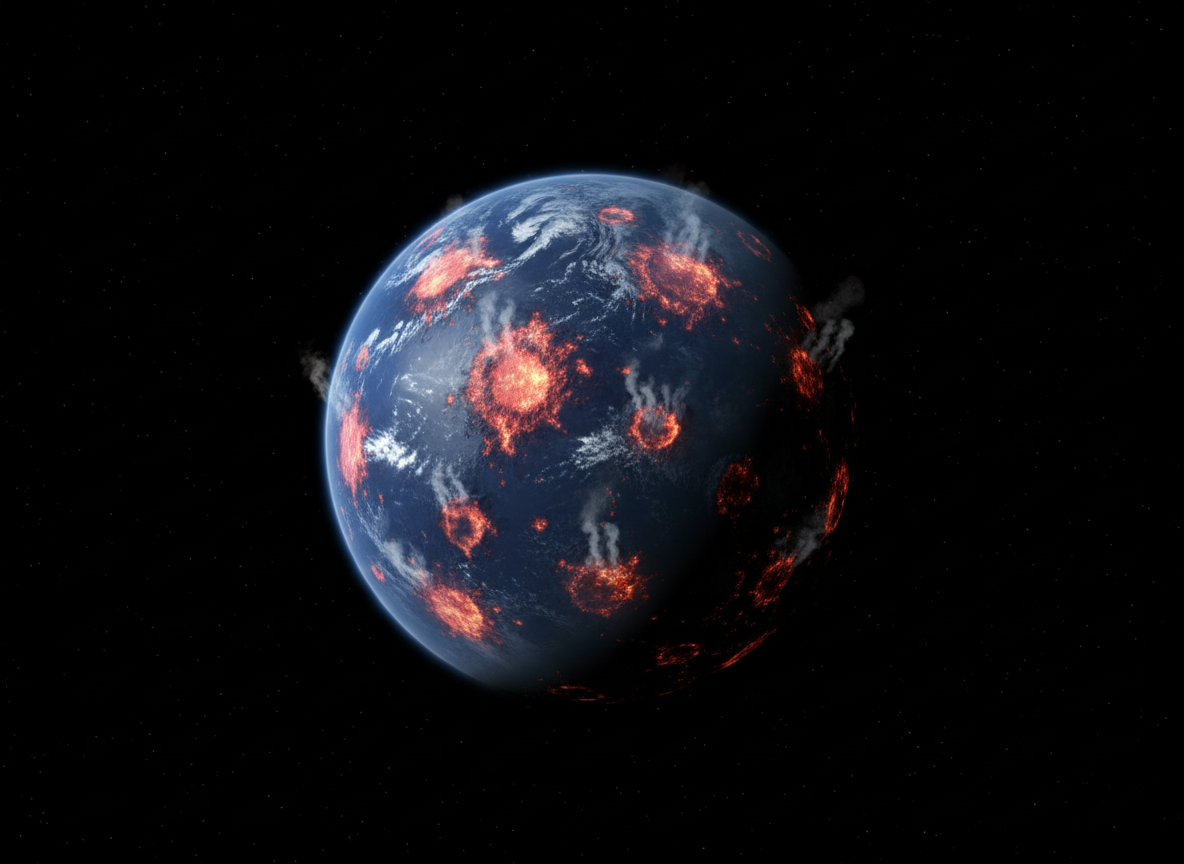
The simulations show why the earliest part of the Hadean would have been difficult terrain for persistent prebiotic chemistry. Depending on the assumed delivered mass, approximately 75% to almost 100% of the lithosphere experienced melting at some point during the simulated bombardment. The fraction molten at any one time ranged from roughly 30% to 70%, with impact-induced melting peaking near 4.47 billion years ago.
The geothermal signal was similarly extreme. The mean geothermal gradient in the upper four kilometres of crust approached 300 degrees Celsius per kilometre near 4.47 billion years ago. It fell to about 210 degrees Celsius per kilometre by 4.4 billion years ago, about 120 degrees Celsius per kilometre by 4.3 billion years ago, and approached a 70 degrees Celsius per kilometre baseline by around 4.1 billion years ago.
Those numbers make the proposed 4.33-billion-year transition easier to understand. It is not a claim that life suddenly appeared on a particular date. Instead, it marks a change in the physical background against which prebiotic chemistry would have had to operate. By that stage, the authors argue, the crust was moving away from a thermal regime controlled primarily by repeated impacts.
Small refuges became persistent environments
The team then translated the thermal model into a question about biochemical persistence. They examined the upper 300 metres of crust and tracked regions that remained below temperature thresholds relevant to biomolecule stability. One particularly important measure was the volume that never again exceeded 110 degrees Celsius after cooling.
That never-sterilized volume remained effectively absent until after about 4.4 billion years ago. It then expanded rapidly and exceeded 50% of the modelled crust by about 4.25 billion years ago. Using a more conservative threshold of 60 degrees Celsius for maintaining the stability of molecular systems relevant to an RNA World, the model likewise found that suitable crustal volume rose substantially only after 4.4 billion years ago.
This distinction is important. A location being cool at one instant is not enough for an origin-of-life scenario. Chemical systems need time to accumulate, interact and persist. The study therefore focuses not only on whether habitable temperatures existed, but whether environments could remain compatible with fragile biomolecules without being repeatedly sterilized by subsequent heating.
Impacts may have created opportunities as well as hazards
The modelling also complicates the idea that bombardment was simply destructive. Large impacts generated hydrothermal systems, potentially creating chemically active environments with strong energy gradients. The modelled hydrothermal volume peaked around 4.4 billion years ago, while the abundance of distinct hydrothermal clusters peaked around 4.3 billion years ago before gradually declining.
In other words, the same impact history that initially made Earth hostile may later have produced numerous localized environments in which prebiotic reactions could proceed. The useful window emerges when impacts had become infrequent enough to stop globally resetting the system but remained capable of producing hydrothermal niches.
The estimated frequency of globally sterilizing impacts illustrates that shift. The model allowed roughly six to seven ocean-vaporizing impacts per 10-million-year interval between 4.5 and 4.48 billion years ago. After about 4.43 billion years ago, the estimated threat fell to only zero or one such event per 10-million-year interval. Across 4.5 to 4.29 billion years ago, the adopted bombardment chronology implied about 40 potential global sterilization events.
Why 4.33 billion years matters
The researchers identify approximately 4.33 billion years ago as an optimal point for the emergence and persistence of an RNA World. At this stage the mean geothermal gradient had fallen to less than twice its equilibrium value, persistent biocompatible environments were expanding, and hydrothermal settings capable of supplying energy and chemical gradients remained widespread.
The timing is also notable because it reaches back much further than the oldest widely accepted evidence for life in the rock record. Yet it is not inconsistent with biological estimates. Molecular-clock analyses cited by the researchers place LUCA between approximately 4.09 and 4.33 billion years ago. If those estimates are broadly correct, an RNA-dominated precursor system would need to predate or overlap the earliest part of that interval.
The study therefore offers a possible bridge between planetary history and molecular evolution. A rapidly cooling Earth could have become persistently biocompatible soon enough for substantial biochemical evolution to occur before the surviving geological record begins.
What the model cannot tell us
The result should not be interpreted as direct evidence that an RNA World existed precisely 4.33 billion years ago. This is a numerical reconstruction of environmental opportunity, not a fossil or geochemical detection of early organisms. The model identifies when temperatures and hydrothermal settings could plausibly support persistent prebiotic chemistry under its assumptions.
Several uncertainties remain. Earth’s exact late-accretion history is reconstructed rather than directly observed, and different impact chronologies or delivered masses change details of the thermal evolution. The global model also does not explicitly simulate hydrothermal fluid circulation. Local permeability can either prolong or shorten hydrothermal heating, meaning the calculated hydrothermal volumes are best understood as first-order indicators rather than exact maps of ancient habitats.
The analysis also concentrates on thermal stability. Temperature is essential, but the origin of life additionally depends on chemical inventories, reaction pathways, concentrations, water activity, atmospheric composition and many other factors. A thermally suitable environment is therefore necessary in many origin-of-life scenarios, but it is not proof that abiogenesis occurred there.
A narrower window for one of science’s oldest questions
The value of the study lies in turning a broad question into a more constrained planetary timeline. The simulations suggest that Earth’s earliest period of extreme impact heating was comparatively brief on geological timescales. Persistent mild environments appeared after about 4.4 billion years ago, while hydrothermal niches remained abundant enough to offer chemically dynamic settings.
That does not solve the origin-of-life problem. It does, however, narrow the period in which experimental chemists, geochemists and evolutionary biologists might reasonably place key transitions. It also suggests that the Hadean should not be viewed simply as a billion-year inferno. Within roughly 150 to 200 million years of the Moon-forming impact, parts of Earth may already have offered sustained environments in which complex prebiotic chemistry could survive.
Source Information
Study: A Hadean timeline for the emergence of the RNA World
Authors: Oleg Abramov, Anna Medvegy, Barbara Kremer and colleagues
Journal: Nature Communications
Published: 22 September 2026
Article number: 9790, volume 17
Study type: Three-dimensional numerical modelling of early Earth thermal evolution and biomolecular stability
Access: Open access