




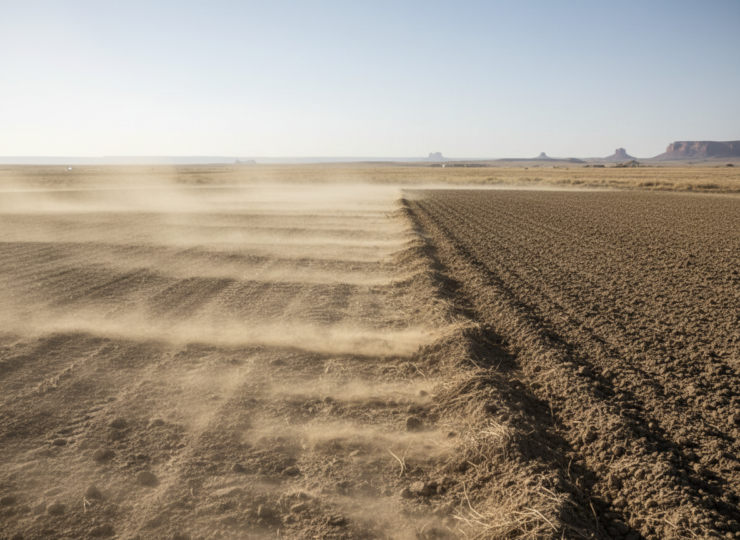
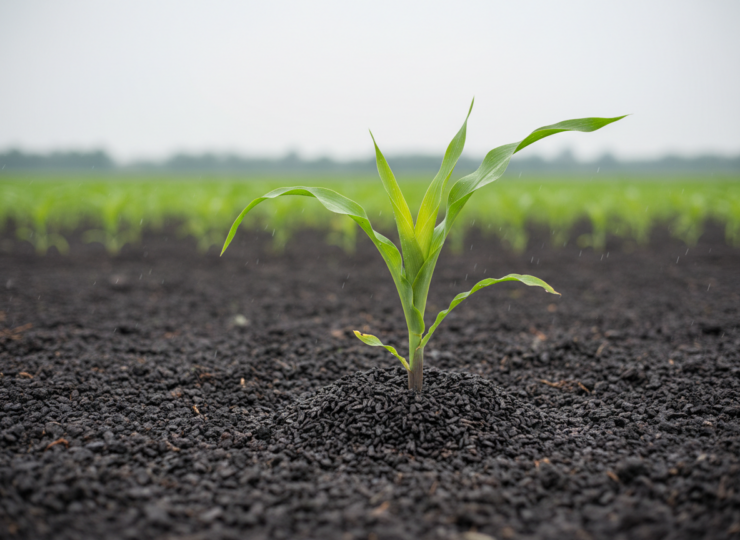

Wind erosion can strip exposed soil from agricultural and dryland surfaces in minutes, but the severity of that loss depends on a complicated interaction between wind speed, the size of soil aggregates and the stability of the surface itself. A new controlled experiment suggests that very small additions of nano-clay can substantially change that balance.
Researchers Abdirashid Ali Wehliye and Sema Kaplan, from Erciyes University in Türkiye, tested nano-clay treatments in a wind tunnel across three aggregate sizes and three wind speeds. At the highest application rate, 3.75 grams per square metre, soil loss fell by 80.8% in 2 mm aggregates, 93.2% in 1 mm aggregates and 95.9% in 0.5 mm aggregates compared with untreated soil.
The findings, published in Scientific Reports on 27 September 2026, point to a potentially powerful erosion-control mechanism under controlled conditions. They also show why the result should not yet be read as a ready-made field prescription. The experiment took place in a wind tunnel, not across working farms or natural landscapes, where rainfall, repeated drying and wetting, vegetation, tillage and longer-term soil chemistry can all change performance.
Testing the problem one variable at a time
The study was designed around three factors that can strongly influence wind erosion. The researchers used soil aggregate sizes of 0.5, 1.0 and 2.0 mm, wind speeds of 8, 10 and 12 metres per second, and nano-clay application rates of 0, 0.94, 1.88 and 3.75 grams per square metre.
This factorial structure matters because a treatment that works at a modest wind speed or on relatively stable aggregates may offer little protection when conditions become more erosive. Fine particles and aggregates are generally easier for wind to mobilise, while increasing wind speed can sharply increase the energy available to detach and transport soil.
Rather than reporting only an average treatment effect, the experiment therefore asked whether nano-clay protection persisted across combinations of aggregate size and wind intensity. The answer was consistently positive within the tested range: nano-clay significantly reduced wind-induced soil loss across all aggregate sizes and wind-speed conditions.
Protection became strongest where erosion pressure was greatest
The largest reductions appeared at the highest nano-clay dose. For the coarsest 2 mm aggregates, the 3.75 g/m² treatment reduced soil loss by 80.8%. For 1 mm aggregates, the reduction reached 93.2%. For the finest 0.5 mm aggregates, it reached 95.9%.
That gradient is notable. The treatment did not merely protect the easiest soil fraction to stabilise. Its relative protective effect was particularly pronounced in fine aggregates and at high wind speeds, the conditions under which untreated soil can be especially vulnerable.
The absolute amount of soil saved will still depend on how much erosion would otherwise occur. A 90% reduction in a controlled tray does not automatically translate into a 90% reduction in annual field-scale erosion. What the experiment establishes more directly is that, within its defined physical system, increasing the nano-clay dose strongly altered the soil-loss response to wind.
Machine learning tested whether the pattern could be predicted
The researchers added a second layer to the experiment by modelling soil loss with machine-learning methods. This allowed them to ask whether the combination of nano-clay dose, wind speed and aggregate size contained enough information to predict erosion outcomes, including nonlinear relationships that a simple linear model might miss.
XGBoost produced the strongest development-stage performance under repeated nested group-aware cross-validation. Its mean coefficient of determination was R² = 0.835 ± 0.064, with a root mean squared error of 11.896 ± 2.229 and a mean absolute error of 6.686 ± 0.854.
The model was selected before being evaluated on an independent group-held-out test set. On that holdout, XGBoost achieved R² = 0.882, RMSE = 13.298 and MAE = 9.443. In practical terms, the model captured a large share of the variation in the experimental soil-loss measurements, although the error statistics also make clear that prediction was not perfect.
The study also compared this performance with a linear baseline. The weaker linear result suggested that soil loss was not adequately described as a simple additive relationship in which each extra unit of wind speed or treatment produced the same change everywhere. That makes physical sense: erosion thresholds and interactions can create abrupt changes rather than smooth straight-line responses.
Explainable AI pointed first to the nano-clay dose
Machine-learning accuracy alone does not reveal which variables are driving a model’s predictions. The researchers therefore used SHAP analysis, an explainable-AI method that estimates how strongly each input contributes to individual predictions.
Nano-clay dose made the largest mean absolute contribution to the fitted model predictions. Wind speed ranked next, followed by aggregate size. This ordering is consistent with the experimental result that changing the treatment rate produced large shifts in soil loss, while wind intensity and particle structure continued to shape the underlying erosion risk.
That does not mean the model has discovered a universal hierarchy for wind erosion. Feature importance is conditional on the variables and ranges included in a particular dataset. Moisture, surface roughness, vegetation, organic matter and many other field variables were not represented in the same way they would be across real landscapes.
Why a very small application rate could matter
The highest tested dose, 3.75 g/m², is small in mass terms. The practical appeal of a clay-based surface treatment is therefore easy to see: if a low material loading can increase the resistance of exposed soil to wind, it could potentially complement existing erosion controls in places where vegetation cover is temporarily sparse.
But the environmental and agronomic case depends on more than immediate erosion reduction. A field treatment would also need to remain effective for a useful period, avoid harming infiltration or seed emergence, withstand rainfall and agricultural traffic, remain economically viable at scale and avoid unwanted ecological effects. Those questions are outside what a controlled wind-tunnel experiment can establish.
The distinction is especially important for nanomaterials. The word “nano” describes a size scale, not an automatic environmental benefit. Any future application would need material-specific assessment of persistence, transport and interactions with soil organisms and water systems.
A strong laboratory signal, not yet a field solution
The strength of this study lies in its controlled comparison across multiple erosion conditions. By varying treatment dose, aggregate size and wind speed, the researchers could show that the protective pattern was not confined to one convenient test condition. The independent holdout evaluation of the machine-learning model also reduces the risk of judging prediction quality only on data used during model development.
Its central limitation is equally clear. Wind tunnels simplify the environment. Natural soils contain mixed aggregate distributions, changing moisture, crusts, roots and residues. Field winds fluctuate in direction and turbulence, while repeated weather events can change a treatment over time. The study therefore supports efficacy under controlled experimental conditions, not yet effectiveness across farms, rangelands or deserts.
Future work will need to test whether the large relative reductions survive those complications. Field trials could also establish how frequently treatment would need to be reapplied, whether performance differs by soil mineralogy and texture, and how costs compare with established measures such as residue retention, windbreaks and vegetation cover.
What the study adds
The headline result is unusually large: up to 95.9% less soil loss at the highest tested nano-clay rate. Yet the more informative finding is the consistency of protection across the experiment. Even as wind speed and aggregate size changed, nano-clay remained associated with lower soil loss, and the explainable machine-learning analysis independently identified treatment dose as the most influential model input.
For soil conservation research, that makes nano-clay a candidate worth testing beyond the tunnel. Whether it becomes a practical erosion-control tool will depend on what happens when the clean experimental signal meets the much messier conditions of real land.
Source Information
Study: Wehliye, A.A. & Kaplan, S. “Nano clay mitigation of wind induced soil loss across aggregate sizes through wind tunnel experiments and explainable machine learning.”
Journal: Scientific Reports
Published: 27 September 2026
DOI: 10.1038/s41598-026-73412-y
Study type: Controlled wind-tunnel experiment with machine-learning and explainable-AI modelling
Key scope: Nano-clay rates of 0, 0.94, 1.88 and 3.75 g/m² tested across 0.5, 1.0 and 2.0 mm soil aggregates at wind speeds of 8, 10 and 12 m/s.