







Methane-producing archaea occupy some of the most consequential microbial niches on Earth. They live in wetlands, animal digestive systems, engineered bioreactors and the human gut, yet one of their most basic structures has remained surprisingly difficult to resolve: the protective cell wall that surrounds many methanogens.
A new study published in Nature has now identified an enzyme that gives researchers a way into that wall. The enzyme, called ArmA, does more than provide a new laboratory tool. By using it to dismantle archaeal peptidoglycan piece by piece, the researchers uncovered a previously undescribed sugar and a molecular architecture that conflicts with the model used for roughly half a century.
A cell wall that resisted conventional tools
Peptidoglycan is best known as a defining component of bacterial cell walls and as the target of important antimicrobial strategies. Most archaea do not have conventional bacterial peptidoglycan. However, members of a major methanogenic lineage possess a related material historically called pseudomurein, or archaeal peptidoglycan.
The problem has been methodological. Enzymes routinely used to cut bacterial peptidoglycan do not provide the same access to the archaeal version. Without a dedicated molecular tool, researchers have had limited ability to break the polymer into fragments that can be chemically analysed and linked back to cellular function.
Robert Smith, Nika Pende and colleagues approached that problem by searching for an archaeal enzyme capable of digesting the wall itself. Their work centred initially on Methanobrevibacter smithii, a prominent methanogen in the human gut microbiome.
ArmA cuts both major components of the wall
The researchers identified and characterised ArmA as the first glycosyl hydrolase shown to be specific for archaeal peptidoglycan. Biochemical digestion experiments demonstrated an unusual dual activity. ArmA can cleave glycosidic bonds in the carbohydrate backbone while also cutting peptide crosslinks that help hold the wall together.
That combination matters because the enzyme effectively opened the polymer for detailed structural analysis. The team purified archaeal peptidoglycan, subjected it to enzymatic digestion and analysed the resulting material using techniques including liquid chromatography, mass spectrometry and nuclear magnetic resonance spectroscopy. Protein and sequence analyses were then combined with microscopy and genetic experiments to determine where ArmA occurs and what it does in living methanogens.
The experiments were not limited to a single analytical readout. For example, lytic activity experiments tested 50 micrograms and 100 micrograms of ArmA over four hours, with experiments repeated independently and in triplicate. The researchers also examined ArmA homologues across diverse peptidoglycan-walled archaea and tested activity in multiple methanogens.
The chemistry did not match the textbook model
Once the wall could be digested cleanly, its architecture looked different from the prevailing description. The glycan backbone contained N-acetylglucosamine or N-acetylgalactosamine connected to a previously undescribed sugar. The researchers named the new molecule N-acetylarmosamine.
The team also found that the glycan strands alternate between beta(1,4) and beta(1,3) linkages. The stem peptide, meanwhile, is attached through an amide bond to the succinyl group of N-acetylarmosamine. Together, these observations require a substantial revision of the molecular model that has framed archaeal peptidoglycan since structural work conducted in the late 1970s and early 1980s.
This is an important distinction. The study is not simply adding another enzyme to a catalogue of archaeal proteins. ArmA made it possible to observe chemistry that had previously been inaccessible, and that chemistry changed the interpretation of the structure itself.
The enzyme is also part of cell division
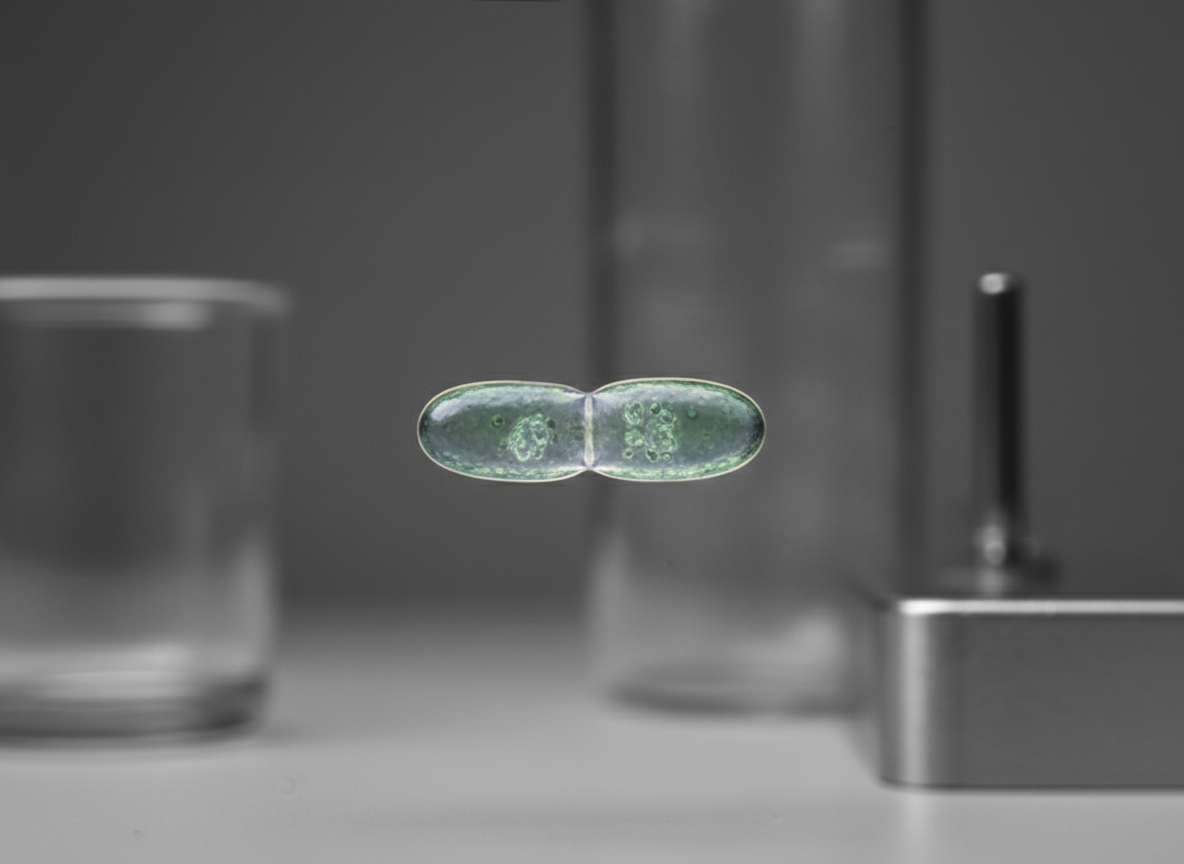
The researchers then moved from purified material back to intact cells. Imaging showed ArmA localising at the division plane, where a methanogen must remodel its rigid wall as one cell separates into two.
Genetic experiments in Methanothermobacter thermautotrophicus strengthened the functional case. A strain lacking the armA gene showed a cell-division defect, demonstrating that the enzyme is required for cells to complete cytokinesis normally. In other words, ArmA is not merely capable of digesting archaeal peptidoglycan in a test tube. Methanogens use it as part of their own wall-remodelling machinery.
Phylogenetic analysis added another layer. ArmA homologues were restricted to archaea that possess this type of peptidoglycan wall, and the researchers confirmed enzyme activity across diverse methanogens. That distribution is consistent with a specialised biological role rather than a broadly acting cell-wall enzyme.
Why a better methanogen tool matters
Methanogens attract attention because their biology connects several otherwise separate research areas. In agriculture, rumen methanogens contribute to methane emissions from livestock. In environmental systems, methanogenesis is a major component of the global carbon cycle. In humans, methanogenic archaea form part of the gastrointestinal microbiome. They are also used and studied in biotechnology.
A molecule that selectively acts on the cell wall of peptidoglycan-bearing methanogens could therefore become useful well beyond structural microbiology. The immediate contribution is a research tool comparable in principle to the muramidases that transformed the study of bacterial cell walls. Longer term, selective interference with methanogen wall biology could inform strategies aimed at manipulating archaeal populations in agricultural, industrial or medical settings.
Those applications remain prospective. The study establishes the enzyme’s biochemical specificity and biological function, but it does not demonstrate a ready-made methane mitigation treatment or a human therapy. Moving from an enzyme that works experimentally to a safe and effective intervention in an animal, ecosystem or patient would require substantial additional research.
What the study cannot yet tell us
The work is mechanistic and laboratory based. Its strength lies in detailed molecular characterisation, genetic manipulation and microscopy rather than population-scale or clinical evidence. The researchers studied representative methanogens, but archaeal diversity is enormous, so the findings should not be generalised to archaea that lack this wall architecture.
The intervention implications also need careful separation from the core finding. Showing that ArmA can lyse relevant cells and that deleting armA disrupts cytokinesis identifies a biological vulnerability. It does not establish the dose, delivery route, ecological consequences or durability that would be required for practical control of methanogens.
There is also a declared translational interest. Part of the work has been included in patent applications covering the use of ArmA to regulate archaeal methanogen populations in industrial, agricultural and medical settings. The authors disclosed this in the paper, while the other authors reported no competing interests.
A new starting point for archaeal cell-wall research
The central advance is unusually foundational. Researchers now have an enzyme that can selectively dismantle archaeal peptidoglycan, a revised chemical model of that wall, a newly identified sugar and direct evidence that the same enzyme participates in cell division.
That combination turns a difficult-to-study structure into an experimentally accessible system. The most consequential applications may take years to emerge, but the immediate effect is clearer: a 50-year-old model of methanogen cell-wall architecture now has to be rewritten.
Source Information
Study: Smith, R., Pende, N., Rifflet, A. et al. A methanogen hydrolase reveals the structure of archaeal peptidoglycan.
Journal: Nature
Published: 23 September 2026
DOI: 10.1038/s41586-026-11028-y
Research focus: Archaeal cell-wall structure, methanogen biology and the ArmA hydrolase.