









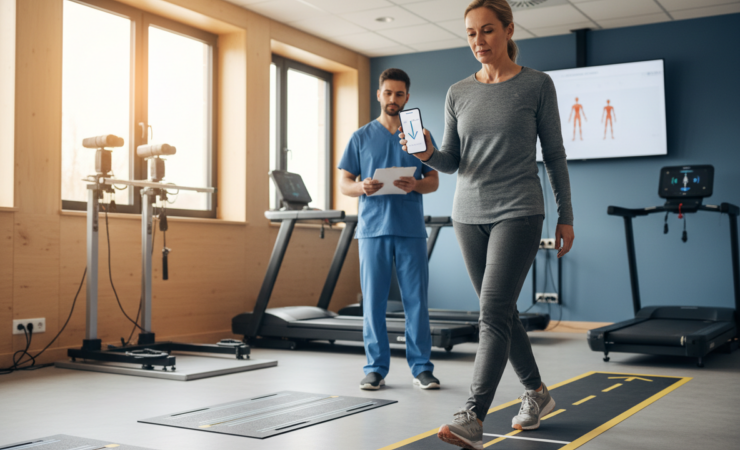
Falls are a persistent challenge for people living with multiple sclerosis, particularly when everyday movement is combined with distraction, decision-making or other cognitive demands. A newly peer-reviewed study suggests that a mobile prompt delivered at the right moment can produce immediate changes in two movement patterns linked to stability, although the researchers have not yet shown that the approach actually prevents falls.
The research, published in Scientific Reports on 2 October 2026, tested a prototype Just in Time Fall Prevention app in 14 ambulatory adults with multiple sclerosis. Participants completed repeated Timed Up-and-Go tests under cognitive load across two laboratory visits while researchers measured trunk flexion during the transition from sitting to standing and stance width during walking.
Those two measures matter because maintaining stability is partly a question of controlling the body’s centre of mass over its base of support. A wider stance can increase the lateral base available during walking, while trunk position during a sit-to-stand transition influences how the centre of mass is managed as the body moves from a stable seated position into motion.
A prompt produced measurable changes within the task
The intervention was deliberately simple. Rather than putting participants through a lengthy rehabilitation programme, the app displayed targeted visual feedback intended to change a specific movement at the point of choice. One prompt targeted trunk flexion during sit-to-stand movements, while another targeted stance width during gait.
The researchers analysed the repeated measurements using linear mixed-effects models and applied Dunnett’s correction when comparing prompt conditions with baseline. The sit-to-stand prompt reduced trunk flexion by 7.1 degrees relative to the control condition. The adjusted result was statistically significant at p<0.001, with a Cohen’s d of -0.483, indicating a moderate-sized immediate response in the context of this small experimental sample.
The gait prompt also changed behaviour. Participants increased their stance width by 8.1 millimetres compared with control. The adjusted p-value was 0.021 and the reported effect size was smaller, with Cohen’s d of 0.259. The estimated 95% confidence interval for the gait-prompt effect extended from roughly 2.0 to 14.1 millimetres.
Importantly, the prompts were movement-specific. The gait prompt did not significantly reproduce the targeted sit-to-stand change, and the sit-to-stand prompt did not produce a statistically significant change in stance width after correction. That pattern strengthens the interpretation that participants were responding to the particular instruction rather than simply changing their movement because they knew they were being observed.
Why real-time feedback could matter
Multiple sclerosis can affect sensory processing, motor control, fatigue and balance in ways that make fall prevention difficult. Traditional rehabilitation can teach strategies in a clinic, but real life rarely presents stability challenges in a controlled sequence. People stand up while thinking about something else, walk while talking, turn around obstacles and divide their attention between movement and the environment.
The study was designed around that gap. Participants performed the Timed Up-and-Go task under cognitive load, creating a simplified laboratory version of the dual-task demands that occur outside the clinic. The longer-term idea is that mobile technology could recognise an appropriate moment and provide a concise prompt that encourages a protective movement strategy when it is actually needed.
That concept is different from continuously instructing someone how to move. A just-in-time system would ideally intervene selectively, reducing the burden of constant monitoring while reinforcing a useful adjustment at a meaningful point in an activity.
Participants were broadly receptive to the app
The researchers also asked participants how willing they would be to use the technology. Acceptance was high, but medical endorsement made a noticeable difference. Ninety-five percent indicated willingness to use the app if it were prescribed by a physician, compared with 68% without a prescription.
Trust followed a similar pattern. All participants indicated trust in the app’s recommendations under the physician-prescribed scenario, while 84% expressed trust without prescription. For a future digital-health intervention, that difference is important. Technical effectiveness alone may not determine adoption. Integration with clinical care and confidence in the source of the recommendation may shape whether people are prepared to use the system consistently.
The findings also illustrate why an app should not be treated as an autonomous substitute for rehabilitation or medical guidance. The movement strategy appropriate for one person may not be suitable for another, particularly in a condition as heterogeneous as multiple sclerosis. A clinically integrated system could potentially allow recommendations to be personalised and reviewed rather than delivered as generic advice.
The study did not test whether falls were prevented
The strongest limitation is also the most important distinction for interpreting the results. The experiment measured immediate biomechanical changes, not actual fall rates. A participant widening their stance by several millimetres or changing trunk flexion in a laboratory task does not establish that the same prompt will prevent a fall at home, at work or outdoors.
The sample was also very small. Only 14 ambulatory people with multiple sclerosis participated, and they completed structured tests across two visits. That design is useful for detecting whether a targeted response can occur, but it cannot establish effectiveness across the much wider spectrum of mobility impairment, disease severity and day-to-day variability found in the broader MS population.
The researchers further note that the increase in stance width had a small effect size. People with multiple sclerosis may already use a wider stance as a compensatory strategy, potentially limiting how much additional widening a prompt can produce. A movement change also needs to be evaluated for comfort, energy demand and unintended effects before it can be assumed to be beneficial over repeated use.
There is another technological step between this experiment and a deployable prevention tool. The prompts in the study were delivered through a realistic mobile interface in a controlled setting. A practical just-in-time system would need to determine when a risky movement or context is occurring, decide whether an intervention is warranted and deliver feedback without becoming distracting itself.
A proof of responsiveness rather than proof of prevention
For now, the value of the experiment lies in showing that targeted mobile feedback can alter specific movement behaviour in people with multiple sclerosis even while they are performing a cognitively demanding mobility task. The changes were immediate, statistically measurable and aligned with the movement targeted by each prompt.
That is a narrower conclusion than saying an app can prevent falls, but it is an important prerequisite. A digital intervention cannot improve stability through a targeted movement strategy if users cannot or will not respond to the prompt when it appears. This study provides early evidence that such responsiveness is possible.
The next question is whether the same principle survives outside the laboratory. Larger and longer studies will need to test real-world prompting, adherence, personalisation, safety and, ultimately, whether meaningful outcomes such as near-falls and falls themselves are reduced. Until then, the work is best viewed as a promising demonstration of how mobile health could extend rehabilitation principles into the moments when people actually move through daily life.
Source Information
Study Title: Point of choice visual feedback prompts elicit motor behavior changes in persons with multiple sclerosis
Authors: Samantha R. Fox, David C. Jangraw, Guido Mascia, Reed D. Gurchiek, Yuanyuan Feng, Brett M. Meyer, Andrew J. Solomon, Ellen W. McGinnis and Ryan S. McGinnis
Journal: Scientific Reports
Year: 2026
Published: 2 October 2026
DOI: 10.1038/s41598-026-74255-3