







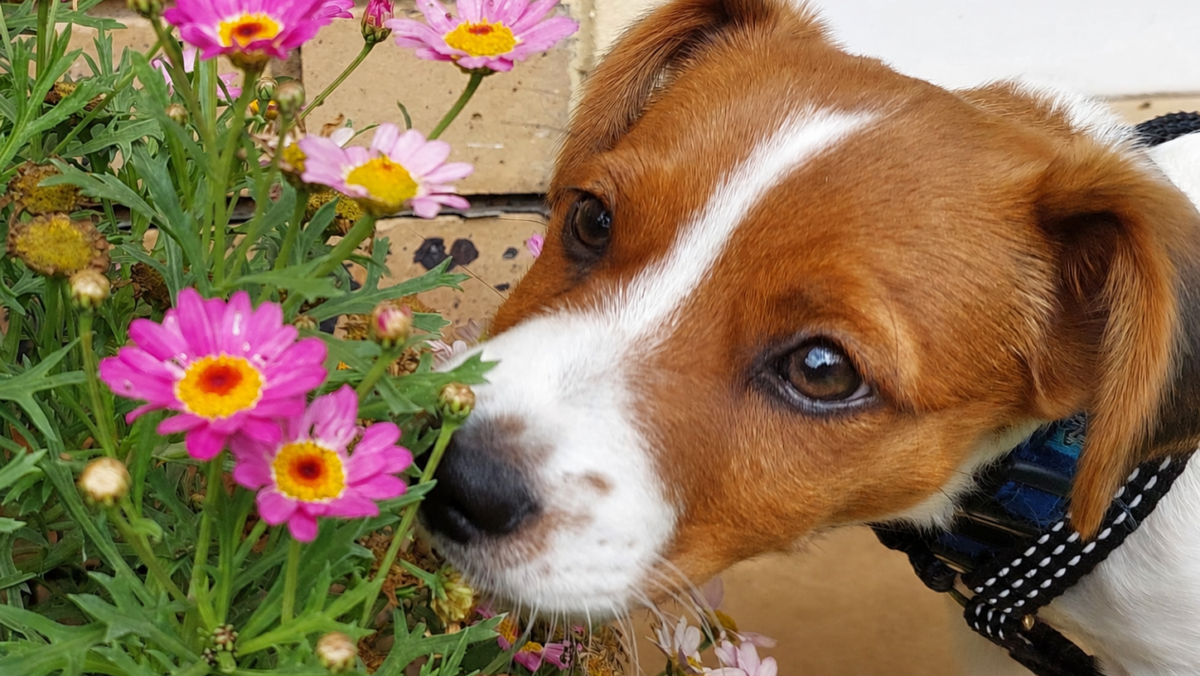
A Jack Russell disappearing nose-first into a patch of grass can look like ordinary terrier behaviour.
The dog stops. Sniffs. Changes direction. Returns to the same spot and investigates again, apparently fascinated by something its owner cannot see.
New research suggests there may be good reason to pay attention to that nose.
A large study comparing olfactory performance across hundreds of dogs found that Russell terriers performed competitively alongside breeds far more commonly associated with detection work. The researchers also highlighted an earlier experiment in which Jack Russell terriers were among the best-performing breeds in a food-detection task.
The results do not prove that Jack Russells have the best sense of smell.
They suggest something more interesting.
The small terrier may be considerably more capable with its nose than traditional breed stereotypes imply.
Researchers tested dogs without teaching them what to find
The study, published in Scientific Reports, initially tested 551 dogs, including 524 family dogs and 27 professional explosive-detection dogs.
After technical exclusions and an initial control stage, researchers analysed olfactory performance from 484 dogs. For the detailed breed comparison, 439 dogs from ten sufficiently represented breed groups were included.
The dogs completed what researchers call the Natural Detection Task.
They were not first trained to recognise a particular target smell.
Instead, the test relied on something most Jack Russell owners will recognise immediately: a dog’s natural motivation to find food.
Dogs were presented with containers and had to locate the one hiding a food reward using scent. As the experiment progressed, the smell became progressively harder to detect.
That makes the experiment different from testing a professionally trained detection dog searching for explosives or narcotics.
It was closer to asking what an ordinary dog could do when its nose was given a problem to solve.
Russell terriers held their own against classic working dogs
Researchers expected that breeds originally developed for scent-related work might form a naturally stronger group.
That assumption did not hold particularly well.
When dogs were grouped according to whether their breeds had historically been selected for smell, cooperation with humans, or both, the groups contained so much internal variation that the classification was not useful for predicting performance in this task.
Individual breeds did differ.
Border collies reached the most difficult level in the highest proportion, while beagles completed their successful searches fastest.
Russell terriers, however, did not emerge as obviously inferior to the larger working breeds people might instinctively expect to dominate scent work.
The researchers found no clear difference in olfactory success between Russell terriers and breeds including German shepherds, Belgian shepherds, cocker spaniels and Labradors in this task.
For a compact terrier usually associated with digging, chasing and seemingly endless energy, that is a notable result.
Another experiment had already put Jack Russells near the top
The 2025 paper becomes more interesting for Jack Russell owners because its findings are not completely isolated.
The authors compared their results with earlier research by Elisa Ferrando and Christoph Dahl, who had tested multiple dog breeds using another food-detection experiment.
In that study, Jack Russell terriers, Siberian huskies and French bulldogs performed best.
The newer paper’s authors specifically note that the earlier Jack Russell result appears consistent with their own findings for Russell terriers.
They also add an important warning: the earlier experiment contained relatively small breed samples and was not balanced for all the factors that could influence performance.
So it would be premature to declare the Jack Russell an undiscovered champion of canine scent detection.
But two different pieces of research now make it harder to dismiss the breed’s nose simply because it does not resemble a bloodhound.
A Jack Russell was built to investigate
There is also a behavioural logic to the result.
The modern Jack Russell’s reputation centres on energy, persistence and a willingness to investigate almost anything.
In a scent-search problem, those characteristics can matter because detecting an odour is only one part of successful performance.
The dog must remain motivated, search effectively, make a decision and indicate where it believes the target is located.
The 2025 researchers found substantial variation even between dogs of the same breed, reinforcing the idea that olfactory performance emerges from a combination of breed, individual behaviour and environmental influences rather than from nose anatomy alone.
They also found that dogs rated as more responsive to training were more likely to reach the hardest level and achieve higher overall success scores.
That makes the stereotypically determined terrier particularly interesting.
Persistence may not make the nose itself more sensitive.
It can help determine what the dog does with the information the nose provides.
Fastest and best are not the same thing
Jack Russells did not win every measure.
Beagles were the fastest breed at completing their final successful level.
Russell terriers were slower than beagles on average, although the statistical uncertainty around that particular comparison means the result should be interpreted carefully.
This distinction is useful. A dog can be highly successful at locating a scent while taking longer to make its final choice.
In real professional detection work, both accuracy and speed matter. Airports, police operations and security searches cannot remain closed indefinitely while a dog investigates every interesting smell in the area.
Anyone who has watched a Jack Russell inspect the same shrub from six different angles may recognise the problem.
Thoroughness and efficiency are not always the same thing.
The study was not a test of professional detection ability
There is a limit to what can be concluded from the experiment.
The Natural Detection Task involved food and visible scent containers. It did not recreate the complexity of searching luggage, buildings, vehicles or open environments for hidden target odours.
Professional detection dogs also require traits beyond smell, including sustained motivation, environmental confidence, trained signalling behaviour and the ability to work with a handler for long periods.
The researchers therefore caution that the task may tell us more about inexperienced dogs’ natural olfactory performance than about which breed would become the best operational detection dog.
That caveat is particularly important for the Jack Russell angle.
This study does not establish that police forces should replace Labradors and shepherds with terriers.
What it does show is that breed reputation can be a poor shortcut for predicting what an individual dog can do with its nose.
The small dog may be hiding a serious sensory talent
Perhaps that is the most interesting result.
Humans have spent generations assigning dogs to categories.
- Hounds smell.
- Shepherds cooperate.
- Retrievers retrieve.
- Terriers chase.
The new research found that those historical divisions did not translate neatly into performance when hundreds of dogs faced the same natural scent challenge.
For the Jack Russell, that makes its everyday behaviour look slightly different.
The intense sniffing, sudden changes of direction and refusal to leave one mysteriously interesting patch of ground may appear chaotic from the other end of the lead.
To the dog, the environment may be full of information we simply cannot detect.
And the evidence suggests the Jack Russell is quite capable of finding it.
Source Information
Primary Study Title: Breed differences in olfactory performance of dogs
Authors: Attila Salamon, Ádám Miklósi, László Róbert Zsiros, Tímea Kovács, Enikő Kubinyi, Attila Andics and Márta Gácsi
Journal: Scientific Reports
Published: 21 January 2025
DOI: 10.1038/s41598-025-87136-y
Supporting Study: An investigation on the olfactory capabilities of domestic dogs (Canis lupus familiaris)
Authors: Elisa Ferrando and Christoph D. Dahl
Journal: Animal Cognition
Published: 2022
DOI: 10.1007/s10071-022-01640-6