








Air pollution may be doing more than damaging human lungs and reducing visibility.
It could also be making vegetation less efficient at using water.
A new global study published in Nature Climate Change found that exposure to fine particulate pollution, known as PM2.5, was predominantly associated with lower plant water-use efficiency across forests and other vegetation.
The researchers traced the problem mainly to photosynthesis.
Polluted air appears to reduce the amount of carbon plants can absorb for roughly the same amount of water moving through the ecosystem, weakening a relationship that is fundamental to how vegetation grows and survives.
For countries where air pollution and water scarcity already overlap, including South Africa, that creates an environmental problem that has received considerably less attention.
Plants have their own water budget
Plants constantly trade water for carbon.
They absorb carbon dioxide through tiny openings in their leaves and use it during photosynthesis to build new plant material. At the same time, water escapes through those openings into the atmosphere.
Scientists describe the balance between carbon gained and water lost as water-use efficiency.
A plant with higher water-use efficiency can absorb more carbon for a given amount of water.
That matters enormously in dry environments.
Over recent decades, rising atmospheric carbon dioxide has generally helped plants become more water efficient because leaves can acquire carbon while losing comparatively less water.
The new research suggests particulate pollution can work in the opposite direction.
Researchers looked from tree rings to satellites
The study did not depend on a single forest or experiment.
Researchers combined several independent ways of observing vegetation across the world.
They analysed tree-ring isotope records, which preserve information about how trees used carbon and water over long periods.
They also used measurements from eddy-covariance towers, instruments positioned above ecosystems that track exchanges of carbon dioxide, water and energy between vegetation and the atmosphere.
Finally, the researchers examined satellite-derived measures of plant activity and combined these with global estimates of PM2.5 pollution.
The different approaches pointed in the same general direction.
Higher fine-particle pollution was predominantly associated with poorer water-use efficiency, although the strength of the relationship differed according to vegetation type, pollution level and climate.
That consistency matters because ecosystems are extraordinarily complicated.
Temperature, rainfall, carbon dioxide, soil conditions and plant species can all affect how efficiently vegetation uses water. Finding a similar pollution signal across several independent datasets makes it harder to explain the result as a quirk of one measurement method.
Pollution appears to interfere with photosynthesis
The researchers then asked what was actually causing the decline.
One possibility was that pollution made plants lose substantially more water.
That was not the main explanation.
Instead, PM2.5 primarily appeared to reduce photosynthesis.
Fine particles suspended in the atmosphere can reduce the amount of photosynthetically active sunlight reaching vegetation. Pollution was also associated with lower carboxylation capacity, which relates to a plant’s ability to chemically process carbon dioxide during photosynthesis.
The result is a plant that gains less carbon without a comparable reduction in water loss.
Imagine two plants losing approximately the same quantity of water.
If one absorbs less carbon while doing so, its water is effectively producing less biological growth.
Across an individual leaf that difference may sound minor.
Across forests, grasslands and agricultural regions, it can influence how ecosystems respond to drought, heat and changing rainfall.
Climate models may be missing part of the picture
There is another important finding.
When the researchers compared their observations with existing ecosystem models, models that did not adequately represent aerosol pollution failed to reproduce the observed relationship between PM2.5 and water-use efficiency.
That suggests pollution may be an overlooked component in projections of how vegetation will respond to climate change.
Plants play an important role in both the carbon and water cycles.
They remove carbon dioxide from the atmosphere, influence how much water returns to the air and affect the amount of moisture retained within landscapes.
If pollution changes the relationship between these processes, models that treat air pollution separately from ecosystem function could miss part of what is happening on the ground.
South Africa has both sides of the problem
The South African relevance is difficult to ignore.
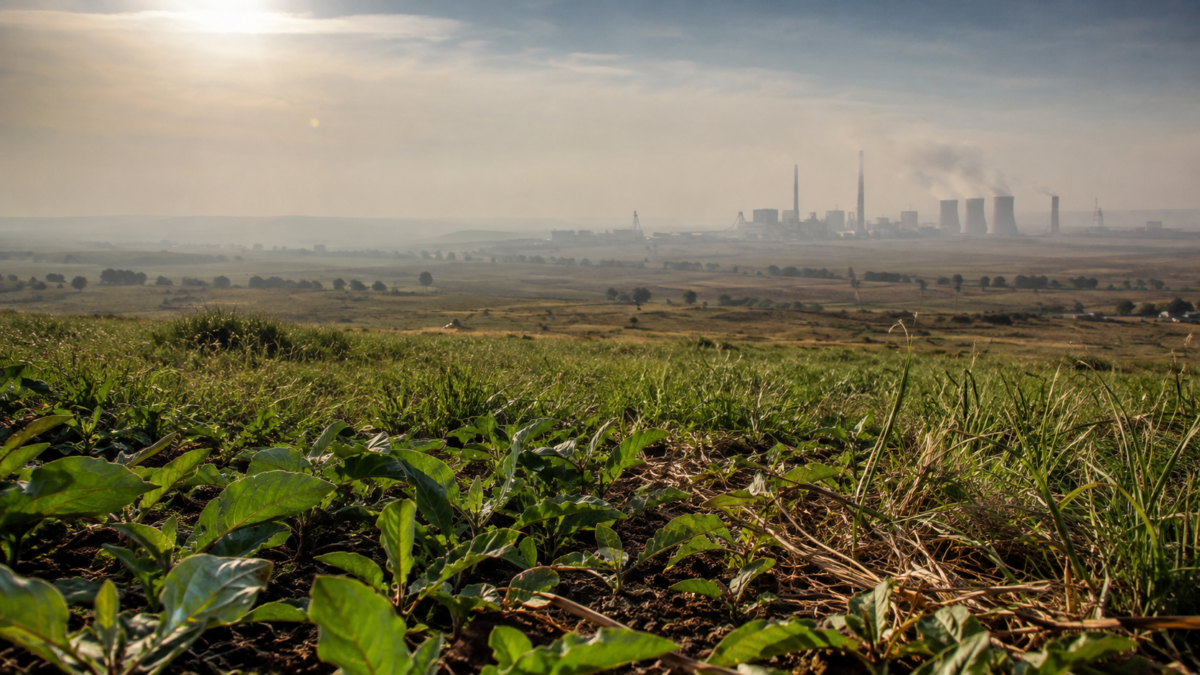
In August, the Department of Forestry, Fisheries and the Environment again described the Highveld Priority Area as facing ongoing air-pollution challenges linked to industrial activity, mining, domestic fuel burning, transport and waste burning.
The Highveld includes major agricultural landscapes as well as extensive natural vegetation.
South Africa is also a water-stressed country in which rainfall variability and drought already place pressure on ecosystems and agriculture.
The new study does not measure the specific effect of Highveld pollution on South African crops or calculate how much additional water local vegetation would require.
That research would still need to be done.
But it changes the environmental question.
Air pollution policy is usually justified through what dirty air does to people.
There may also be consequences for the vegetation surrounding polluted cities and industrial regions.
Cleaner air could have benefits we have not been counting
There are important limitations.
The study identifies a strong global relationship using several observational datasets, but the size of the effect varies geographically. Forests and non-forest vegetation also responded differently, meaning there is no single number that can be applied to every ecosystem.
PM2.5 is also a mixture of particles from different sources rather than one uniform substance.
Further research will be needed to determine which pollution sources have the greatest ecological effects and how those effects translate into crop production, forest growth and drought resilience in individual regions.
Still, the finding broadens the case for cleaner air.
Reducing particulate pollution already carries obvious benefits for human health.
If cleaner skies also allow plants to capture more carbon for every unit of water they use, the environmental return may be larger than previously recognised.
In a warming world where clean air, water and productive ecosystems are all becoming increasingly valuable, they may be more closely connected than we thought.
Source Information
Study Title: Particulate air pollution undermines plant water-use efficiency by inhibiting photosynthesis
Authors: Jian Wang, Yuyu Zhou, Lingli Liu, Constantin M. Zohner, Jing Wei et al.
Journal: Nature Climate Change
Published: 17 August 2026
DOI: 10.1038/s41558-026-02712-y