








Detecting extremely weak magnetic fields at very small scales is important across physics, materials science and emerging biomedical sensing. Diamond defects known as nitrogen-vacancy centres have become powerful quantum sensors because a single electronic spin can be read optically and positioned close to a sample. Their performance, however, depends strongly on the type of magnetic signal being measured. Static and slowly varying fields are particularly challenging because the spin loses phase coherence over a comparatively short timescale.
A new experiment published in Physical Review Applied reports a hybrid approach that tackles this limitation by pairing a single near-surface nitrogen-vacancy centre with a soft ferromagnetic microwire. Rather than relying on the diamond defect alone to detect the external field, the microwire acts as a magnetic amplifier. The researchers report that the resulting configuration improved direct-current magnetic-field sensitivity by about 500 times compared with conventional single-spin magnetometry limited by inhomogeneous broadening and the nitrogen-vacancy centre’s dephasing time.
Why static fields are difficult for diamond quantum sensors
Nitrogen-vacancy centres are atomic-scale defects in diamond in which a nitrogen atom sits next to a missing carbon atom. Their electronic spin states respond to magnetic fields and can be prepared and measured using light and microwaves. This combination has made them attractive for nanoscale magnetic imaging, where spatial resolution can be far better than that of many conventional magnetic sensors.
The difficulty is that sensitivity to a static magnetic field is constrained by the spin’s dephasing time, commonly written as T2*. Interactions with the surrounding spin environment broaden the magnetic-resonance response. For alternating fields, pulse sequences can often extend useful sensing times, but direct-current measurements cannot exploit the same strategies in exactly the same way. Improving static-field sensitivity without sacrificing the ability to probe very small regions is therefore an important technical challenge.
A magnetic amplifier beside a single spin
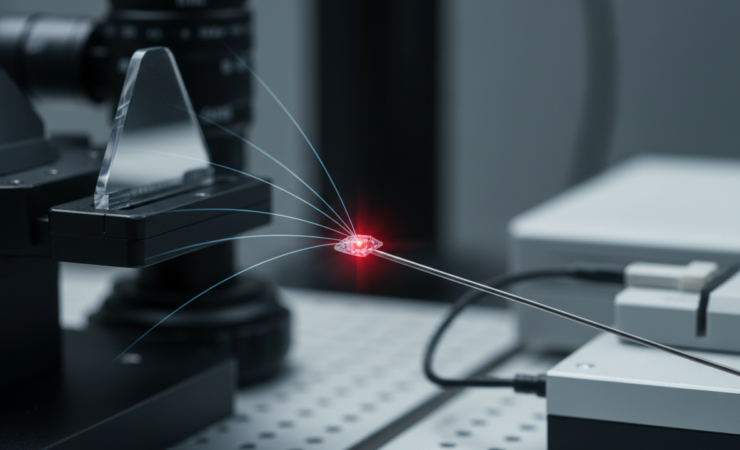
Vinaya K. Kavatamane and colleagues built their sensor around a single nitrogen-vacancy centre located close to the diamond surface. They integrated this quantum sensor with a soft ferromagnetic microwire. Soft magnetic materials can respond strongly to relatively weak external fields, so the microwire concentrates and amplifies the magnetic response in the region sampled by the nitrogen-vacancy centre.
The important feature of the design is that amplification occurs before the magnetic signal is read by the quantum defect. The nitrogen-vacancy centre therefore does not have to overcome its static-field sensitivity limit solely through longer coherence or a narrower resonance. Instead, the local magnetic field experienced by the spin is made larger than the original external field.
The team characterised the hybrid configuration experimentally using optically detected magnetic resonance and compared its response with the conventional T2*-limited approach. The study focuses on weak static or slowly varying magnetic fields, rather than presenting the device as a universal replacement for all magnetometry methods.
Sensitivity improved by roughly two and a half orders of magnitude
The headline result is an approximately 500-fold improvement in direct-current magnetic-field sensitivity for a single nitrogen-vacancy centre. Expressed as an order-of-magnitude change, that is roughly 2.7 orders of magnitude beyond the conventional sensitivity associated with inhomogeneous broadening or the T2* limit.
This comparison matters because it addresses one of the central compromises in nanoscale magnetometry. Ensemble sensors can improve sensitivity by averaging signals from many defects, but a single defect provides highly localised spatial information. The hybrid strategy aims to preserve the advantages of a single-spin probe while strengthening its response to a weak external direct-current field.
The result should not be interpreted as a 500-fold improvement over every magnetic sensor or every nitrogen-vacancy protocol. It is specifically a comparison with conventional single-NV static-field magnetometry under the sensitivity limits discussed by the authors. Other sensor classes, including atomic magnetometers and superconducting devices, operate under different constraints and at different spatial scales.
Why the hybrid design could matter
Weak static magnetic fields occur in a wide range of research settings. Nanoscale magnetic measurements can be used to investigate magnetic materials, condensed-matter systems and local electronic behaviour. The broader literature also points to possible biomedical applications of sensitive magnetometry, including measurements associated with neural, cardiac and biomolecular signals, although translating a laboratory-scale hybrid sensor into those settings would require substantial additional engineering and validation.
The study also illustrates a wider direction in quantum technology: improving a quantum sensor by coupling it to a classical material that performs part of the signal-processing task. Here, the ferromagnetic microwire supplies magnetic gain while the nitrogen-vacancy centre supplies nanoscale quantum readout. This division of labour can be useful when the fundamental properties that make a quantum sensor attractive also impose a practical limit on one type of measurement.
Compactness is another potential advantage. The researchers describe the configuration as a route towards highly sensitive detection of static and slowly varying fields without abandoning the small sensing geometry associated with diamond defects. Further optimisation of the magnetic material, geometry, sensor-to-wire separation and optical readout could potentially improve performance beyond the demonstrated configuration.
Important limitations remain
The work is a device-level physics experiment, not a demonstration in a clinical or commercial environment. The reported sensitivity enhancement was obtained in a controlled experimental configuration, and practical instruments would need to contend with alignment, fabrication tolerances, environmental magnetic noise, temperature stability and reproducibility across devices.
Magnetic amplification can also introduce its own trade-offs. A ferromagnetic component has material-specific response characteristics, and amplification, bandwidth, noise and spatial resolution cannot automatically be optimised independently. The study therefore establishes a promising sensing architecture rather than a finished general-purpose magnetometer.
It is also important to distinguish sensitivity from application performance. Detecting a weaker field in a laboratory does not by itself establish that a sensor can identify a particular biological signal, image a specific material feature or outperform established instruments in real-world use. Those questions require application-specific experiments.
A different route around a quantum sensing limit
The study’s main contribution is conceptual as well as quantitative. Instead of trying only to extend the coherence of the nitrogen-vacancy spin, the researchers changed the magnetic environment around it. A soft magnetic microwire increased the local response to an external static field, allowing a single-spin sensor to operate with substantially greater sensitivity.
With an improvement of about 500 times over the conventional T2*-limited approach, the experiment shows how hybrid quantum-classical sensor designs can address a specific weakness without discarding the nanoscale advantages of the underlying quantum probe. Whether this translates into robust devices for materials research, biology or other technologies will depend on how well the architecture performs outside its present laboratory setting.
Source Information
Study: Single-spin nitrogen-vacancy hybrid magnetometer with enhanced static field sensitivity
Authors: Vinaya K. Kavatamane, Dewen Duan, Hadi Zadeh-Haghighi, Manh-Huong Phan and Gopalakrishnan Balasubramanian
Journal: Physical Review Applied, Volume 26, 044010
Published: 2 October 2026
DOI: 10.1103/z5x1-9rng
Access: Open access under the Creative Commons Attribution 4.0 International licence.