








Counting hours on social media has become one of the simplest ways to talk about digital wellbeing. Phone dashboards report daily screen time, parents set time limits and public debate often treats fewer minutes online as an obvious route to better mental health. A newly published study suggests that this measure captures only part of the picture.
Research involving 304 adults found that the way people engaged with social media was associated with symptoms of depression and anxiety in different ways. Cognitive preoccupation, behavioural checking and emotional investment were not interchangeable, and daily time spent on social media did not explain every relationship between engagement and mental health.
The study, published in Computers in Human Behavior Reports, is useful because it separates two questions that are often collapsed into one: how long people use social media, and what is happening psychologically while they use it. That distinction also fits a broader pattern in recent research. Research Today previously reported that a year-long study of 1,966 adults found little evidence that changes in social-technology use predicted later life satisfaction, while other work has identified more specific risks around particular forms and timings of use.
The study separated three styles of engagement
Jason R. J. Hill of the University of Exeter recruited 304 adults for a cross-sectional online study. Participants reported their daily time spent on social media, symptoms of depression and anxiety, aspects of trait mindfulness and three styles of social-media engagement.
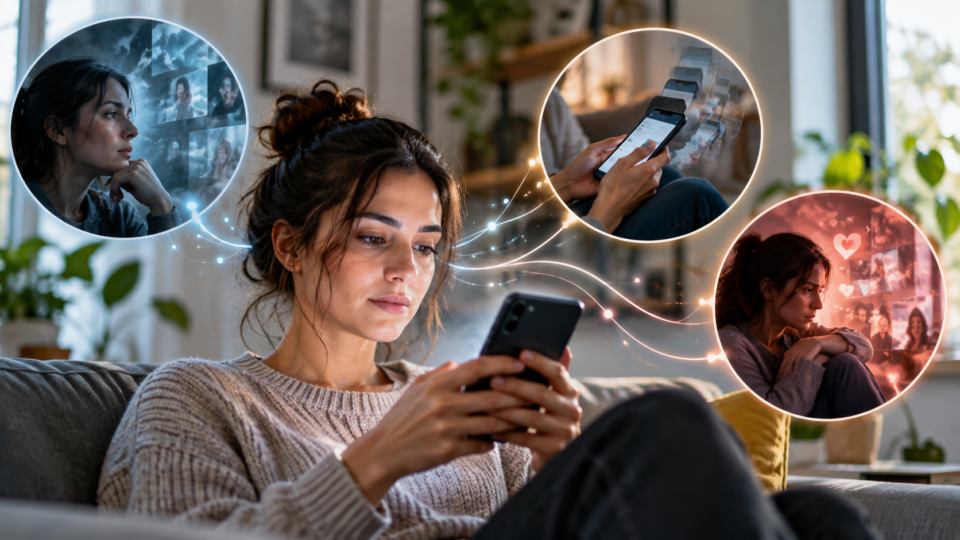
Cognitive engagement captured the extent to which social media occupied a person’s thoughts. Behavioural engagement reflected the pull towards checking or using platforms. Affective engagement focused on emotional investment in what happened online.
Participants also completed measures of mindfulness, including awareness of present experience, the ability to describe internal experiences and a tendency to respond to thoughts and feelings without immediately judging them. The analysis then used structural equation modelling to test whether daily usage time and these mindfulness facets statistically mediated links between engagement styles and symptoms of depression and anxiety.
This design is more informative than a simple correlation between hours online and a mental-health score because it allows several potential pathways to be considered simultaneously. It does not, however, establish which variable came first.
Time mattered more consistently for depression than anxiety
One of the clearest patterns was that daily time on social media fully mediated the relationships between cognitive and behavioural engagement and depressive symptoms. In practical terms, people who were more mentally preoccupied with social media or more behaviourally drawn to it also tended to spend more time using it, and this time-based pathway statistically accounted for those links with depression in the model.
The pattern for anxiety was different. Time spent online played a more limited role, while affective engagement was more important. Emotional involvement in social media therefore appeared to carry information that a simple total of minutes or hours could miss.
Mindfulness added another layer. Awareness, describing internal experiences and nonjudging consistently mediated some associations between affective and behavioural engagement and depressive symptoms. The corresponding indirect pathways for anxiety were more selective and less consistent, while cognitive engagement showed relatively few indirect associations through mindfulness.
The findings do not mean that mindfulness is a proven treatment for problematic social-media use. Mediation in a cross-sectional dataset identifies statistical pathways consistent with a proposed mechanism, but it cannot demonstrate that one variable caused the next.
Why two hours online can mean very different things
The distinction is intuitive when social-media use is treated as behaviour rather than a single exposure. Two people can each spend two hours on the same platform while having very different experiences. One may deliberately exchange messages with friends and leave. Another may repeatedly check reactions, remain preoccupied with what others are posting and experience strong emotional responses to online feedback.
A time counter records both as two hours. It does not record rumination, compulsive checking, social comparison, emotional dependence or whether the activity was purposeful and socially rewarding.
This helps explain why broad claims about screen time have repeatedly produced mixed findings. Duration can still matter. In Hill’s analysis it was an important part of the pathway to depressive symptoms. The problem is treating duration as if it were a complete description of digital behaviour.
The result also complements evidence that context can matter in other ways. Research Today recently covered a study showing that social-media self-presentation predicted body satisfaction differently across cultural groups. Another longitudinal study found that starting social media earlier in adolescence was associated with persistent learning losses. Together, such findings argue against treating every minute of platform use as psychologically equivalent.
What this could mean for digital wellbeing
Screen-time limits remain attractive because they are measurable. A phone can count minutes automatically, and a household, school or employer can set a clear numerical rule. Engagement style is harder to observe.
Yet the new study suggests that interventions focused only on reducing total use may leave some relevant mechanisms untouched. Someone can reduce usage while remaining highly emotionally invested in online feedback. Conversely, a person with substantial daily use may be using social platforms deliberately for work, learning or supportive relationships without showing the same pattern of cognitive or emotional involvement.
For policymakers and platform designers, this creates a measurement problem. Usage duration is convenient, but indicators of repeated checking, emotionally charged engagement or persistent preoccupation may sometimes provide additional information about risk. Any attempt to use such behavioural indicators would also raise privacy and interpretation concerns, particularly because high engagement is not itself a mental-health diagnosis.
The study cannot establish cause and effect
The strongest limitation is the cross-sectional design. All of the central variables were measured within the same broad period, so the analysis cannot establish whether a particular engagement style contributed to depression or anxiety, whether existing symptoms changed how participants used social media, or whether both were influenced by other factors.
The measures were also self-reported. Estimates of daily social-media use can differ from device-recorded behaviour, and psychological questionnaires capture reported symptoms rather than clinical diagnoses. The sample of 304 adults is useful for modelling several relationships but is far smaller than the large longitudinal datasets needed to examine how these patterns develop over time and differ across demographic groups or platforms.
Those limitations make the study a reason to refine the question rather than declare screen time irrelevant. The evidence points towards a more detailed framework in which quantity, cognitive preoccupation, behavioural pull, emotional investment and self-regulatory processes may each contribute differently.
The practical message is therefore more nuanced than simply putting the phone down. Time remains one useful signal, particularly in relation to depressive symptoms in this study. But understanding digital wellbeing may require asking what people are doing, thinking and feeling during that time as well.
Source Information
Study Title: Scrolling the Mind Away? Social Media Engagement Styles, Mindfulness, and Symptoms of Depression and Anxiety
Author: Jason R. J. Hill
Journal: Computers in Human Behavior Reports
Year: 2026
Sample: 304 adults
Method: Cross-sectional online survey with structural equation modelling of social-media engagement styles, daily use, mindfulness, depression and anxiety
DOI: 10.1016/j.chbr.2026.101334