


A billion-dollar threat beneath maize fields
A parasitic weed that attacks maize roots is responsible for an estimated US$1.04 billion in annual losses across African production systems, according to research published in Nature Communications on 15 October 2026.
The study focuses on Striga, a group of parasitic plants that can damage crops before farmers see obvious symptoms above the soil. The researchers say the economic burden is concentrated in particular locations rather than distributed evenly across every infested field.
Their central estimate comes with a 95% confidence interval of US$0.94 billion to US$1.15 billion. That range describes uncertainty in the model, not a direct accounting of every farm’s losses.
Perhaps the most actionable finding is geographical. Less than 6% of infested land accounts for half of the estimated economic losses.
This suggests that the location of control programmes may be as important as their overall scale. The study also warns that the spread of maize farming into new areas could make the problem considerably more expensive by 2050.
What makes Striga different from ordinary weeds
Most familiar weeds compete with crops for sunlight, space, water and nutrients. Striga is more direct: it attaches to the roots of host plants and extracts resources from them.
Species within the genus are often called witchweeds. They are especially concerning in agricultural systems where maize is an important food and income source.
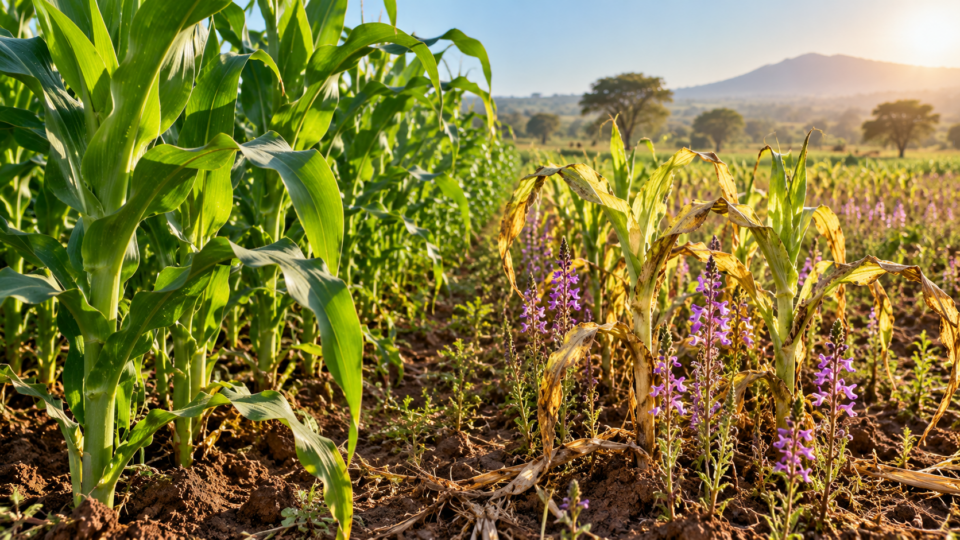
Because the damaging relationship begins underground, the visible appearance of the field can lag behind the biological problem. By the time severe crop stress becomes obvious, the parasite may already have affected growth.
That makes early detection, prevention and appropriate field management important questions for agricultural research.
The consequences also extend beyond one harvest. Weed populations and their seeds can complicate subsequent cropping seasons, although the severity depends on species, local conditions and management.
A uniform response is unlikely to be equally effective everywhere because maize systems vary in rainfall, soil fertility, crop varieties and farming practices.
The new study approaches this challenge as both a biological and economic problem.
How researchers estimated the losses
Franck B. N. Tonle, Alcade C. Segnon and colleagues combined several modelling approaches to estimate Striga’s economic effects across African maize production systems.
The researchers describe their method as a spatially explicit framework, meaning it considers where losses occur rather than calculating only one continent-wide average.
The framework integrated agroecological similarity mapping, machine learning and stochastic modelling.
Agroecological similarity mapping compares environmental and agricultural conditions across locations. It can help identify places resembling areas where the weed is already known to occur.
Machine-learning methods can identify patterns in available observations and environmental information, although their performance depends on the quality and representativeness of the underlying data.
Stochastic modelling incorporates uncertainty rather than assuming every input is known precisely.
These approaches were combined to address a recurring challenge: comprehensive, comparable field measurements are not available for every maize-growing location.
The authors then used the resulting spatial estimates to examine where losses are concentrated and how alternative intervention strategies could perform.
The analysis is therefore a model-based assessment informed by available evidence, not a direct experimental trial of every proposed control programme.
What US$1.04 billion actually represents
The reported annual loss estimate is US$1.04 billion, with a 95% confidence interval extending from US$0.94 billion to US$1.15 billion.
The estimate is substantial because maize is an important staple crop and source of livelihoods in many African communities.
However, the figure should not be read as a cash payment made by governments or as the cost of a particular intervention.
It represents estimated economic damage associated with the parasitic weed across the production systems included in the model.
The confidence interval communicates the range of estimates under the study’s statistical assumptions. It does not cover every conceivable source of uncertainty.
Changes in maize prices, crop areas, farming methods and future weed distributions could alter the economic value of losses.
The value of the new analysis lies partly in making the size and spatial distribution of the problem more explicit for decision-makers.
Instead of relying only on broad statements that Striga is costly, planners can begin to compare locations and potential management priorities.
Half the damage comes from a small share of land
The study estimates that less than 6% of infested areas generate approximately half of all economic losses.
That is a striking concentration. It means the heaviest economic damage is not spread proportionally across all land where Striga is present.
An area with the weed is not necessarily an area with the highest financial losses. Damage also depends on the maize production occurring there and the severity of crop effects.
This distinction matters when public agencies have limited budgets for agricultural support.
A programme that allocates identical resources to every infested area could spend heavily in places with comparatively small economic losses.
Targeting high-loss zones may therefore offer a more efficient starting point, provided local farmers’ needs and implementation conditions are considered.
The finding does not imply that lower-loss areas should be ignored. Some may be vulnerable to future expansion, and some households may experience serious hardship even where aggregate losses are modest.
It does suggest that national or regional strategies should distinguish between existing hotspots and areas where prevention could avert new infestations.
Why agricultural expansion changes the outlook
The researchers identify agricultural expansion as a major potential driver of future economic damage.
As maize cultivation extends into new locations, production can become exposed to Striga in places where the parasite is present or capable of establishing.
The study’s scenarios suggest that losses could potentially triple by 2050 if expansion allows the weed to colonise new production areas.
A tripling would correspond to roughly US$3.12 billion if applied mechanically to the study’s current central estimate, but that simple calculation is not a separate forecast from the paper.
The scenario is conditional. It should not be presented as an inevitable outcome or as a prediction of what losses will be in every African country.
Future crop distribution, weed management, climate conditions, technology and policy decisions could all influence the result.
Nevertheless, the finding highlights a planning problem: waiting for visible damage in newly cultivated areas may be more expensive than considering prevention at the outset.
Land-use decisions and pest-management strategies are therefore linked, especially in regions where agricultural expansion is expected.
A two-part strategy for protection
The researchers conclude that a combined strategy offers the strongest potential benefit in their analysis.
The first component is spatial targeting: concentrating control efforts in locations where the model identifies particularly large existing economic losses.
The second is expansion prevention: reducing the risk of Striga establishing or spreading into newly cultivated maize areas.
These two priorities address different stages of the problem. One focuses on damage already occurring, while the other attempts to limit additional exposure.
The study reports that this approach outperforms uniform intensification in its modelled comparisons.
Uniform intensification means broadly increasing intervention effort without giving the same priority to the geography of economic losses or future spread.
Such comparisons are useful for policy design, but they are not a guarantee that any particular intervention will achieve a specified return in practice.
Local feasibility, agricultural extension services, farmer participation and available resources will determine whether targeted programmes can be implemented successfully.
Effective planning will also need reliable local monitoring to check whether the predicted hotspots match conditions in the field.
What this means for food security
The authors frame the issue as a food-security concern affecting populations dependent on maize, citing more than 300 million Africans in the context of the crop’s importance.
Maize losses can matter to household food supplies, farm incomes and the wider markets that depend on agricultural production.
However, the economic burden is not necessarily experienced equally. A smallholder family and a large commercial operation may face very different consequences from a similar percentage decline in yield.
Aggregate estimates also do not tell us how much income any one household loses.
That is why spatial prioritisation should be combined with an understanding of vulnerability and local livelihoods.
Areas with the largest monetary losses may not always be the places where households have the fewest alternatives.
A well-designed programme would consider both the total production that could be protected and the people most exposed to food insecurity.
The research provides a framework for the first part of that discussion, rather than a complete social-impact assessment.
Why the results matter to southern Africa
Southern Africa includes major maize-growing regions, making the study’s continental findings relevant to agricultural planning discussions.
Nevertheless, a continent-wide estimate cannot be divided evenly among countries to calculate a national burden.
The published headline results do not establish a new South African rand value for Striga damage, and such a figure should not be inferred from the US$1.04 billion total.
Country-specific estimates would require examination of the study’s spatial outputs alongside local production, weed observations and agricultural conditions.
Researchers and policymakers could use the modelling approach to identify where improved surveillance or targeted support might be most valuable.
The emphasis on prevention may also be relevant when maize production shifts into new areas or cropping systems change.
Any intervention would need to reflect local weed species, farmer practices and the availability of suitable management methods.
The broader implication is that regional pest strategies may benefit from looking beyond national averages to the locations where losses and future risks are concentrated.
What the research does not establish
The study is a modelling analysis, not a randomised field experiment demonstrating that a particular weed-control product or practice eliminates a fixed share of losses.
Because field observations are incomplete across parts of Africa, the framework relies on statistical inference and assumptions about comparable agroecological conditions.
Modelled hotspots should be checked against local evidence before major resources are committed.
The 95% confidence interval quantifies uncertainty within the framework but cannot remove all uncertainty about future prices, weather, land use or farmer responses.
Likewise, the possibility of tripled losses by 2050 depends on future expansion and colonisation scenarios.
The paper’s conclusion that targeting and prevention outperform uniform intensification is a comparison of strategies under its assumptions, not proof that implementation will be simple.
Interventions may have costs, trade-offs and distributional consequences that differ between farming communities.
Continued monitoring, transparent evaluation and adaptation will therefore be important if the modelling insights are used in policy.
The bigger lesson for agricultural policy
The new analysis turns a broad warning about a damaging parasitic weed into a more geographically specific economic problem.
Its most important figures are clear: approximately US$1.04 billion in annual losses, a confidence interval of US$0.94 billion to US$1.15 billion, and half the damage concentrated in less than 6% of infested land.
The research also suggests that agricultural expansion could substantially increase losses if new areas become infested.
Taken together, these findings support a strategy that protects existing high-loss production zones while seeking to prevent spread into future maize-growing areas.
That approach is particularly relevant where monitoring resources and agricultural budgets are constrained.
The study does not offer a single cure for Striga, but it provides evidence that where action takes place could make a major difference.
For farmers and policymakers, the central question is no longer only how much damage the weed causes. It is also where prevention and management can do the most good.
Source Information
Study: Spatial targeting and expansion prevention offer effective pathways to protect African maize from parasitic weeds
Authors: Franck B. N. Tonle, Alcade C. Segnon, Mori W. Gouroubera, Dan Makumbi, Hugo De Groote, Saliou Niassy, Takemore Chagomoka, Henri Tonnang and Robert B. Zougmore.
Journal: Nature Communications
Published: 15 October 2026
Methods: Spatially explicit agroecological similarity mapping, machine learning and stochastic modelling of Striga-related economic losses in African maize production systems.