



A brick made from two difficult waste streams
Plastic packaging and industrial casting sand are rarely discussed together. Yet both can create disposal challenges when they can no longer be used for their original purposes.
Researchers in India have investigated whether these discarded materials could become a useful building product without adding conventional cement.
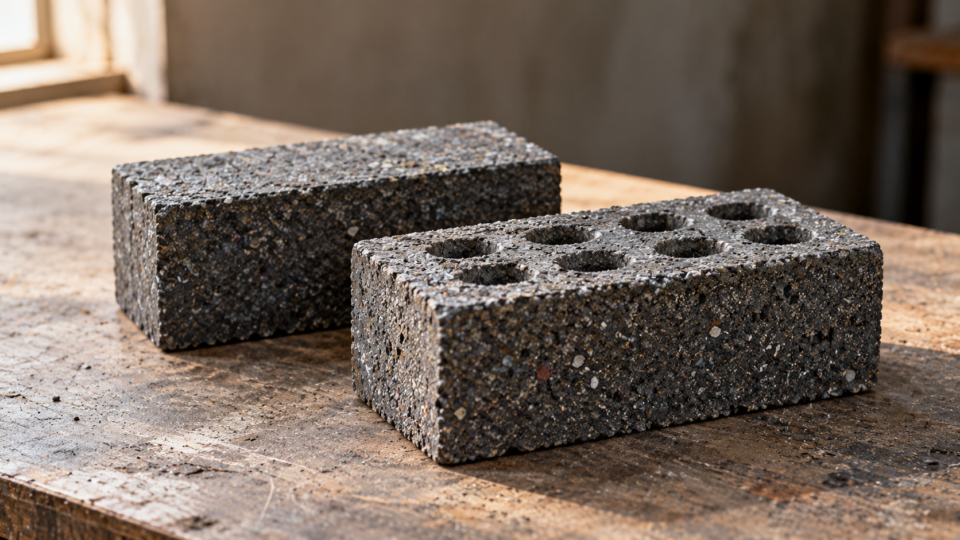
Their experiment combined mixed post-consumer thermoplastic waste with waste foundry sand, producing perforated composite bricks through heating and compression.
Ten specimens were manufactured and assessed for physical and mechanical performance.
The bricks achieved an average compressive strength of 5.32 megapascals and a measured water absorption of 1.11 percent.
These results suggest potential for low-load construction applications, but do not establish that the bricks are ready for load-bearing buildings or widespread commercial production.
The study was published in Scientific Reports on 17 October 2026 by Praveen Kumar Pandey and M. V. Raju.
Why waste foundry sand is an attractive ingredient
Foundries use sand to form moulds and cores when manufacturing metal components.
After repeated industrial use, some of that sand is discarded rather than returned to production.
Disposal requires space and management, and the properties of used sand can vary according to the casting process.
Researchers have therefore explored whether waste foundry sand can replace virgin aggregates in construction materials.
In the new experiment, the sand supplied a mineral-rich particulate component for a plastic-based composite.
The authors described the sand as silica-rich and reported a fineness modulus of 2.13.
That figure characterises the particle-size distribution of the sand; it is not a measure of brick strength.
Reusing foundry sand could reduce demand for some virgin materials, although environmental benefits must be demonstrated across the full production process.
The plastic mixture was not a single polymer
Much research on plastic building materials focuses on one plastic type, such as polyethylene terephthalate.
This study instead examined a mixed post-consumer thermoplastic stream.
The reported mixture included PET, high-density polyethylene, low-density polyethylene, polypropylene and multilayer plastic.
These materials differ in melting behaviour, stiffness and processing characteristics.
Using them together is relevant because real-world plastic waste is frequently mixed and difficult to separate perfectly.
However, mixed feedstocks can also introduce variability into manufacturing.
An industrial process would need controls to ensure that changes in incoming waste do not create unpredictable product quality.
The laboratory findings demonstrate feasibility for the tested formulation rather than every possible combination of discarded plastics.
How the experimental bricks were manufactured
The researchers combined waste foundry sand and post-consumer thermoplastic waste at a 50:50 mass ratio.
In practical terms, that means equal masses of the two waste ingredients were used in the composite.
The mixture was processed through melt mixing, allowing softened plastic to surround and bind sand particles.
The material was then formed into bricks through compression moulding.
Unlike conventional cement-based products, the experimental bricks did not depend on cement hydration to create their structure.
The plastic acted as a binding phase while the sand supplied much of the mineral component.
The researchers manufactured ten perforated composite-brick specimens for evaluation.
The work establishes a specific experimental recipe, not a universal formula for replacing traditional bricks.
What 5.32 megapascals actually tells us
The reported mean compressive strength was 5.32 newtons per square millimetre, equivalent to 5.32 megapascals.
Compressive strength measures the stress a material can resist when a force pushes against it.
A higher value generally indicates greater resistance to crushing under a controlled test.
However, the suitability of a brick depends on more than one strength measurement.
Design standards, wall configuration, connections, long-term behaviour and safety factors all matter.
The study’s authors identified low-load applications as the appropriate area of potential use.
It would be inaccurate to claim that the experiment proves the bricks can replace structural masonry in multistorey buildings.
Further testing and certification would be necessary before any specific building application could be approved.
Why the water absorption result matters
The researchers measured water absorption of 1.11 percent in the experimental bricks.
Water absorption is one way to examine how readily a building material takes up moisture under specified testing conditions.
Low absorption may be useful in environments where moisture exposure affects durability or maintenance.
However, water absorption alone does not establish complete weather resistance.
Building products may also face repeated wetting and drying, temperature changes, ultraviolet radiation and chemical exposure.
The new paper’s result describes the specimens tested under its laboratory conditions.
It does not guarantee that the material will retain the same performance after years outdoors.
Longer-term durability tests would be required to evaluate that question.
The microscopic explanation for the results
The researchers examined the composite’s microstructure to understand how the ingredients interacted.
They reported that sand particles were mechanically encapsulated within a continuous polymer matrix.
In simpler language, the softened plastic formed a binding network around the grains of waste foundry sand.
The authors also observed that dense packing of the silica-rich particles helped create a compact structure.
Fewer connected voids can make it harder for water to penetrate a material.
This provides a plausible physical explanation for the measured low water absorption.
The observation supports the laboratory findings but does not prove that every manufactured batch will have the same internal structure.
Scaling up production would require attention to heating, mixing consistency and moulding conditions.
Why the perforations are important
The researchers produced perforated bricks rather than simple solid blocks.
Perforations are openings formed through or within a masonry unit.
Such designs can influence material consumption, weight and the distribution of forces during testing.
However, the performance of a perforated unit cannot automatically be compared with a solid unit without considering geometry.
Bricks with different dimensions or hole arrangements may respond differently under compression.
The reported strength should therefore be interpreted in the context of the specimens that were actually manufactured.
An engineering assessment would also need to consider how units behave when assembled into a wall.
Individual-brick tests are an important starting point, but they are not a substitute for testing a complete construction system.
Does cement-free automatically mean greener?
Removing cement from a brick formulation may sound environmentally beneficial because conventional cement production has substantial environmental impacts.
But the absence of cement is only one part of the sustainability question.
Plastic must be collected, sorted and heated, and those processes require energy.
Transport distances, feedstock preparation and the durability of the finished product also affect environmental performance.
A composite that lasts a long time and replaces virgin materials could offer benefits under some circumstances.
Yet those benefits should be measured rather than assumed.
The study reports promising material properties, not a complete life-cycle assessment demonstrating a particular reduction in greenhouse-gas emissions.
Claims about carbon savings would require transparent comparisons with conventional alternatives.
The practical challenge of using mixed plastic waste
Post-consumer plastic can contain several polymer types, additives and contaminants.
These differences matter when the material is heated and shaped into a new product.
Manufacturers would need to manage feedstock consistency to achieve repeatable strength and absorption results.
Processing temperatures and ventilation would also require appropriate occupational and environmental controls.
The study demonstrates that a mixed thermoplastic feedstock can be incorporated into the tested composite.
It does not establish that any unsorted household plastic can be melted safely into bricks.
Nor does it resolve how products containing mixed polymers should be handled at the end of their service life.
A circular-economy application should consider both the input waste and the eventual disposal or recovery of the finished material.
Ten bricks are a proof of concept, not a building standard
The researchers manufactured ten specimens, a useful scale for an initial materials experiment.
Testing a small batch can reveal whether a formulation deserves further investigation.
However, a small laboratory sample cannot establish manufacturing consistency across thousands of units.
Future testing would need to examine variation between batches and across different sources of waste.
Other important questions include fire performance, thermal behaviour, long-term deformation and resistance to environmental exposure.
Construction products also need to meet the standards applicable in the places where they will be used.
Nothing in the reported findings should be interpreted as regulatory approval for structural construction.
The appropriate conclusion is that the tested material showed technical promise for low-load uses.
How this compares with earlier plastic-brick research
Using plastic and sand to manufacture construction products is not an entirely new idea.
Earlier researchers have examined combinations of waste plastics, foundry sand and other mineral materials.
Some previous experiments reported different strength levels because they used different polymers, mixtures, specimen shapes and processing methods.
Those values cannot be compared directly without accounting for test conditions.
The new study contributes evidence about a particular mixed-plastic formulation containing several post-consumer thermoplastics.
Its use of equal masses of plastic and waste foundry sand is a distinctive aspect of the reported recipe.
The findings should be evaluated on their own terms rather than described as proof that all recycled-plastic bricks outperform conventional masonry.
Different applications will demand different balances of strength, cost, durability and environmental performance.
Where low-load applications might be considered
The authors point to potential use in low-load construction applications.
That is a deliberately narrower claim than recommending the bricks for major structural walls.
Possible uses would depend on engineering assessment, local standards and the final properties of production-scale units.
Even in a non-structural setting, fire behaviour and environmental durability can be critical.
Testing must also consider how bricks interact with mortar, adhesives or other joining systems.
The paper does not establish a certified list of permitted applications.
Instead, it identifies a material that may warrant further development for settings with modest mechanical demands.
That distinction helps prevent laboratory results from being mistaken for a finished construction specification.
Why the findings matter for waste management
The research connects two waste streams that might otherwise require separate disposal or recycling routes.
Foundry sand is generated by metal-casting operations, while mixed plastic waste comes from consumer products and packaging.
Combining them into a useful product could potentially create a market for materials that are difficult to recover.
However, waste diversion is not automatically a net environmental gain.
Collection, transport, processing and product lifetime all affect whether a new pathway is preferable to existing alternatives.
The economic case would also depend on equipment costs, local availability and demand for suitable construction products.
The study did not establish commercial profitability at scale.
It provides experimental evidence that can inform later environmental and economic assessments.
What researchers need to establish next
Before commercial adoption, the composite would need a broader programme of testing.
That would include manufacturing repeatability, strength variability and performance after prolonged environmental exposure.
Fire safety deserves particular attention because the binding phase contains thermoplastic polymers.
Researchers would also need to examine the implications of different waste mixtures and possible contaminants.
Independent assessment against relevant building standards would be essential.
A life-cycle comparison could determine whether the process offers environmental advantages over existing materials.
Cost analysis could help identify locations where waste collection and production are practical.
Only after these questions are addressed could engineers make reliable recommendations for specific construction uses.
The bottom line
The new experiment shows that mixed discarded thermoplastics and waste foundry sand can be combined into cement-free perforated bricks.
Ten specimens made with a 50:50 mass ratio produced an average compressive strength of 5.32 megapascals.
Measured water absorption was 1.11 percent, and microscopic analysis showed sand particles embedded within a compact plastic matrix.
Those results support further investigation of the material for low-load applications.
They do not establish long-term durability, fire safety, regulatory compliance or environmental superiority.
The work is best understood as a promising proof of concept for recovering value from two difficult waste streams.
Whether the idea becomes a practical building product will depend on larger trials and careful engineering validation.
Source Information
Study: Cement-free composite brick from waste foundry sand and mixed post-consumer thermoplastic waste for sustainable construction.
Authors: Praveen Kumar Pandey and M. V. Raju.
Journal: Scientific Reports.
Publication date: 17 October 2026.
Methodology: Laboratory fabrication and testing of ten perforated composite bricks made from equal masses of waste foundry sand and mixed post-consumer thermoplastics, using melt mixing and compression moulding. Physical, mechanical and microstructural properties were assessed.