



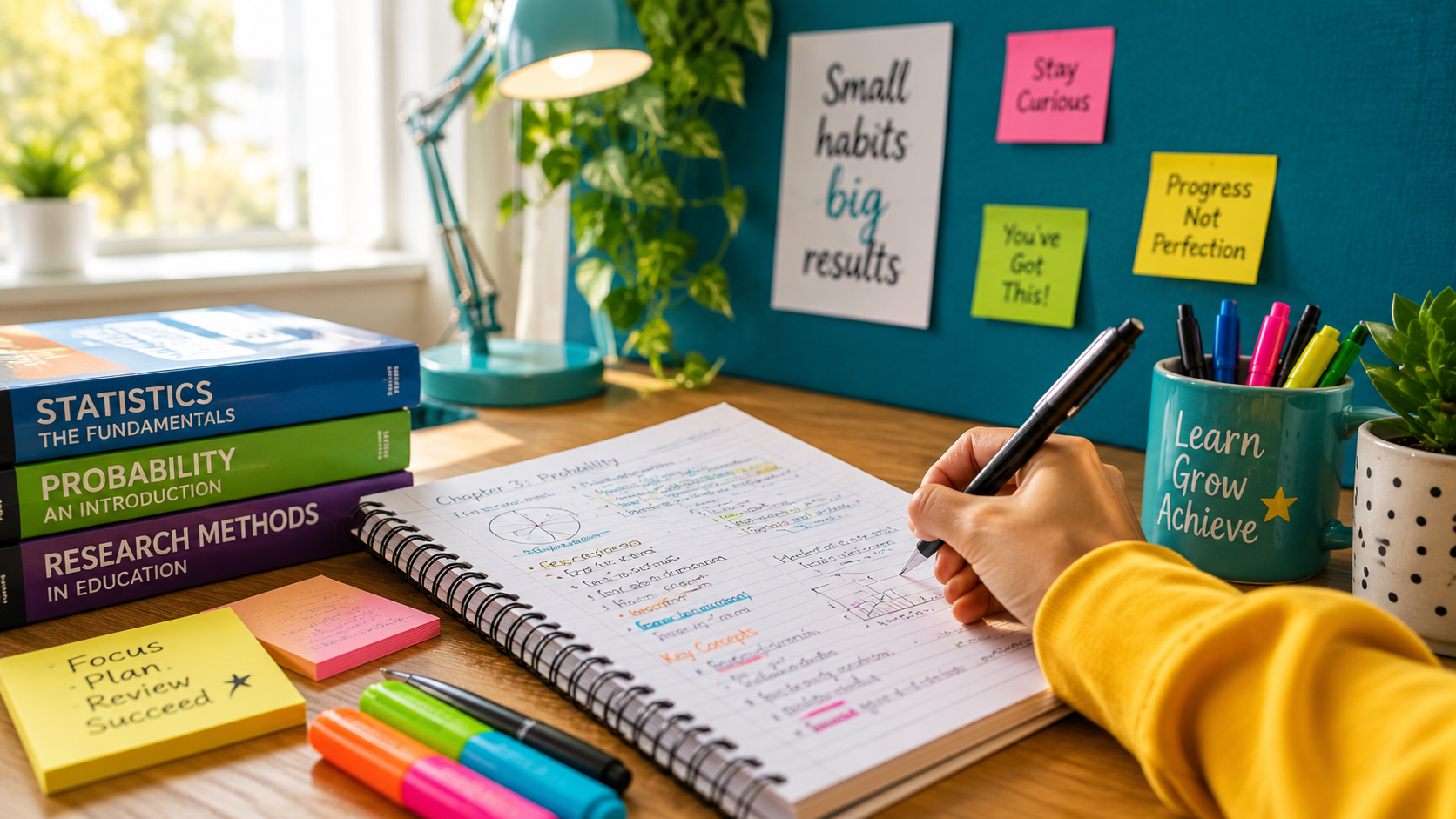






Most students have been told to take notes in class.
Far fewer are ever taught what useful notes should actually contain.
New experimental research suggests that distinction matters.
In a study involving 94 high-school students, researchers found that a short lesson teaching students how to take “deep notes” improved their performance on mathematics tests.
The intervention itself lasted only around 90 seconds.
But the most interesting result was not that students subsequently produced better notes.
Instead, the researchers found that the improvement in mathematical understanding appeared to come partly from something happening inside the students’ own judgement: they became less likely to overestimate how well they understood the lesson.
The study, published in Learning and Instruction, suggests that good note-taking may work not simply because more information ends up on the page, but because it forces students to notice what they genuinely understand and where their knowledge still breaks down.
Students watched two mathematics lessons
Researchers Mengsi Liu and Yuri Uesaka randomly assigned 94 Japanese high-school students to different note-taking conditions.
The experiment used two short mathematics lessons covering topics familiar to secondary-school learners: the equation of a circle and exponential expansion.
Students completed tests of their prior knowledge before watching each lesson and then completed assessments designed to measure procedural knowledge, conceptual understanding and whether they could transfer what they had learned to a new problem.
For one of the learning sessions, some students were shown a roughly 90-second instructional video teaching them a specific form of deep note-taking.
Others were not given the same instruction.
The researchers also tested whether taking notes directly inside a textbook rather than in a separate notebook would make learning easier by reducing the amount of information students had to copy.
This created a controlled experiment in which the researchers could separate the effect of how students thought while taking notes from the physical place in which they wrote them.
Deep notes are not about writing everything down
The note-taking strategy focused on three simple things.
Students were encouraged to record the meaning behind important information, rather than merely copying what appeared on the screen.
They were also encouraged to record the steps or strategies used to solve problems.
Finally, they were told to actively mark points they did not fully understand.
That last instruction may be the most important.
Ordinary classroom notes can easily become a transcription exercise.
A teacher writes a formula on the board, the learner copies it, and both move on.
The page eventually looks complete.
But a complete page does not necessarily mean the learner could explain why the formula works or use it when a problem looks slightly different.
Deep note-taking asks the student to treat the page as a record of thinking rather than simply a record of what the teacher said.
The students performed better after the instruction
The researchers found a statistically significant effect of deep note-taking instruction on students’ mathematics post-test performance.
The reported effect size was a partial eta-squared of 0.07, indicating that the short intervention produced a measurable improvement in understanding within the experiment.
Students who received the instruction also produced higher-quality notes according to the researchers’ coding system.
At first, that seems to provide an obvious explanation.
Better notes produced better test results.
But when the researchers examined the pathway statistically, note quality did not explain why instructed students performed better.
Something else did.
The real difference was knowing what you did not know
After the mathematics lessons, students were asked to judge how well they thought they understood the material.
The researchers could then compare those judgements with how students actually performed.
This revealed what psychologists call monitoring bias.
A student may leave a lesson feeling that the topic made perfect sense, only to discover during a test that they cannot solve the problem independently.
The larger the gap between perceived understanding and actual understanding, the greater the monitoring bias.
Deep note-taking reduced this tendency towards overestimation.
The researchers’ exploratory mediation analysis indicated that this reduction in monitoring bias helped explain the improvement in test performance.
In other words, the note-taking lesson may have worked partly because it made students more accurate judges of their own learning.
Feeling like you understand is not the same as understanding
This is particularly relevant in mathematics.
Watching someone solve an equation can create a powerful illusion of competence.
Every step looks logical while the teacher is explaining it.
The real test comes when the learner faces a blank page and has to decide what the first step should be without assistance.
Students who deliberately mark the point at which they stop understanding may be less likely to leave class with a false sense that everything has been mastered.
That gives them useful information.
A question mark beside one step tells the learner exactly where revision needs to begin.
Without that awareness, studying can become inefficient because students repeatedly review material that already feels familiar while overlooking the part they cannot actually reproduce themselves.
Writing in the textbook did not help
The study produced another useful result.
The researchers expected that allowing students to write directly in their mathematics textbooks might reduce the mental burden of taking notes.
Instead of repeatedly copying information already printed on the page, students could theoretically devote more attention to understanding the lesson.
That did not happen.
Using the textbook as the note-taking medium did not significantly improve mathematics performance.
It also did not significantly reduce the students’ reported cognitive load.
The findings therefore suggest that the important variable was not whether students used a notebook, textbook or some supposedly more efficient surface.
What mattered more was the mental activity taking place while they were writing.
This changes the old laptop-versus-paper debate
Discussions about note-taking often focus on the tool.
Should students write by hand or type? Should laptops be allowed? Should they annotate a textbook or use a separate notebook?
Those questions can matter, but the new study suggests they may sometimes distract from the more important issue.
A student can passively transcribe a lecture with a fountain pen just as easily as with a laptop.
Likewise, a digital note can involve substantial thinking if the student is explaining ideas, identifying solution strategies and recording confusion.
The quality of the cognitive process may therefore matter more than the format of the page.
There is an obvious lesson for South African classrooms
In South African mathematics classrooms, where teachers often have large amounts of curriculum content to cover, note-taking can easily become copying.
Students may fill books with definitions, equations and worked examples without being taught how to use those notes to monitor their own understanding.
The new study does not prove that the same 90-second intervention would produce identical results among South African learners.
But the strategy itself is remarkably simple.
When writing notes, students can ask three questions:
What does this actually mean? How was this problem solved? What part do I still not understand?
Those questions require no new technology, expensive software or specialised equipment.
They simply change the purpose of the notebook.
The study is promising, but small
There are important limitations.
The experiment involved only 94 high-school students and was conducted under controlled conditions rather than across an entire school term.
Students watched short prerecorded mathematics lessons rather than participating in ordinary classroom teaching.
The research also tested only two mathematical topics and measured understanding shortly after the lessons.
It therefore does not tell us whether the advantage would remain months later, whether students would continue using the strategy without reminders or whether the same effect would appear across different subjects and education systems.
The researchers also describe the mediation findings concerning monitoring bias as exploratory, meaning further studies are needed to confirm that this is the mechanism producing the learning benefit.
The best notes may be the ones that expose confusion
Students often judge their notes by how complete they look.
Neat headings, copied formulas and several pages of writing can create the reassuring feeling that learning has taken place.
This study suggests that useful notes may serve a less comfortable purpose.
They should expose the gaps.
A question mark beside a formula, an unfinished explanation or a reminder that one step still makes no sense may look like evidence of incomplete learning.
That is exactly why it can be valuable.
Knowing that you do not understand something is not a failure of learning.
It may be the point at which deeper learning finally begins.
Source Information
Study Title: The mind, not the pen: Deep notetaking instruction enhances lecture understanding by mitigating overestimation bias
Authors: Mengsi Liu and Yuri Uesaka
Journal: Learning and Instruction
Article: 102360
Published: 2026
DOI: 10.1016/j.learninstruc.2026.102360