





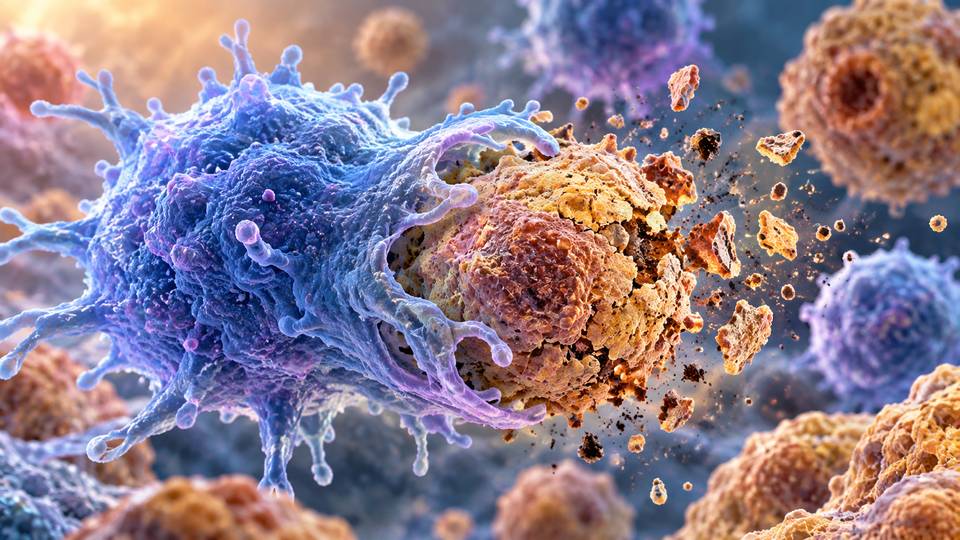




Influenza antivirals usually work by interfering with a specific viral process. A new preclinical study suggests that changing the physical architecture of an antiviral can do something more unusual: make the drug cross-link whole influenza particles, restricting both their entry into cells and their release after replication.
Researchers reporting in Nature Communications developed a programmable platform that attaches multiple copies of influenza neuraminidase inhibitors to an antibody Fc domain. Their central finding was that valency, the number of drug molecules presented by the conjugate, changed not only potency but also the mechanism of antiviral action. Trivalent constructs were particularly effective, and a trivalent peramivir-Fc conjugate called AVC-P3 ultimately outperformed several comparator treatments in mouse models of influenza A and B.
The work is still preclinical. It does not show that AVC-P3 is safe or effective in people, and results in infected mice cannot be assumed to translate directly into clinical benefit. Even so, the study offers a useful demonstration of how molecular design can turn an established class of small-molecule antivirals into multivalent agents with different physical behaviour.
Why valency could change an antiviral’s behaviour
Influenza viruses carry neuraminidase proteins on their surfaces. Drugs such as zanamivir and peramivir inhibit this enzyme, which is important for efficient release and spread of newly formed virus particles. The researchers asked what happens when several neuraminidase-binding drug molecules are presented together on a larger Fc-based scaffold rather than acting as separate small molecules.
Using click chemistry, the team built a multivalent antiviral conjugate platform in which the number and identity of attached antiviral molecules could be varied systematically. They first used zanamivir as a model and produced mono-, di- and trivalent zanamivir-Fc conjugates. This allowed a direct test of whether adding more binding units simply increased conventional neuraminidase inhibition or produced a qualitatively different antiviral effect.
The trivalent zanamivir conjugate, AVC-Z3, showed greater antiviral activity than the lower-valency constructs. More importantly, microscopy and mechanistic experiments indicated that the trivalent architecture could bridge separate virus particles. Instead of acting only at the scale of an enzyme active site, the conjugate promoted inter-virion aggregation.
Cross-linking created a dual-stage mechanism
That aggregation matters because it changes what the antiviral can physically do. By linking virus particles together, AVC-Z3 restricted viral entry into cells while retaining the ability to interfere with viral release. The researchers describe this as a shift from neuraminidase suppression alone toward physical immobilisation of influenza particles.
This dual-stage action is the conceptual centre of the study. Conventional neuraminidase inhibitors are primarily associated with limiting the release of progeny virions. A multivalent construct that binds several viral particles can potentially interfere earlier as well, because aggregated particles have less freedom to reach and enter susceptible cells. The same molecular target is therefore being used in a different spatial arrangement to create an additional barrier to infection.
The results also help explain why simply attaching a drug to a large protein is not enough. The mono-, di- and trivalent comparisons indicate that the number of simultaneously presented ligands is an important design variable. In this system, three drug units produced behaviour that lower-valency versions did not reproduce as effectively.
Peramivir produced the strongest candidate
After establishing the principle with zanamivir, the researchers applied the same trivalent design to peramivir. The resulting AVC-P3 construct showed stronger antiviral activity in vitro than AVC-Z3. This provided an important test of whether the platform was tied to one particular neuraminidase inhibitor or could be adapted by changing the conjugated drug.
Pharmacokinetic experiments added another advantage. AVC-P3 had a substantially longer in vivo half-life than AVC-Z3 and also a longer half-life than a YTE-mutated version of CD388, another long-acting drug-Fc antiviral approach discussed by the researchers. Longer persistence can be valuable for an influenza medicine because exposure over time affects both treatment and prophylactic potential, although dosing in humans would need to be established independently.
The team then compared antiviral efficacy in mouse infection models covering a broad set of influenza viruses. These included H1N1, H3N2 and H5N1 influenza A viruses as well as influenza B. Across these models, AVC-P3 produced stronger in vivo antiviral efficacy than the other antiviral conjugates tested, the polymerase inhibitor baloxavir and CD388.
Breadth across influenza strains strengthens the preclinical case
Testing multiple influenza subtypes is important because a candidate that performs well against only one laboratory strain may have limited practical relevance. H1N1 and H3N2 circulate seasonally in humans, influenza B contributes substantially to seasonal disease, and H5N1 remains important because of its zoonotic and pandemic potential.
The cross-model performance therefore strengthens the argument that the multivalent architecture is not restricted to one narrow viral background. At the same time, mouse models remain controlled experimental systems. Differences in immune responses, drug distribution, Fc biology, infection timing and disease severity mean that comparative efficacy in mice should not be interpreted as evidence that AVC-P3 would outperform approved antivirals in patients.
What the study adds to antiviral design
The broader implication is that ligand valency can be treated as a pharmacological design variable rather than merely a way to increase binding. Presenting several copies of a small-molecule inhibitor on one scaffold changes the geometry of the interaction with the virus. When the spacing and number of ligands permit cross-linking, the drug can act at the scale of entire viral particles.
This principle could be valuable because viral resistance often emerges when a treatment depends heavily on one molecular interaction. The current study does not establish that multivalent conjugates prevent resistance, but physical aggregation adds a mechanism that is different from enzyme inhibition alone. Future work will need to test how readily influenza can escape this combined pressure and whether neuraminidase variation affects cross-linking efficiency.
The Fc component may also contribute practical advantages by extending circulation time and providing a large scaffold on which multiple drug molecules can be displayed. But Fc-based designs introduce their own questions, including manufacturing complexity, tissue distribution, immunogenicity and the possibility that Fc interactions with the immune system could influence efficacy or safety.
Important limits before clinical translation
The most important limitation is the stage of development. The strongest efficacy evidence reported here comes from cell-based experiments and mouse infection models. Human influenza is biologically and clinically more variable, and an antiviral intended for widespread use must demonstrate an acceptable safety margin as well as reliable efficacy across age groups, immune states and circulating strains.
Long half-life can be beneficial, but it also makes safety especially important because a persistent drug cannot be rapidly removed after administration. Dose optimisation, toxicology, repeated-exposure studies and detailed pharmacokinetic work would be necessary before clinical testing could establish whether the advantages seen in animals translate into a practical medicine.
The comparison with existing drugs also requires care. Baloxavir and other approved influenza treatments have human dosing, safety and effectiveness data that an experimental conjugate does not yet have. An animal-model efficacy advantage is therefore a reason for further development, not evidence that current clinical treatment should change.
A molecular architecture with a different kind of leverage
The study’s most distinctive result is not simply that one experimental compound performed well. It is that increasing the number of antiviral ligands on an Fc scaffold altered the mechanism of action. The trivalent constructs could cross-link influenza particles, converting neuraminidase-targeting molecules into agents that also physically restricted viral movement.
AVC-P3 combined that multivalent mechanism with strong in vitro activity, prolonged in vivo persistence and efficacy across several influenza mouse models. Whether those properties can survive the much harder test of human development remains unknown. For now, the work provides a proof of concept that the architecture surrounding an antiviral molecule can be as important as the molecule itself.
Source Information
Study: Feng, X., Yuan, L., Zhao, L. et al. “Multivalent antiviral conjugates enhance activity against Influenza via cross-linking viruses.”
Journal: Nature Communications.
Published: 4 October 2026.
DOI: 10.1038/s41467-026-78126-3