







Visible light can warm water, and that heat can increase evaporation. A more surprising proposal has gained attention in recent years: that visible light might also eject water molecules directly from an air-water interface without relying on heating. If real, such a photomolecular effect could alter how researchers think about evaporation and potentially influence technologies that use sunlight to move or purify water.
A new study in the Proceedings of the National Academy of Sciences subjected that proposal to three complementary experimental tests. Yucong Chen and colleagues at the Max Planck Institute for Polymer Research report that visible light produced no measurable change in the evaporation rate or interfacial molecular structure of neat water under the conditions they tested.
The negative result is scientifically important because earlier reports of unexpectedly rapid evaporation from illuminated hydrogels and droplets had raised the possibility that light itself was directly helping water molecules escape. The new experiments narrow that interpretation. They indicate that researchers need to look more closely at the materials, geometry, heat transport and vapour environment surrounding illuminated water rather than assuming a direct non-thermal effect on pure water.
Testing evaporation without a material scaffold
The researchers focused on neat water at an air-water interface. That distinction matters. Hydrogels and porous materials introduce additional components that can absorb light, redistribute heat and change the local movement of water and vapour. By studying a flat surface of pure water, the team sought to isolate the proposed interaction between visible light and water itself.
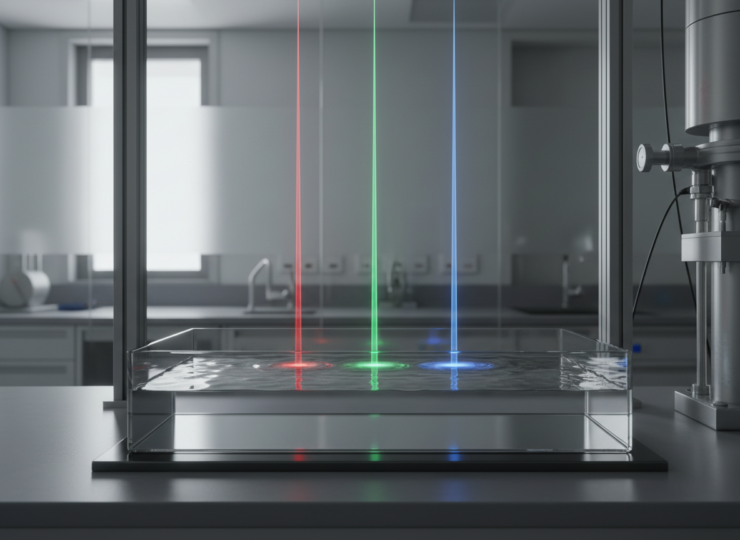
In the first experiment, blue, green and red laser light illuminated the water at intensities comparable to sunlight. The researchers varied humidity and used a sensitive displacement measurement to track the lowering of the water surface as molecules evaporated. The key comparison was straightforward: if visible light directly accelerated evaporation beyond heating, switching the illumination on should produce a detectable change in the rate at which the surface receded.
No measurable acceleration appeared. The water surface receded at the same rate with the light on and off within the experiment’s sensitivity. The lack of a detectable response across several visible wavelengths also weighs against a simple wavelength-dependent photomolecular mechanism in neat water.
Looking directly at the top molecular layers
An evaporation-rate measurement alone cannot reveal every microscopic change at a surface. The team therefore used surface-sensitive vibrational spectroscopy capable of probing approximately the top two or three molecular layers of water. A direct optical mechanism strong enough to weaken the molecular interactions holding water at the surface could be expected to leave a signature in these interfacial vibrations.
The researchers again found no measurable light-induced change. The molecular structure detected at the interface remained effectively unchanged under visible illumination. This second result is important because it tests the proposed mechanism from a different direction. The first experiment asked whether more water left the surface. The spectroscopy experiment asked whether illumination measurably altered the molecular environment from which evaporation occurs.
Ultrashort pulses pushed the test to extreme intensity
The third approach used ultrashort laser pulses lasting roughly a trillionth of a second. According to the researchers’ reporting, the peak intensities were more than 10 billion times higher than those of conventional illumination while the pulses were sufficiently brief to minimise ordinary heating. This created a demanding test for a direct interaction between light and the interfacial hydrogen-bond network.
Even under those conditions, the measurements did not show the predicted disruption of the bonds between surface water molecules. Taken together, the three approaches converged on the same conclusion: the team found no evidence that visible light directly drives additional evaporation from neat water at the air-water interface under the tested conditions.
Why earlier enhanced evaporation still needs explaining
The study does not imply that earlier reports of unusually high evaporation from illuminated systems were necessarily measurement errors. Instead, it changes the question. If pure water itself does not show a measurable non-thermal response, enhanced evaporation in gels, pores or droplets may emerge from the broader physical system.
Several mechanisms remain plausible. A solid or gel matrix can absorb light and create local temperature gradients that are difficult to capture with a single bulk temperature measurement. Heat can move through a porous structure differently from the way it moves through an open water surface. Vapour can accumulate or be transported near an interface, changing the local humidity that controls evaporation. Radiation pressure, droplet curvature and the geometry of pores can also influence transport.
These alternatives are not interchangeable, and the present work does not establish which one explains every previous observation. Its contribution is to provide a stricter reference case. Any proposed non-thermal enhancement mechanism now has to explain why the effect appears in more complex water-containing systems while remaining undetectable in the team’s direct measurements of neat water.
Implications for solar water technologies
Evaporation underpins technologies ranging from solar desalination to atmospheric water management. Reports of evaporation exceeding what conventional thermal calculations predict are attractive because they suggest that sunlight might be exploited more efficiently than expected. The new findings do not rule out high-performing solar evaporation systems. They do, however, caution against attributing that performance to a direct light-water mechanism without separating it from heating and material effects.
For engineering, that distinction is useful rather than disappointing. If enhanced evaporation originates in absorbers, pore structures, heat localisation or vapour transport, those features can be deliberately designed and optimised. A mechanism that is correctly identified is easier to reproduce, scale and compare across laboratories.
What the experiments do and do not establish
The study’s strength lies in using multiple measurements aimed at different consequences of the same proposed phenomenon. Evaporation was measured macroscopically, the molecular interface was examined spectroscopically, and ultrashort high-intensity pulses tested whether an extreme optical field could perturb surface bonding without prolonged heating.
There are still boundaries to the conclusion. A null result applies to the wavelengths, intensities, humidity ranges, geometries and detection limits used in the experiments. It cannot prove that no conceivable optical condition could ever influence an interface. Nor does a neat-water experiment reproduce the chemical and structural complexity of hydrogels, saline water, biological fluids or porous solar absorbers.
The findings therefore should not be read as a claim that light is irrelevant to evaporation. Light plainly supplies heat in natural and engineered systems. The narrower conclusion is that the researchers did not detect the proposed direct non-thermal acceleration of evaporation or a corresponding structural change at a clean air-water interface.
A useful negative result
Science advances not only when a new effect survives increasingly stringent tests, but also when careful experiments define where an apparent effect does not occur. Here, three independent measurements point away from a direct photomolecular explanation for neat-water evaporation.
That shifts attention toward the surrounding material and transport physics behind previously reported evaporation enhancements. For researchers trying to understand solar-driven water loss, the result provides a clearer baseline: before invoking a new interaction between visible light and water molecules, conventional heat, mass transfer, geometry and material responses need to be ruled out with equal care.
Source Information
Study: Chen, Y. et al. “Visible light leaves evaporation and interfacial structure of neat water unchanged at the air-water interface.”
Journal: Proceedings of the National Academy of Sciences.
Published: 2026.
DOI: 10.1073/pnas.2615377123