





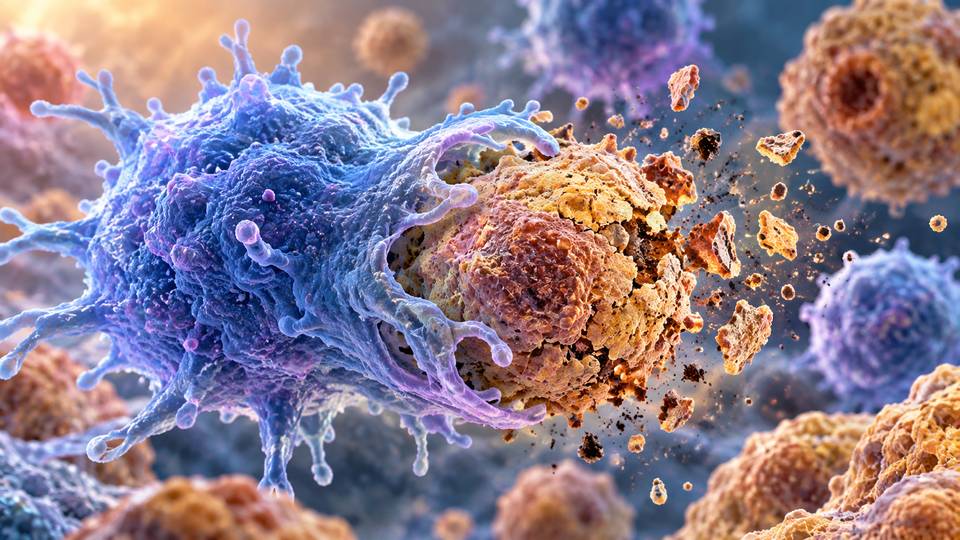




Immune checkpoint drugs have changed the outlook for many people with advanced non-small cell lung cancer, but they do not work for everyone. A major challenge is that some tumours remain immunologically “cold”, with too few effective T cells entering the tumour or with local conditions that suppress those cells once they arrive.
A phase I clinical trial published in Nature Communications on 4 October 2026 tested a strategy designed to alter that environment from inside the tumour. Researchers combined pembrolizumab, an established PD-1 checkpoint inhibitor, with an experimental dendritic cell vaccine engineered to produce CCL21, a signalling protein involved in recruiting immune cells.
The result is scientifically informative but clinically sobering. The treatment was well tolerated and changed immune activity inside tumours, including increasing CD4-positive T-cell infiltration and introducing new T-cell clones. Yet none of the treated patients achieved an objective tumour response. The contrast matters because it shows that successfully moving immune cells into a tumour is not necessarily enough to make an immunotherapy work.
Why researchers tried a vaccine inside the tumour
Pembrolizumab works by blocking PD-1, a molecular brake that can restrain T cells. Checkpoint inhibition can produce durable responses in some cancers, including non-small cell lung cancer, but resistance remains common. One reason is that releasing a brake is of limited value when too few tumour-reactive T cells are present or when the surrounding tumour microenvironment continues to suppress them.
The experimental vaccine took a different approach. Dendritic cells are immune cells that help organise T-cell responses. In this trial, patients’ own dendritic cells were modified to express CCL21 and then injected directly into a tumour. CCL21 can attract T cells and other immune cells, creating a plausible route for turning an immune-poor tumour into one that is more heavily infiltrated.
Earlier work had established the feasibility of CCL21-modified dendritic cell vaccination and suggested that it could increase immune-cell infiltration. The new trial asked whether combining that local immune recruitment with systemic PD-1 blockade could translate the biological effect into clinical tumour responses.
Twenty-three patients received treatment
The phase I study enrolled people with advanced non-small cell lung cancer and was structured in dose-escalation and dose-expansion stages. Eleven patients entered the dose-escalation cohort. Another 12 were treated in the expansion cohort at the maximum administered dose of 30 million modified dendritic cells per injection.
The treatment schedule combined intravenous pembrolizumab with image-guided or bronchoscopic injection of the CCL21-modified dendritic cell vaccine directly into a tumour. The vaccine was administered on treatment days 0, 21 and 42, while pembrolizumab could continue every three weeks for up to a year in the absence of progression or unacceptable toxicity.
The trial had two primary objectives. The dose-escalation stage was intended to establish how much of the cellular vaccine could be administered safely with pembrolizumab. The expansion stage assessed objective response rate at the selected dose. Researchers also collected longitudinal tumour biopsies and blood samples, allowing them to examine what happened to the immune system even when scans did not show tumour shrinkage.
The clinical endpoint was not met
No objective responses were observed, meaning the trial did not meet its primary objective for response rate. Among evaluable patients, 36.8% achieved stable disease as their best response. Stable disease can still be meaningful in advanced cancer, particularly in heavily treated populations, but it is fundamentally different from demonstrating that tumours consistently shrink in response to a new regimen.
The absence of objective responses is especially important because early-stage immunotherapy research can produce compelling biological signals that are easy to overinterpret. Here, the investigators found evidence that the treatment did what part of its design intended: it altered the immune landscape. That biological activity did not translate into the level of clinical efficacy needed to support the combination as an effective treatment on these data alone.
Safety was more encouraging. Across the 23 patients who received trial therapy, no dose-limiting toxicities were reported, and the combination had a low incidence of treatment-related adverse events. This allowed the researchers to investigate why an apparently active immune intervention did not generate corresponding tumour responses.
New T-cell clones appeared, but many did not last
Analysis of serial tumour biopsies showed increased infiltration by CD4-positive T cells after treatment. Researchers also detected novel T-cell clones, many with memory-like CD4-positive phenotypes, indicating that the combination could recruit or generate immune populations that had not been prominent in the tumour before therapy.
Patients whose disease remained stable showed greater T-cell receptor diversity and more expansion of novel intratumoral clones. Their tumours also showed reduced mutational heterogeneity after therapy, a pattern consistent with immune pressure acting differently across tumour-cell populations.
However, the immune response had important weaknesses. Many of the newly detected T-cell clones failed to persist over time. Some expanding clones shifted towards exhausted phenotypes, while immunosuppressive signalling from myeloid cells remained evident, particularly in samples from patients with progressive disease.
This provides a possible explanation for the gap between immune infiltration and tumour control. Bringing more T cells into a tumour is only one step. Those cells must also recognise relevant tumour targets, remain functional, survive long enough to exert pressure and operate in a microenvironment that does not neutralise them.
A negative efficacy result can still answer an important question
The study matters partly because it separates a measurable immunological effect from a meaningful clinical outcome. Cancer immunotherapy development increasingly relies on detailed molecular and cellular readouts, but changes in biomarkers are not substitutes for patient benefit.
For researchers designing the next generation of therapeutic cancer vaccines, the findings suggest that recruitment may need to be paired with stronger tumour specificity, better persistence of useful T-cell clones or additional strategies that weaken suppressive myeloid signalling. They also reinforce the value of serial biopsies in early trials. Without those samples, the combination might simply have been classified as clinically inactive, providing much less information about where the strategy succeeded biologically and where it failed.
The trial should not be interpreted as evidence that dendritic cell vaccines broadly do not work. It tested one engineered vaccine, one combination and a small group of patients with advanced disease. Rather, it provides a detailed example of why an immune response measured in tumour tissue may still fall short of controlling cancer.
Important limitations
This was a phase I study involving only 23 treated patients, with 11 in dose escalation and 12 in dose expansion. It was designed primarily to establish safety, dosing and early evidence of activity, not to provide a definitive comparison with standard treatment. There was no randomised control group, so the study cannot determine whether stable disease occurred more often than it would have under an alternative therapy.
The immune analyses are also exploratory. Associations between disease stability, T-cell diversity, clonal expansion and tumour heterogeneity do not establish that those changes caused better disease control. Longitudinal biopsy studies can additionally be affected by small sample numbers and by spatial variation within tumours.
Finally, the trial did not meet its objective-response endpoint. Any future version of this strategy would therefore need to show that improvements to vaccine design or combination therapy can turn the observed immune recruitment into durable, clinically meaningful benefit.
Source Information
Study title: A CCL21 gene-modified dendritic cell vaccine combined with pembrolizumab in advanced non-small cell lung cancer: a phase I trial
Authors: Michael S. Oh, Aaron E. Lisberg, Camelia Dumitras and colleagues
Journal: Nature Communications
Year: 2026
Published: 4 October 2026
DOI: 10.1038/s41467-026-78130-7